
CAT4 Test in the USA: Where It Appears, Grade Levels & What US Parents Need to Know

A practical guide for families in the United States who have come across the CAT4 test — through an international school application, a relocation, or a school that accepts CAT4 alongside other standardized tests. This page explains where CAT4 appears in the US, how American grade levels map to CAT4 test levels, and how CAT4 compares to the tests US parents are more likely to recognize.

  • Understand where and why CAT4 is used in the United States
  • Find the correct CAT4 level for your child's US grade
  • Compare CAT4 with CogAT, MAP, SSAT and ISEE in plain language
  • Get clear advice if you are relocating to or from the USA

CAT4 in the US at a Glance

CogATClosest US equivalent
~72 minTimed content
4Reasoning batteries
100+Countries using CAT4

Who Meets CAT4 in the US?

International schoolsOn US soil — IB or British
All grades
Private schoolsGlobally mobile intake
Some private
Relocating familiesAlready have a CAT4 score
Transfer
Free guide — no sign-up required · Updated for 2026 · Covers schools, grade levels & test comparisons · Written for US & relocating families

What does CAT4 mean in the United States?

CAT4 is the Cognitive Abilities Test, Fourth Edition — a standardized reasoning assessment made by GL Assessment. It is used by more than 8,000 schools across 100+ countries, predominantly in the UK, Ireland, the UAE, Hong Kong, and Singapore. Most school exams test what a child has learned in English and math. CAT4 is different — it looks at how a child reasons with words, numbers, shapes, and space, not what they have been taught.

In the United States, CAT4 is not widely used in public schools. American public schools are far more likely to use CogAT, MAP Growth, or state-specific assessments. CAT4 appears in the US almost exclusively in three contexts.

  1. International schools on US soil. Particularly those offering the International Baccalaureate (IB) curriculum or with roots in British education systems. These schools use CAT4 because it is a widely used standard cognitive assessment across international school networks.
  2. Private schools with a globally mobile intake. Schools that accept families transferring from countries where CAT4 is standard. Some accept CAT4 scores alongside other tests such as ISEE, SSAT, or MAP.
  3. Relocation situations. A family moving to the US from a country where their child already has a CAT4 score, who needs to know whether a US school will accept it.

Which US schools use CAT4?

CAT4 in the US is concentrated in international and British-curriculum schools. Below, schools we have checked against a published admissions page are marked Confirmed; schools where CAT4 is the usual assessment for their network or curriculum — but which we have not yet individually confirmed — are marked Likely, so you can see where to look while knowing what still needs checking.

Confirmed — checked against published admissions information

The Village School Houston, TX Confirmed

British / IB (Nord Anglia Education). CAT4 is listed as one of several acceptable standardized test scores for middle and high school entry, alongside MAP, PSAT, ISEE, ACT, SAT, STAAR, and SSAT. If your child already has a CAT4 score from a previous school, it is accepted alongside other scores.

Source checked May 2026 — admissions page.

Boca Prep International School Boca Raton, FL Confirmed

International Baccalaureate (IB), PK–12. CAT4 is a required step in the admissions process — all applicants sit the CAT4 exam after submitting documents and paying the registration fee. If your child has not taken CAT4 before, the school arranges the sitting.

Source checked May 2026 — admissions page.

Likely — network or curriculum based (confirm before preparing)

The schools below belong to the Nord Anglia network or follow a British/Cambridge framework, where CAT4 is the usual cognitive assessment. We have not individually confirmed CAT4 in each school's published admissions process, so treat these as likely rather than verified — and check directly with the school before preparing.

US schools where CAT4 is likely used, based on network or curriculum — confirm with each school before preparing.
SchoolCityCurriculumStatus
BIS HoustonKaty, TXBritish / IB (Nord Anglia)Likely
BIS BostonBoston, MABritish / IB (Nord Anglia)Likely
BIS Chicago (South Loop)Chicago, ILBritish / IB (Nord Anglia)Likely
BIS CharlotteCharlotte, NCBritish / IB (Nord Anglia)Likely
British International School of New YorkManhattan, NYBritish / CambridgeLikely
Nord Anglia International School New YorkNew York, NYBritish (Nord Anglia)Likely
Windermere Preparatory SchoolOrlando, FLIB (Nord Anglia)Likely
North Broward Preparatory SchoolCoconut Creek, FLAmerican / IB (Nord Anglia)Likely

US grade to CAT4 level: which test does my child take?

CAT4 levels are designed to match age groups, not curriculum stages. Because US grades and UK year groups use different numbering, the table below shows the most common mapping. (UK school years run roughly one number ahead of US grades — UK Year 4 ≈ US Grade 3.)

How US grades map to CAT4 levels by age, with the UK year-group equivalent.
US gradeTypical ageRecommended CAT4 levelUK year
Grade 16–7Level XYear 2
Grade 27–8Level Pre-A (UK schools: Level Y)Year 3
Grade 38–9Level AYear 4
Grade 49–10Level BYear 5
Grade 510–11Level CYear 6
Grade 611–12Level DYear 7
Grade 712–13Level EYear 8
Grade 813–14Level FYear 9
Grade 914–15Level FYear 10
Grade 1015–16Level F or GYear 11
Grade 11–1216–17+Level GYear 12–13

Source: GL Education — choosing a test type and level (international recommended year groups). CAT4 levels have overlapping age norms, and Level Y is a UK-only, paper-based level with no international equivalent. The school administering the test will confirm which level your child should sit. If in doubt, age is the primary factor, not grade.

Not sure which level fits your child's age? See the full CAT4 Levels Guide.

How CAT4 compares to tests US parents already know

If your child has taken CogAT, MAP, ISEE, or SSAT, you may be wondering how CAT4 fits alongside these. The short answer: CAT4 is a reasoning test — it measures how your child thinks, not what they have learned. That makes it most similar to CogAT, and quite different from MAP or ISEE.
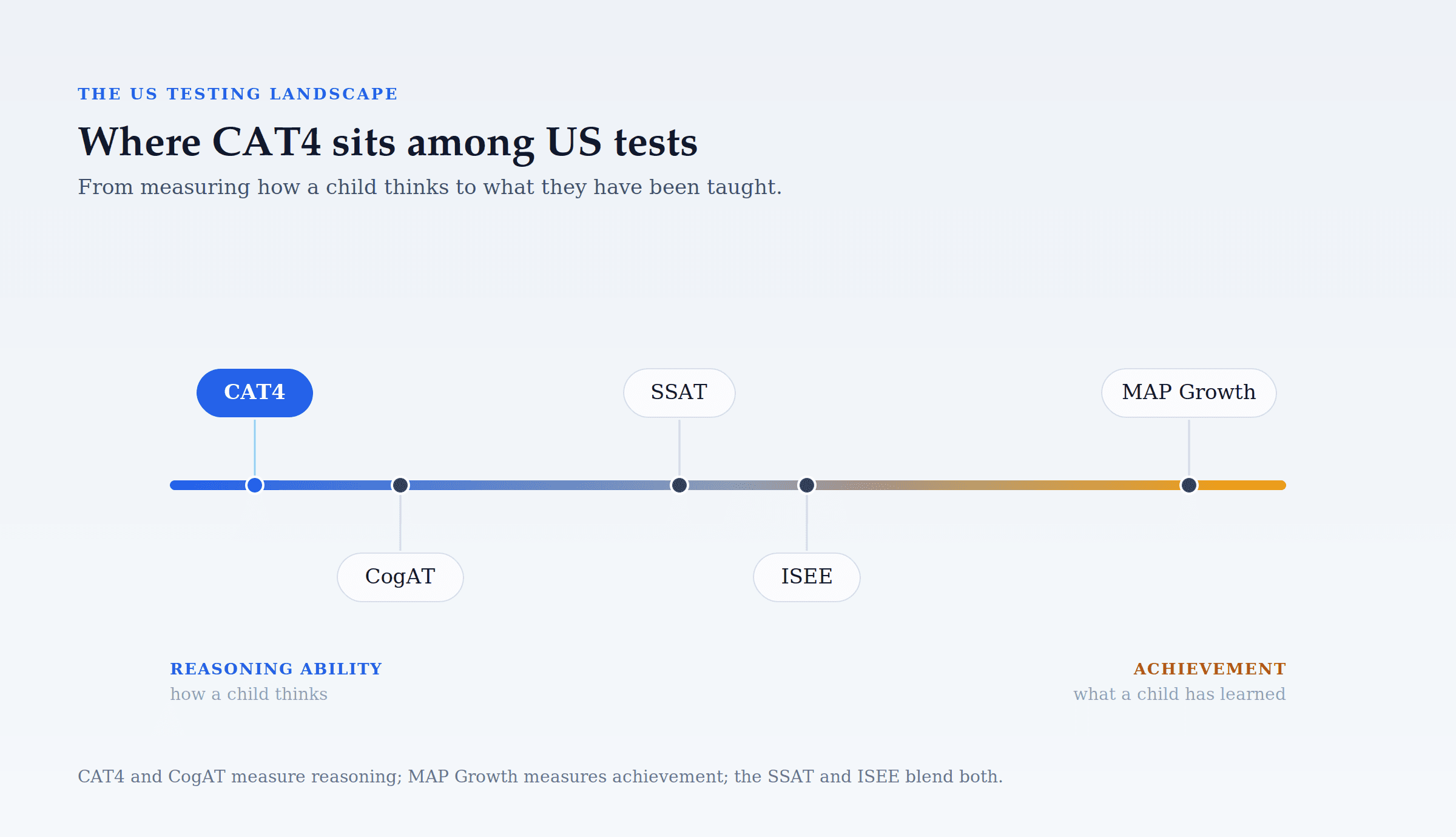
Spectrum of US school tests by what they measure — CAT4 and CogAT at the reasoning end, SSAT and ISEE in the middle, and MAP Growth at the achievement end.
CAT4 and CogAT measure how a child reasons; MAP Growth measures what they have learned; the SSAT and ISEE sit in between.

At a glance

How CAT4 compares with CogAT, MAP Growth, and the SSAT/ISEE — what each measures, its norms, format, and typical US use.
This test CAT4 GL Assessment CogAT Riverside Insights MAP Growth NWEA SSAT / ISEE EMA & ERB
TypeReasoning / abilityAchievementAdmissions (mixed)
MeasuresVerbal, Quantitative, Non-Verbal reasoningMath, reading, language, scienceReasoning, reading, vocabulary, math
Norms / originUSUSUS / Canada
Format3 batteriesComputer-adaptiveMulti-section + essay
Language loadVerbal section is EnglishHeavily English / curriculumHigh (vocabulary, reading)
Typical US usePublic gifted programs; some privateProgress monitoringPrivate / independent admissions

The big difference: CAT4 is the only one of these that is pure reasoning — no reading passages, no vocabulary, no arithmetic — and two of its four batteries use no language at all. That is why it travels across school systems and often suits children who are strong reasoners but still building their English.

CAT4 vs CogAT

This is the closest comparison. CAT4 was derived from CogAT, and David Lohman is credited as author of both tests (CogAT's lineage runs back through Irving Lorge and Robert Thorndike, with Lohman as its later senior author). The biggest difference is the fourth battery: CogAT has three — Verbal, Quantitative, and Non-Verbal — while CAT4 adds Spatial Reasoning. CogAT is normed against a US population; CAT4 is normed against a UK population, with international benchmarking data available. Both are group-administered, multiple-choice, reasoning-based assessments, and neither tests curriculum knowledge. If your child has practiced CogAT question types, the Verbal, Quantitative, and Non-Verbal sections of CAT4 will feel familiar — only the Spatial battery (Figure Analysis and Figure Recognition) will be new.

CAT4 vs MAP Growth

MAP Growth (from NWEA) is an achievement test — it measures what a child has learned in math, reading, language, and science. CAT4 measures reasoning potential regardless of what has been taught. These tests serve fundamentally different purposes and are not interchangeable, though some schools accept either. A child could score highly on CAT4 (strong reasoning) but modestly on MAP (still learning curriculum content), or the reverse.

CAT4 vs SSAT / ISEE

The SSAT and ISEE are admissions tests used by US and Canadian independent schools. Both blend reasoning questions with curriculum-based content (reading comprehension, vocabulary, math). CAT4 is purely reasoning — no reading passages, no vocabulary definitions, no arithmetic computation. For families applying to schools that accept multiple test types, CAT4 may be a better fit if the child is stronger in reasoning than in test-specific academic content, or if English is an additional language (CAT4's Non-Verbal and Spatial batteries do not rely on English at all).

When CAT4 may be the better choice

  • Your child is transferring from an international school and already has a CAT4 score
  • English is an additional language — two of CAT4's four batteries are language-free
  • The school explicitly accepts CAT4 alongside other tests
  • Your child is stronger in reasoning than in memorized content

When another test may be required

  1. The school names a specific alternative. It requires ISEE, SSAT, or CogAT and does not list CAT4 as an option.
  2. The school uses MAP for progress monitoring. CAT4 does not serve that purpose.
  3. You are applying to a US public-school gifted program. These almost always use CogAT or NNAT, not CAT4.

Moving to the USA with an existing CAT4 score

If your child has already taken CAT4 at a school overseas, that score may be directly usable in a US admissions context. Here is what to consider.

If the US school accepts CAT4

Request a copy of the CAT4 report from your child's current school — most can provide the Individual Student Report or Parent Report, showing Standard Age Scores (SAS), National Percentile Rank, and stanines for each battery. A US school familiar with CAT4 will know how to read these. See our CAT4 Results Guide for what each score means.

If the US school does not accept CAT4

You may need to sit a different test — ISEE, SSAT, or CogAT. The good news: preparation for CAT4 transfers well to CogAT in particular, since the two share a common origin. The Verbal, Quantitative, and Non-Verbal sections are structurally similar.

If the school accepts CAT4 but doesn't administer it

Ask the school to arrange a sitting through GL's network, or to accept a report from an approved test center. If you are applying from abroad, ask whether remote proctored testing is available. If no sitting can be arranged, ask which alternative they accept. Unlike the SAT or ACT, CAT4 is not a walk-in public test — it is administered through schools and approved centers, so the school usually has to initiate it.

How recent must the score be?

There is no universal rule, but most schools prefer a score from within the last 12–18 months. A score from two or three years ago may be considered outdated, particularly for younger children whose reasoning is developing quickly.

Switching year groups to grades

UK school years run about one number ahead of US grades, so a child in UK Year 7 (Level D) typically enters US Grade 6 — occasionally Grade 7, depending on birth date and the school's cut-off. The CAT4 level they already sat remains valid regardless of the grade label.

Common relocation scenarios

  • 🇬🇧 From the UK. Your child likely has a recent CAT4 score from their UK school. US international schools (like Boca Prep) accept it directly. Mainstream US private schools may prefer ISEE or SSAT, but some accept CAT4 — always ask before sitting a new test.
  • 🇊🇪 From the UAE. CAT4 is very widely used across UAE international schools. The same advice applies — check whether the target US school accepts CAT4 before preparing for a different test.
  • 🇭🇰 From Hong Kong or Singapore. CAT4 is common in British international schools in both. If your target US school is also internationally oriented, CAT4 scores are likely accepted.
  • 🇺🇞 From a US public school to a US international school. Your child may have CogAT or MAP scores but not CAT4. If the international school requires CAT4 specifically, your child will need to sit it. CogAT experience helps, but the Spatial battery will be new.

Questions to ask your school about CAT4

If a US school has mentioned CAT4, these questions will help you understand exactly what is expected.

  1. Is CAT4 required, or is it one of several accepted tests?
  2. Which CAT4 level will my child sit? If the school cannot answer, use the grade table above and suggest a level based on your child's age.
  3. Is CAT4 used for admission decisions, class placement, or both?
  4. Can we submit an existing CAT4 score from a previous school? If so, how recent does it need to be?
  5. Does the school administer CAT4 on site, or do we need to arrange testing separately?
  6. Are accommodations available for children with special educational needs or English as an additional language?
  7. What other assessments or documents are required alongside CAT4?

Real parent scenarios

Common questions we hear from US and relocating families, with short answers.

My child is in Grade 6 in Texas — which CAT4 level is likely?

At age 11–12, the most likely level is CAT4 Level D — the most common admissions-stage level internationally. (A school with a younger cohort may occasionally use Level C.) Confirm with the school which level they will administer.

We already took CAT4 abroad — can a US school use that?

Yes, if the school accepts CAT4. Request the report from your child's previous school and share it directly. If the score is more than 18 months old, the school may ask for a re-sit.

A school asked for CAT4 or SSAT — what is the difference?

CAT4 tests reasoning only — no curriculum content, no reading passages, no vocabulary. SSAT tests a blend of reasoning and learned content. If your child is stronger in logical thinking than in test-specific English vocabulary, CAT4 may be the more representative test. If your child is a strong reader with broad vocabulary, SSAT may showcase that.

My child is strong in math but weaker in English — does CAT4 help?

Potentially yes. Two of CAT4's four batteries (Non-Verbal Reasoning and Spatial Ability) are entirely language-free. The Quantitative battery uses numbers and patterns, not word problems. Only the Verbal battery requires English. A child with strong reasoning but weaker English may show a stronger overall CAT4 profile than on a language-heavy test like ISEE or SSAT.

Is it worth preparing for CAT4 if we are used to US tests?

If your child has experience with CogAT, three of the four CAT4 batteries will feel familiar. The Spatial Ability battery (Figure Analysis and Figure Recognition) is unique to CAT4 and worth practicing. If your child has only taken achievement tests (MAP, STAAR), CAT4's reasoning-based format will feel quite different — practice with sample questions is strongly recommended.

CAT4 practice for each US grade

Choose the CAT4 level that matches your child's grade. Each page has free sample questions, downloadable PDFs, and preparation tips.

Typical CAT4 level by US grade, with a link to free practice for each level.
US gradePractice page (free)
Grade 1Level X
Grade 2Level Pre-A
UK Year 3Level Y (UK only)
Grade 3Level A
Grade 4Level B
Grade 5Level C
Grade 6Level D
Grade 7Level E
Grades 8–10Level F
Grades 10–12Level G

Not sure which level? The grade table above shows the match by age, or see the full CAT4 Levels Guide.

Practice by battery

You can also prepare one reasoning area at a time. Each guide includes free sample questions and tips.

Parent-friendly glossary: US ↔ UK terms

If you are reading CAT4 materials written for a UK audience, these translations may help.

Common UK education terms with their US equivalents and meanings.
UK termUS equivalentWhat it means
Year group (e.g. Year 7)Grade (e.g. Grade 6)The school year a child is enrolled in
AdmissionsAdmissions / EnrollmentThe application and acceptance process
Setting / StreamingTracking / Ability groupingOrganizing pupils by ability within a year group
Cognitive abilityCognitive ability / ReasoningHow a child thinks and problem-solves (not what they know)
EAL (English as an Additional Language)ESL / ELLA pupil whose first language is not English
Key StageNo direct US equivalentA phase of the UK national curriculum (e.g. KS2 = Years 3–6)
GCSE / A-LevelNo direct US equivalentUK national exams taken at 16 (GCSE) and 18 (A-Level)
Grammar schoolNo direct equivalentA UK state school that selects by academic ability
Independent schoolPrivate schoolA fee-paying school not funded by government
StanineStanineA 1–9 score band — used identically in both countries

CAT4 in the USA — Frequently Asked Questions

Is CAT4 a common test in the United States?

No. CAT4 is mainly used in the UK, Ireland, and international schools worldwide. In the US it appears almost exclusively at international schools and some private schools that accept internationally mobile students. The closest US equivalent is CogAT.

Is CAT4 the same as CogAT?

No, but they are related. CAT4 was derived from CogAT, and David Lohman is credited as author of both. CAT4 has four batteries (including Spatial Reasoning); CogAT has three. CAT4 uses UK norms; CogAT uses US norms. The question formats are similar but not identical.

My school asked for "CATS testing" — is that CAT4?

Not necessarily. In Dallas and Houston, CATS usually refers to the Collaborative Academic Testing Service, which uses the WPPSI or WISC. This is different from CAT4 (GL Assessment). Confirm with the school which test they mean.

Will a CAT4 score from the UK be accepted by a US school?

If the US school uses or accepts CAT4, yes — the scoring system is the same worldwide. Request the official report from your child's previous school. If the US school does not accept CAT4, you may need to take a different test.

Does CAT4 test English ability?

Only partly. The Verbal Reasoning battery uses English. The other three batteries (Quantitative, Non-Verbal, Spatial) do not require English. This makes CAT4 more accessible than tests like ISEE or SSAT for children who speak English as an additional language.

How long is the CAT4 test?

For levels A–G (the most common levels for school-age children), the timed content takes about 72 minutes across eight subtests. Including instructions, examples, practice items and breaks, the full session is typically around two hours, often split into three parts. Younger levels (Pre-A, Y, X) are shorter.

Can my child take CAT4 at home?

CAT4 is normally administered in school under supervised conditions. Some international schools may allow remote testing for families applying from abroad, but this is the exception. Check with the specific school.

What if a US school accepts CAT4 but doesn't administer it?

Ask the school to arrange a sitting through GL's network or to accept a report from an approved test center. If you are applying from abroad, ask whether remote proctored testing is available. If no sitting can be arranged, ask which alternative they accept (CogAT, ISEE, or SSAT). Unlike the SAT or ACT, CAT4 is not a walk-in public test.

How much does CAT4 cost, and who pays?

When CAT4 is part of a school's admissions or internal assessment, the school usually administers it and absorbs the cost or folds it into an application fee, so you typically don't buy CAT4 directly. This differs from CATS in Texas, where families pay a testing fee (around $325) straight to the psychologist's office. Ask the school whether any fee applies.

Should my child prepare for CAT4?

Yes. Although CAT4 is designed to measure reasoning rather than taught knowledge, familiarity with the question format, timing, and structure makes a measurable difference to confidence and performance. Practice with level-matched sample questions is the most effective preparation.

What is a good CAT4 score for a US school?

There is no universal answer — each school sets its own expectations. CAT4 scores are centered on a Standard Age Score (SAS) of 100. A score above 115 is above average; above 130 is typically considered in the gifted range. For admissions purposes, ask the school directly what score range they consider.

Next steps

If your child has been asked to take CAT4 for a US school, here is where to start.

  1. Confirm the level. Use the grade table above, or see the CAT4 Levels Guide.
  2. Try a sample test. Download a free CAT4 practice PDF for your child's level, or take a free online practice test.
  3. Understand the scores. Read the CAT4 Results Guide so you know what to expect on report day.

Last reviewed June 2026. School details are reviewed every six months and updated periodically. If you spot an error or know of a US school that uses CAT4, email us.