CAT4 Test: What It Is, How It Works & Free Practice

The CAT4 (Cognitive Abilities Test) is a school-based reasoning assessment from GL Assessment used across UK and international schools for Years 2–12. It measures how students think — not what they have been taught — across four batteries: Verbal, Non-Verbal, Quantitative and Spatial.

  • Understand exactly what the CAT4 test measures and why schools use it
  • Find the right CAT4 level (X–G) for your child's year group
  • Decode SAS scores, percentiles and stanines in plain English
  • Free practice questions and PDF — no sign-up needed

Test at a Glance

9Levels (X–G)
4Batteries
6–17Age range
Digitalor Paper

Who Takes This Test?

United KingdomYears 2–12 · Ages 6–17
All levels
GlobalInternational schools worldwide
All levels
Independent guide · Not affiliated with GL Assessment · Based on official GL guidance · Trusted by UK & international families

What the CAT4 Test Measures: The Four Batteries

CAT4 Test Format: Parts, Subtests & Timing

Batteries Verbal Non-Verbal Quantitative Spatial

Part 1 → Part 2 → Part 3

  1. Part 120 min
  2. Part 226 min
  3. Part 326 min

Part 1

Non-Verbal battery

20 min
  • Figure Classification

    10 min · 24 questions

    10:00
  • Figure Matrices

    10 min · 24 questions

    10:00

Part 2

Verbal + Quantitative

26 min
  • Verbal Classification

    8 min · 24 questions

    8:00
  • Verbal Analogies

    8 min · 24 questions

    8:00
  • Number Analogies

    10 min · 18 questions

    10:00

Part 3

Quantitative + Spatial

26 min
  • Number Series

    8 min · 18 questions

    8:00
  • Figure Analysis

    9 min · 18 questions

    9:00
  • Figure Recognition

    9 min · 18 questions

    9:00

Levels A–G: CAT4 has 4 batteries and 8 timed subtests in total.

Total timed test time is ~72 minutes across all subtests. Timings exclude instructions, examples, practice items and breaks, and can vary slightly by level and school delivery format.

Source: GL Education Support — Pre-testing essentials

CAT4 Subtests: Timing and Question Counts

Each CAT4 battery contains two short timed subtests. Here is the full breakdown of time and question count for each subtest across all batteries.

4 batteries8 subtests~72 minutes timedvaries slightly by level
CAT4 subtests, timing and question counts — common versions (Levels A–G)
BatterySubtestTimeQuestionsAvg. per question
VerbalVerbal Classification8 min2420 sec
VerbalVerbal Analogies8 min2420 sec
Non-VerbalFigure Classification10 min2425 sec
Non-VerbalFigure Matrices10 min2425 sec
QuantitativeNumber Analogies10 min1833 sec
QuantitativeNumber Series8 min1827 sec
SpatialFigure Analysis9 min1830 sec
SpatialFigure Recognition9 min1830 sec

Find Your Child’s CAT4 Level

Choose a school system and year group to instantly find the recommended CAT4 test level.

CAT4 Level Finder

Test resultSelect a system and year/grade to see the recommended CAT4 level.
Official CAT4 level mapping (GL reference) Age norms → CAT4 level → year/grade (UK, US, IB, Aus)

Source: GL Education Support (International recommended year groups)·UK note: Level Y is paper-only (UK)

CAT4 International recommended year groups by level (GL Education Support)
Age normsCAT4 levelUK YearUS GradeIB ProgrammeAus YearTypical age
6:00–7:11X21st1st (PYP)16–7
6:06–8:11Pre-A32nd2nd (PYP)27–8
7:06–9:11A43rd3rd (PYP)38–9
8:06–10:11B54th4th (PYP)49–10
9:06–11:11C65th5th (PYP)510–11
10:06–12:11D76th6th (MYP)611–12
11:06–13:11E87th7th (MYP)712–13
12:06–15:11F98th8th (MYP)813–14
12:06–15:11F109th (Freshman)9th (MYP)914–15
14:06–17:00+G1110th (Sophomore)10th (MYP)1015–16
14:06–17:00+G1211th (Junior)11th (DP Junior)1116–17

Schools sometimes choose a higher/lower level in special cases (for example, selective cohorts or testing before a transition).

How is the CAT4 Test Administered?

CAT4 is usually taken in school under staff supervision. Most schools use the digital version (Testwise), while some still use paper booklets.

  • Where it happens

    • Run at school in a quiet room, supervised by trained staff.
    • Students work independently — staff cannot help with answers.
  • Digital vs paper

    • Digital CAT4 is taken on a computer via Testwise using an access code.
    • A paper-based version exists in some settings — less common.
  • Timing on the day

    • Each subtest is timed and starts with examples and practice items.
    • Schools may schedule short breaks between parts.
    • Total timed questions are ~72 minutes — breaks and instructions add time.
Parent tip: Ask your school whether CAT4 is digital (Testwise) and which level (X–G) your child is sitting.
Sources — official GL guidance

The points above are summarised from GL Education’s CAT4 administration guidance (digital and paper) and Testwise instructions.

Full CAT4 Practice

Get access to 1,000+ CAT4 practice questions with mock exams, expert tips, and step-by-step explanations — matched to every level from X to G.

Start full practice

CAT4 Test Results: What to Do Next

Your CAT4 report uses a few standard scores. Use this quick decoder to understand what they mean — then choose the right next step. Read the full results guide →

60-second steps

  1. Scan the four batteries — Verbal, Quantitative, Non-Verbal, Spatial — to spot strengths and gaps.
  2. Use SAS for the clearest comparison because it is age-standardised.
  3. Use NPR to understand where they sit compared with students of the same age.
  4. Use Stanines for a simple band when you want a quick 1–9 summary.
Tip CAT4 measures reasoning — not memorised curriculum content. Schools often use results alongside other evidence.
Quick note CAT4 scores are age-standardised — comparing your child to others of the same age. If your report shows a confidence band, use the range for decisions, not a single number.

Quick score decoder

SAS
Standard Age Score

An age-standardised score used for comparison — typically centred around 100.

NPR
National Percentile Rank

The percentage of same-age students who scored the same or below your child.

ST
Stanine (1–9)

A broad band summary — 1 is low, 5 is average, 9 is high.

Why this decoder is reliable

These score definitions are based on official GL Education guidance. View GL source →

Using CAT4 Results: What They Can Predict and How Schools Use Them

A quick, parent-friendly guide to what the scores are good for — and how schools should use them responsibly.

What CAT4 Can Predict (and What It Can’t)

Academic potential Not a guarantee
  • Helps estimate likely learning trajectory when combined with attainment data — such as internal grades and teacher assessment.
  • Often used to flag underachievement — strong reasoning with lower classroom performance — and target support.
  • Can inform targets and pathways in some schools, including GCSE, A-level, and IB planning — but it is indicative only.
  • Best read as strengths across the four batteries — not as a single overall intelligence number.

How Schools Should Use Results Responsibly

Teacher report Fair use
  • Use CAT4 alongside other evidence — classwork, curriculum tests, observations — never as the only decision.
  • Prefer banded or range interpretation when available — use the confidence band, not a single number.
  • Consider context: language background (EAL), SEND, test conditions, and recent disruption.
  • Use the Individual Report for Teachers to identify barriers, plan support, and track progress over time.

Want a clear decoder for SAS, NPR and stanines with examples? See the full CAT4 results guide →

Preparing for the CAT4 Test: Sample Questions & Explanations

Free CAT4 sample questions from all four batteries — Verbal, Quantitative, Non-Verbal, and Spatial. Choose your answer, then reveal the full step-by-step explanation.

Verbal Reasoning Sample Questions

Verbal Reasoning · Verbal Analogies

bright – dark : noisy – ?

Verbal Analogies · Question

The quickest way to solve this one is to find the relationship in the first pair, then apply exactly the same relationship to the second pair.

Fast rule-check method for similar questions

Question type

Verbal Analogies

Skill tested

Identifying opposites

Difficulty

Medium

What to notice first

Start with the first pair, not the answer choices. Bright and dark are opposites. That tells you the rule. Now apply the same rule to noisy. You need the word that means the opposite of noisy, and that word is quiet.

Check 1

Read the first pair

Bright and dark sit at opposite ends of the same idea.

Check 2

Keep the same relationship

The second pair must also use opposites, not just words linked to sound.

Check 3

Apply it to noisy

The opposite of noisy is quiet, so that must be the missing word.

Core rule

When the first pair shows opposites, the missing word must be the opposite of the second given word.

Model the pattern

1

Step 1

Look at bright and dark first. They are opposites, so that is the relationship you must copy.

2

Step 2

Move to noisy. Since the rule is opposites, you now need the opposite of noisy, not just another sound-related word.

3

Step 3

Test the options. Quiet is the only word that directly opposes noisy in the same way that dark opposes bright.

Option check

A

Eliminate

Loud is similar to noisy, not the opposite, so it breaks the analogy rule.

B

Correct

Quiet is correct because it is the opposite of noisy, just as dark is the opposite of bright.

C

Eliminate

Music is related to sound, but it is not the opposite of noisy.

D

Eliminate

Shout is something noisy, so it points in the wrong direction instead of giving an opposite.

E

Eliminate

Busy is a different idea altogether. It does not form an opposite pair with noisy.

Use this quick checklist next time

  • Read the first pair carefully and name the relationship.
  • Apply exactly the same relationship to the second pair.
  • Reject words that are only related in topic but not in relationship.

Reflection

This question is about discipline. Once you see that bright and dark are opposites, the second half becomes direct.

Bridge forward

In other analogies, always build from the first pair first. That stops you from choosing a word that feels related but does not match the real rule.

Conclusion

Option B, quiet, is correct because bright and dark are opposites, and noisy and quiet are opposites too.

Verbal Reasoning · Verbal Classification

hammer, saw, spanner

Verbal Classification · Question

The best way to solve this one is to find the shared group exactly, not just choose a word that is connected to DIY or building in a general way.

Fast rule-check method for similar questions

Question type

Verbal Classification

Skill tested

Grouping words by shared category

Difficulty

Medium

What to notice first

Hammer, saw, and spanner all belong to the same broad group: hand tools. They are objects you use for practical work such as building, cutting, fixing, or tightening. So the correct answer must be another hand tool. It is not enough for an option to be related to work or repair. It must itself be a tool.

Check 1

Name the shared category

All three stem words are tools that can be held and used by hand.

Check 2

Be strict about the category

Do not choose something used with tools or made by tools. Choose something that is itself a hand tool.

Check 3

Test each option directly

Ask: is this actually a tool, or is it an object, place, or material connected to working?

Core rule

Choose the word that belongs to the same group as hammer, saw, and spanner: hand tools.

Model the pattern

1

Step 1

Read the three stem words together and ask what kind of things they are. Hammer, saw, and spanner are all tools used for practical work.

2

Step 2

Turn that into a short label you can use. A good label here is hand tools.

3

Step 3

Now check the options one by one. The right answer must fit inside the same category exactly, not just be related to building or repair.

Option check

A

Eliminate

A screw is something a tool is used on. It is not a hand tool itself.

B

Correct

A screwdriver is a hand tool, just like a hammer, saw, and spanner. It fits the same group exactly.

C

Eliminate

A shelf is an object you might build, fix, or install, but it is not a tool.

D

Eliminate

A garage is a place, not a hand tool.

E

Eliminate

Paint is a material or substance, not a tool.

Use this quick checklist next time

  • Name the shared category of the stem words in one short phrase.
  • Choose an option that belongs inside that category, not one that is merely related.
  • Reject places, materials, and objects that tools are used on.

Reflection

This question tests category control. Several options are connected to working, but only one is actually another hand tool.

Bridge forward

In other verbal-classification questions, first ask what kind of thing each stem word is. That usually makes the correct answer much clearer.

Conclusion

Option B, screwdriver, is correct because it belongs to the same broad category as hammer, saw, and spanner: hand tools used for working.

Full CAT4 Practice

Get access to 1,000+ CAT4 practice questions with mock exams, expert tips, and step-by-step explanations — matched to every level from X to G.

Start full practice

Quantitative Reasoning Sample Questions

Number Analogies

[3 → 12] : [5 → ?]

Number Analogies · Question

If you jump straight to subtraction, you'll lock in the wrong rule. This question tests whether you can identify a multiplication relationship — not just spot a numerical difference.

Core pattern: first number × 4 = second number

Question type

Number Analogies

Skill tested

Identifying a multiplication rule

Difficulty

Easy–Medium

What to notice first

Look at the first pair: 3 → 12. Ask what single operation takes 3 to 12. Multiplying by 4 works: 3 × 4 = 12. Now apply that same rule to 5. The answer must follow the exact same operation.

Check 1

Find the operation

3 → 12: try ×4. It works. Do not stop at subtraction.

Check 2

Verify, do not assume

×4 gives an exact result. Simpler and cleaner than addition.

Check 3

Apply to the second pair

5 × 4 = 20. Now match it to the options.

Core rule

Always test your rule on the first pair before applying it to the second.

Step-by-step solution

1

Analyse the first pair

3 × 4 = 12. Only ×4 fits exactly.

2

Reject the addition trap

Adding 9 also works for the first pair, but it is a weaker, less transferable rule.

3

Apply and confirm

5 × 4 = 20. It appears in the options — confirmed.

Option check

A

Eliminate

Addition trap (+9). Not the clean rule.

B

Eliminate

×2 fails on the first pair.

C

Correct

20 follows ×4 exactly.

D

Eliminate

Squaring fails on the first pair.

E

Eliminate

×3 fails on the first pair.

Use this checklist next time

  • Test your rule on the first pair.
  • Prioritise multiplication over addition.
  • Eliminate any rule that fails immediately.

Conclusion

Option C is correct. The rule is ×4.

Number Series

50, 46, 42, ?, 34, 30

Number Series · Question

If you only check one gap between numbers, you risk locking in the wrong step size. This question rewards checking the rule across all visible gaps before committing to an answer.

Core pattern: subtract 4 at every step

Question type

Number Series

Skill tested

Identifying a consistent subtraction rule

Difficulty

Easy–Medium

What to notice first

The sequence is decreasing. Check gaps: 50 − 46 = 4 and 46 − 42 = 4. The rule is consistent: subtract 4 each time. Apply it to find the missing term.

Check 1

Find the first gap

50 − 46 = 4.

Check 2

Confirm consistency

46 − 42 = 4 and 34 − 30 = 4. Rule holds.

Check 3

Apply rule

42 − 4 = 38. Verify with next term.

Core rule

Always verify your answer on both sides of the gap.

Step-by-step solution

1

Calculate gaps

All visible gaps are 4. The sequence decreases steadily.

2

Apply the rule

42 − 4 = 38.

3

Verify

42 − 38 = 4 and 38 − 34 = 4. Confirmed.

Option check

A

Eliminate

Wrong step size (−6).

B

Correct

38 follows −4 exactly.

C

Eliminate

Wrong step size (−2).

D

Eliminate

Wrong direction (increasing).

E

Eliminate

Wrong direction and step size.

Use this checklist next time

  • Check at least two gaps before deciding.
  • Confirm direction first (up or down).
  • Verify your answer on both sides.

Conclusion

Option B is correct. The sequence decreases by 4 each step.

Non-verbal Reasoning Sample Questions

Figure Classification
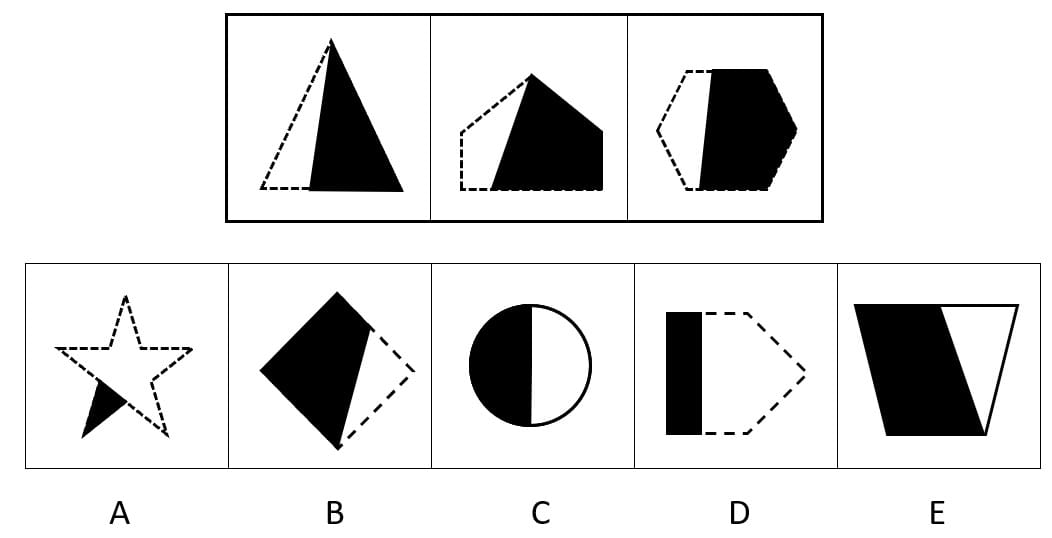
CAT4 Level F figure classification question showing shapes with a small dashed top joined to a larger striped lower shape

Figure Classification · Question

The quickest way to solve this one is to focus on two features together: a dashed outer outline and a shape that is mostly filled in black.

Fast rule-check method for similar questions

Question type

Figure Classification

Skill tested

Matching a shared visual rule

Difficulty

Medium

What to notice first

All three stem figures share two features: a dashed outer outline and a shape that is mostly filled in black. The correct answer must preserve both.

Check 1

Outer outline

Each figure keeps a visible dashed boundary.

Check 2

Shading proportion

Most of the shape is black, not a small section.

Check 3

Combine both

Correct option must match both features together.

Core rule

Dashed outer outline + mostly black interior.

Model the pattern

1

Step 1

Ignore exact shapes. Focus on shared visual rule.

2

Step 2

Notice dashed outline + mostly black fill.

3

Step 3

Only one option preserves both features: B.

Option check

A

Eliminate

Too little black area.

B

Correct

Matches dashed outline and mostly black fill.

C

Eliminate

No dashed outline.

D

Eliminate

Black area too small.

E

Eliminate

No dashed outline.

Use this checklist next time

  • Identify repeating visual features.
  • Check both outline and shading.
  • Reject partial matches.

Reflection

Success comes from isolating exact visual rules.

Bridge forward

Describe the rule before checking options.

Conclusion

Option B is correct because it preserves both key features.

Figure Matrices
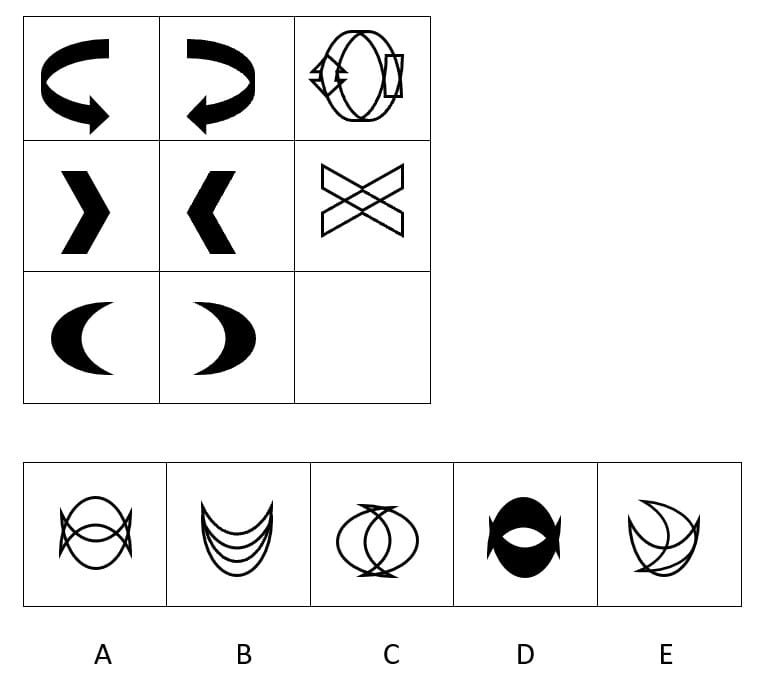
CAT4 figure matrices sample question showing a 3x3 grid of mirrored arrows, chevrons and crescents with five answer options A to E

Figure Matrices · Question

The rule moves across each row: the first and second shapes are rotated 90 degrees and then placed on top of each other, and the final combined shape is shown in white outline.

Fast rule-check method for similar questions

Question type

Figure Matrices

Skill tested

Row pattern, rotation, and overlay

Difficulty

Medium

What to notice first

Work across the row. Each row combines the first two shapes by rotating them 90 degrees, overlaying them, and converting the result to a white outline.

Check 1

Row consistency

Rows 1 and 2 follow the same rule, so Row 3 must match.

Check 2

Rotation

Both source shapes rotate 90 degrees.

Check 3

Overlay + style change

Shapes combine and switch to white outline.

Core rule

Rotate + overlay + convert to outline.

Model the pattern

1

Step 1

Row 1 shows rotated shapes overlaid into an outline result.

2

Step 2

Row 2 confirms the same transformation.

3

Step 3

Apply to Row 3 → only Option A fits.

Option check

A

Correct

Matches full transformation.

B

Eliminate

Wrong overlay result.

C

Eliminate

Incorrect structure.

D

Eliminate

Wrong fill style.

E

Eliminate

Incorrect overlay logic.

Use this quick checklist next time

  • Check direction (row vs column).
  • Look for transformations (rotate, reflect, overlay).
  • Check final styling (fill vs outline).

Reflection

Rebuilding the rule beats visual guessing.

Bridge forward

Always reconstruct the missing cell step-by-step.

Conclusion

Option A is correct because it follows the full row transformation rule.

Full CAT4 Practice

Get access to 1,000+ CAT4 practice questions with mock exams, expert tips, and step-by-step explanations — matched to every level from X to G.

Start full practice

Spatial Ability Sample Questions

Figure Analysis

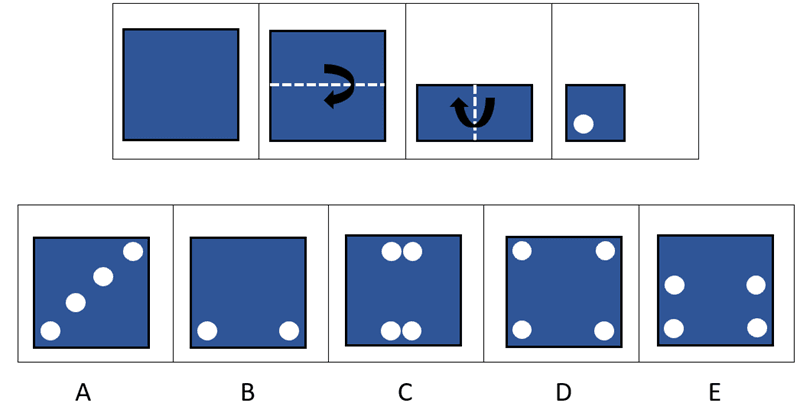
CAT4 Level B free figure analysis sample question presenting a 2x folded paper with 1 punched hole in it and 5 options

Figure Analysis · Question

If you only count the holes and ignore their positions, you will choose C or E instead of D. The number of holes is only half the answer — where they land when unfolded is what separates the correct option from the traps.

Core rule: two folds = four layers = four holes, placed symmetrically across both fold lines

Question type

Figure Analysis

Skill tested

Fold tracking and spatial symmetry

Difficulty

Medium

What to notice first

Read the folds from left to right. Two folds create four layers, so one punch produces four holes. You must then track where each hole appears by reversing each fold step-by-step.

Step 1

Count folds

Two folds → four layers.

Step 2

Locate punch

Hole is in the corner of the folded shape.

Step 3

Unfold with mirrors

Each fold creates a mirrored copy.

Key insight

Each fold line acts as a mirror. Unfold in reverse order.

Step-by-step solution

1

Layer count

Two folds = four layers → eliminate options with fewer holes.

2

First unfold

Mirror across vertical fold → two holes in bottom half.

3

Second unfold

Mirror across horizontal fold → four holes, one per quadrant.

Option check

A

Eliminate

Only three holes.

B

Eliminate

Only two holes.

C

Eliminate

Wrong positions.

D

Correct

Four holes, correctly mirrored in all quadrants.

E

Eliminate

Incorrect symmetry.

Use this checklist next time

  • Count folds → get hole count fast.
  • Unfold in reverse order.
  • Track symmetry across each fold line.

Conclusion

Option D is correct. Two folds create four layers, producing four symmetrically placed holes.

Figure Recognition
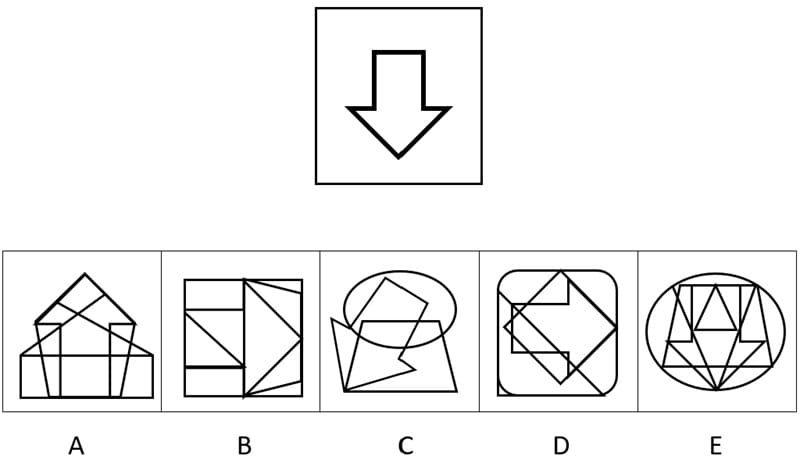
CAT4 Level A Figure Recognition Sample question presenting an arrow facing down and 5 possible options

Figure Recognition · Question

The best way to solve this one is to memorise the exact outline of the test shape, then look for that same outline hidden inside a larger figure.

Fast rule-check method for similar questions

Question type

Figure Recognition

Skill tested

Finding an identical hidden shape

Difficulty

Medium

What to notice first

The test shape is a downward-pointing arrow. The correct answer must contain this exact outline in the same orientation — not rotated or flipped.

Check 1

Fix the outline

Memorise the arrow’s structure.

Check 2

Match direction

Arrow must still point down.

Check 3

Search inside shapes

Ignore extra lines — trace the exact outline.

Core rule

Same shape, same direction, same structure.

Model the pattern

1

Step 1

Study the exact arrow shape.

2

Step 2

Scan options for identical structure.

3

Step 3

Only Option E contains the correct hidden shape.

Option check

A

Eliminate

Shape does not match.

B

Eliminate

Incorrect structure.

C

Eliminate

Missing key features.

D

Eliminate

Wrong orientation.

E

Correct

Exact match in structure and direction.

Use this quick checklist next time

  • Memorise the exact outline first.
  • Check orientation carefully.
  • Ignore extra lines and trace the shape.

Reflection

Precision beats visual similarity.

Bridge forward

Look for exact matches, not close ones.

Conclusion

Option E is correct because it contains the exact same arrow.

Figure recognition solution presented for sample question

Support

Spotted something that needs fixing?

If you notice an error, broken link, or unclear explanation, email us and we’ll review it.

CAT4 Practice Test Video Walkthrough

Step-by-step answers to real CAT4 exam-style questions across all four batteries — Figure Matrices, Verbal Reasoning, Number Series, and more.

CAT4 Practice Test Walkthrough — step-by-step answers to real CAT4 exam-style questions

CAT4 Practice Test Walkthrough · Step-by-Step Answers · Watch on YouTube →

Strategies & Tips for Taking the CAT4 Test

A short, CAT4-specific route that helps parents pick the right level of support — without generic advice.

Levels X–G Eight short subtests, strictly timed
Digital timer Counts down and cannot be overridden — when time ends, the test moves on
Session length Can vary slightly by level and how a school schedules parts and breaks
Before 10–15 minutes

Calm + familiarity (not revision)

  • Confirm the CAT4 level (X–G) so practice matches the right format.
  • Explain “strictly timed” in one sentence: pace matters more than perfection.
  • Do one short example per battery so the first real item is not a surprise.
During In the room

Three rules that protect time

Timing

Steady pace. If stuck, pick the best option and move on — do not freeze on one question.

Guessing strategy

Make your best choice quickly, then continue. Treat it as a timed skills check.

Eliminate first

Cross out wrong answers first. It improves accuracy without slowing you down.

Tip For Number Analogies and Number Series, use quick rough working — not long calculations.
After Next step

Turn results into a simple plan

  • Use the 60-second decoder to read SAS, NPR and Stanines correctly.
  • Pick one battery to improve first — usually the lowest, or the one the school cares about most.
  • Practise in short, timed bursts so timing becomes familiar.
Jump to practice questions

Is the CAT4 Test Hard?

For most children, CAT4 feels “hard” mainly because it’s unfamiliar and timed, not because it tests school content. Use the quick decisions below to choose the right level of support.

CAT4 isn’t a curriculum test – it profiles reasoning, so you can’t “revise topics” the usual way.

Levels A–G include 8 strictly timed subtests, usually delivered in 3 parts when time ends, the test moves on.

The goal is familiarity and confidence – short practice builds comfort with the format and time pressure.

No prep vs light prep vs targeted prep

Pick the minimum that matches your child — don’t overdo it.

No prep Light prep Targeted prep
  • No prep: sleep, breakfast, and a calm explanation of what “timed sections” means.
  • Light prep: 10–15 minutes of format familiarisation (one example per battery).
  • Targeted prep: practise the hardest battery with short, timed bursts.

If your child struggles with timing

Timing is often the real challenge — treat it as a skill you can train.

  • Practise with a timer and aim for “steady pace”, not perfection.
  • If stuck, choose the best option and move on (don’t freeze on one item).
  • Use a simple rule: “Two tries, then next” to protect time across the section.

If your child struggles with non-verbal patterns

Non-verbal questions are wordless — they test spotting relationships in shapes.

  • Focus on “what changes vs what stays the same” (shape, count, rotation, position).
  • Use a consistent checklist: count → compare → eliminate.
  • Start with easier examples to build the habit of spotting relationships quickly.
Ready for full CAT4 practice and mock tests?
Get Full CAT4 Practice

Final Thoughts: Helping Your Child Succeed on the CAT4

Preparing for the CAT4 is not about cramming — it is about familiarity, confidence, and calm. The test measures how your child thinks, not what they have memorised. That means the most useful preparation is short, regular exposure to the question formats so that nothing feels unfamiliar on test day.

Encourage open communication before and after practice. Watch for signs of frustration or anxiety — these are signals to slow down, not push harder. Celebrate progress across all four batteries, not just the areas where your child already feels strong.

If results come back and something looks unexpected, use the score decoder above to read them carefully before drawing conclusions. CAT4 is one data point — schools use it alongside many others.

CAT4 measures reasoning ability — not memorised content. Every child approaches it from the same starting point: how they think, not what they have been taught.

CAT4 Test – Frequently Asked Questions

What is the CAT4 test?

The CAT4 test (Cognitive Abilities Test) is a standardised assessment created by GL Assessment to measure how students think, rather than what they have been taught. It focuses on reasoning skills across four areas – verbal, quantitative, non-verbal, and spatial – to give schools a clearer picture of a student’s learning profile and future academic potential.

What skills does the CAT4 test measure?

CAT4 measures four main types of reasoning:

  • Verbal reasoning – thinking with words and language.
  • Quantitative reasoning – working with numbers and numerical patterns.
  • Non-verbal reasoning – solving problems using shapes, patterns, and abstract visual information.
  • Spatial reasoning – imagining and manipulating shapes in space, important for many STEM subjects.

Together, these areas help schools understand how a student processes information and where they may need support or extra challenge.

Who takes the CAT4 test and at what ages?

CAT4 is typically used with students aged around 6 to 17+. Schools usually administer it from the early primary years up to secondary school. The test is divided into levels (X, Y, A–G), and each level is matched to a specific year group and age range so that scores can be fairly compared with national norms for that age.

How is the CAT4 test structured and how long does it take?

CAT4 is a multiple-choice test delivered either online or on paper. For most levels (A–G), it is organised into three main parts, each made up of short, timed subtests that cover the four reasoning batteries. In total, the assessment usually takes around two to a little over two hours, including instructions and short breaks, although the exact timing can vary slightly by level.

How is the CAT4 test scored?

CAT4 results are reported using several standardised scores:

  • Standard Age Scores (SAS) – compare a student’s performance to others of the same age, with an average score of 100.
  • National Percentile Rank (NPR) – shows the percentage of students in the same age group who scored below that student.
  • Stanines (ST) – group scores into nine broad bands from 1 (very low) to 9 (very high).

Scores are usually given for each battery as well as an overall profile, helping teachers see both strengths and areas that may need support.

What is considered a good CAT4 score?

In CAT4, a Standard Age Score of around 100 is considered average for a student’s age. Scores in the 89–111 range are broadly average, 112–126 are above average, and scores 127 and above indicate a very high level of reasoning for that age. On the stanine scale, stanines 4–6 are average, while 7–9 are above average. However, “good” always depends on context, the school, and the individual student’s learning history.

Is the CAT4 test an IQ test?

CAT4 is not marketed as a traditional IQ test. It does measure underlying reasoning abilities that are related to intelligence, but its main purpose is educational: to help schools understand how a student learns best and where they may need support or extension. CAT4 results should always be interpreted alongside classroom performance, teacher observations, and other assessments, rather than used as a single label for a child’s ability.

Can students prepare for the CAT4 test?

GL Assessment emphasises that CAT4 is designed to measure underlying reasoning rather than taught curriculum knowledge, and they do not formally endorse practice materials. At the same time, many parents and schools find that gentle preparation – becoming familiar with question styles, practising similar puzzles, and working on timing – can reduce anxiety and help students show their true ability under timed conditions.

The most helpful preparation focuses on understanding question types and building confidence, not on memorising specific questions.

How do schools use CAT4 test results?

Schools use CAT4 profiles to inform a wide range of decisions. Results can support setting and streaming, help identify students who may benefit from extra support or enrichment, and guide curriculum planning in subjects like maths, science, and languages.

In some schools, CAT4 also feeds into decisions about admissions, scholarships, or selection for gifted and talented programmes, but it should always be considered alongside other evidence.