
CAT4 Admissions Test: How Schools Use It, What Scores Matter, and How to Prepare
CAT4 is one of the most widely used admissions tests in UK independent schools, grammar schools, and British-curriculum international schools around the world. If your child's target school has named CAT4 as part of the entry process, this guide explains how it works: what schools look for, how CAT4 differs from other entrance tests, what scores are usually competitive, and how to help your child prepare.
- Understand how schools use the CAT4 admissions test and what your child's scores tell them
- See how CAT4 compares to the 11+, ISEB Pre-Test, and UKiset
- Learn which SAS scores are competitive at different types of school
- Get clear advice on when and how to prepare — no sign-up needed
What is CAT4, and why do schools use it for admissions?
The CAT4 admissions test is the Cognitive Abilities Test, Fourth Edition — a reasoning assessment made by GL Assessment and used by independent, international, and grammar schools to assess applicants. The test measures how a child reasons with words, numbers, shapes, and space. Most school exams test what a child has learned in English and Maths. CAT4 is different. It looks at how a child thinks, not what they have been taught.
Schools use CAT4 for admissions because it gives them something a normal subject exam cannot: a measure of reasoning that does not depend on the curriculum a child has studied. This is useful in three main situations.
- Fair comparison across different backgrounds. A child from a small village primary school and a child from a large prep school with private tutoring may have very different levels of subject knowledge. CAT4 can show whether both have the reasoning ability to do well in a demanding academic school. This is one reason some schools have moved towards reasoning tests — they reduce the head start that heavy tutoring gives to wealthier families. In practice, knowing the question formats — especially the less common spatial ones — still gives a child a real advantage. That is why some preparation is still worthwhile, even though CAT4 is designed to limit the effect of coaching.
- International admissions. A child moving from a school in the UAE, Hong Kong, or Singapore may have studied a completely different curriculum. CAT4 gives schools a single, shared benchmark that works no matter which national system the child came from. Three of its four batteries contain no language at all, so they work across borders. (The verbal battery is the exception, which matters for families who speak English as a second language — more on that below.)
- Finding hidden potential. CAT4 can reveal strong reasoning in children who do not shine on traditional exams. This includes children who speak English as an additional language (EAL), because the non-verbal and spatial parts need no English at all. It also includes children whose previous school never stretched them.
Where in the world is CAT4 used?
CAT4 is used in over 100 countries. It began in the UK, but it has become the standard admissions test across British-curriculum schools worldwide.
Middle East
- UAE
- Saudi Arabia
- Qatar
- Kuwait
- Egypt
CAT4 is the standard admissions test across the region — see the dedicated guide to CAT4 in the UAE (Dubai, Abu Dhabi & Sharjah): verified schools, competitive scores, and Year 7 timelines.
Asia-Pacific
- Hong Kong
- Singapore
- Malaysia
- Thailand
- Vietnam
- South Korea
- India
- China
- Australia
Europe & Africa
International schools across both regions
The Americas
International schools in parts of the region — including schools across the US. CAT4 is used for admissions at international and British-curriculum schools in Texas, Florida, New York and beyond.
Which schools use CAT4 for admissions?
CAT4 is used as an admissions tool by three main types of school.
International schools worldwide
CAT4 is the standard admissions test across most British-curriculum international schools. It is deeply built into school admissions in the UAE, where it is often called the "gold standard." It is also widely used in Hong Kong, Singapore, and across international schools in Europe, Asia, Africa, and the Americas. These schools value CAT4 because it gives a fair, shared benchmark for students arriving from many different systems.
UK independent (private) schools
Many leading UK independent schools use CAT4 as their entrance test, either instead of or alongside the traditional 11+ exam. Some prefer it because the 11+ tests retained knowledge, while CAT4 measures potential in a different way. CAT4 is usually taken in the autumn or winter term of Year 6 for Year 7 entry, often with a face-to-face interview.
UK prep schools also use CAT4 results to guide conversations about senior schools. Because CAT4 is similar in style to the ISEB Pre-Test, prep schools use the results to help predict which senior schools a child is likely to be competitive for.
The most selective UK independent schools usually look for a Standard Age Score of 115 or higher. The most over-subscribed schools may expect 125 or more.
UK grammar schools
Grammar schools use CAT4 in two main ways. Most use it inside the school after admission, for setting, streaming, and tracking progress — not to select students. A smaller number use it for late-transfer entry at Year 8 or Year 9, where no standard 11+ exam exists. For late transfer, the CAT4 result is usually combined with an interview and a school report.
A note for EAL families: understanding the verbal score
This section matters most for families who speak English as a second language. The verbal battery — Verbal Classification and Verbal Analogies — needs English vocabulary and language skill. If your child learned to read and write mainly in Arabic, French, Mandarin, or another language, a lower verbal score is expected and normal. It does not mean weak reasoning. It means less exposure to English, which is a different thing.
GL Assessment's own international data confirms this pattern. International school groups usually score higher than UK averages on the non-verbal, quantitative, and spatial batteries, and lower on verbal. This is a direct result of how many international school students speak English as an additional language.
Schools that are experienced with international admissions — in the UAE, Singapore, and Hong Kong especially — read CAT4 profiles with this in mind. A student with a verbal SAS of 95 but scores of 118, 122, and 116 on the other three batteries is not a borderline candidate. They are a strong candidate whose English is still growing. If you are applying from an EAL background, ask the admissions team directly how they weigh the four batteries. Most experienced offices will tell you.
The profile described above
How CAT4 compares to other admissions tests
Parents often meet CAT4 alongside other test names — the 11+, the ISEB Pre-Test, UKiset, or CEM tests. Knowing how they differ helps you prepare the right way.
CAT4 vs the 11+
The 11+ is the traditional entrance exam for grammar schools and some independent schools. It used to come in two versions — GL Assessment and CEM — but since 2023 GL Assessment has become the main provider: CEM withdrew from the standard paper 11+, and most grammar schools moved to GL. (CEM's current computer-based test, Cambridge Select Insight, is covered further down.)
| This test CAT4 Reasoning only | 11+ (GL) GL Assessment | |
|---|---|---|
| What it tests | Reasoning only (4 batteries) | English, Maths, Verbal, Non-Verbal |
| Tests curriculum content? | No (verbal needs English vocabulary) | Yes (English and Maths) |
| Adaptive? | No (fixed questions) | No |
| Format | Multiple choice, 5 options | Multiple choice |
| Duration | ~72 minutes timed (Levels A–G) | 1–2 hours, varies by region |
| Used by | Independent, international, grammar (late entry) | Grammar (main Year 7 intake), some independent |
The big difference: CAT4 does not test English or Maths content. A child who reads well but finds shapes hard may score very differently on CAT4 than on a GL 11+ paper. If a school uses CAT4, practising a normal 11+ English or Maths paper will not help much — the question types are not the same.
CAT4 vs the ISEB Common Pre-Test
The ISEB Common Pre-Test is an adaptive, computer-based test used by many leading UK independent schools. It screens candidates in Year 6 or 7, before Common Entrance at 13+. It tests English, Maths, Verbal Reasoning, and Non-Verbal Reasoning.
The ISEB Pre-Test is developed and run by GL Assessment on behalf of ISEB (the Independent Schools Examinations Board). This is why its reasoning sections look so similar to CAT4 in style. The main difference is that the ISEB Pre-Test also has English and Maths sections that test curriculum knowledge, which CAT4 does not.
If your child is sitting both the ISEB Pre-Test and CAT4 for different schools, the reasoning practice carries straight over. The extra work needed for ISEB is the English comprehension and the Maths content.
CAT4 vs UKiset
UKiset is an online test used by many UK independent schools to assess international students applying from overseas. It tests Vocabulary, Non-Verbal Reasoning, and Mathematical Reasoning, plus an English essay.
CAT4 and UKiset overlap a lot in non-verbal and mathematical reasoning. The main differences: UKiset has a vocabulary section and an essay, while CAT4 has a spatial battery (Figure Analysis and Figure Recognition) that UKiset does not. UKiset can be taken at approved test centres worldwide, while CAT4 is normally taken in school. A child applying to UK boarding schools from overseas may sit UKiset as a first filter, then CAT4 as part of the school's own assessment once shortlisted.
CAT4 vs CEM Select and the Harrow Test
Two names parents often ask about belong here. CEM (the Centre for Evaluation and Monitoring, now part of Cambridge) left the standard paper 11+ in 2023. Its current test is Cambridge Select Insight — a computer-based assessment of verbal, numerical, and non-verbal reasoning used by a smaller number of selective schools. CAT4's reasoning practice prepares a child well for its reasoning sections.
The Harrow Test is different again. Harrow School uses the ISEB Common Pre-Test as a first-stage filter, then invites shortlisted boys to sit its own bespoke assessment — a short interview, a computerised English and Maths test, and a group activity. It is not a CEM test. CAT4's reasoning practice helps with the reasoning demands of these school tests, but any English and Maths parts need separate preparation.
Summary: which schools use which test?
| Test | Typical school type | What it tests | Curriculum content? |
|---|---|---|---|
| CAT4 | Independent, international, grammar (late entry) | Reasoning only (Verbal, Non-Verbal, Quantitative, Spatial) | No |
| 11+ (GL Assessment) | Grammar (main Year 7 intake) | English, Maths, VR, NVR | Yes |
| ISEB Common Pre-Test | Leading UK independent (Year 6–7 screening) | English, Maths, VR, NVR | Yes (English, Maths) |
| UKiset | UK independent (international applicants) | Vocabulary, NVR, Maths, Essay | Partly |
| Cambridge Select Insight (CEM) | Some selective schools | Verbal, numerical, non-verbal reasoning | Mostly reasoning |
What CAT4 score do schools look for?
There is no single "pass mark" for CAT4 in admissions. Each school sets its own expectations, and most do not publish a cut-off score. Still, the ranges below are widely used. The Standard Age Score (SAS) has an average of 100, so the percentile column shows roughly how a score compares to other children of the same age.
| School type | Typical competitive SAS | Approx. percentile | Context |
|---|---|---|---|
| Highly selective UK independent | 125+ | Top ~5% | Year 6 sitting; most over-subscribed schools |
| Most UK independent using CAT4 | 115+ | Top ~16% | Competitive, but not the very top tier |
| UK grammar (late transfer) | 110–120+ | Top ~10–25% | Varies by school and region |
| UAE premium international | 115+ | Top ~16% | e.g. JESS, Dubai College, Kings', Repton |
| UAE mid-tier British schools | 105–115 | Top ~16–37% | Competitive but more accessible |
| International schools (general) | 100–110+ | Around average and up | Varies widely by school and country |
| Academic scholarships | 130+ | Top ~2% | Extra criteria usually apply |
What about the confidence band?
Every CAT4 report shows a confidence band around each SAS score. This is a small range that shows where the child's "true score" is likely to sit. Schools that understand CAT4 well read the band, not just the single number. A score of SAS 112 with a band of 107–117 tells the school the child's ability sits somewhere in that range, not exactly at 112.
Understanding the CAT4 report
After the test, the school receives a report showing the SAS, the National Percentile Rank (NPR), and a Stanine score for each of the four batteries, plus an overall mean and a cognitive profile.
A Stanine (short for "standard nine") is a simple 1–9 scale. Stanine 5 is average, 7–9 is above average, and 1–3 is below average. Because each band covers a range of scores, it is good for a quick comparison but less exact than the SAS itself.
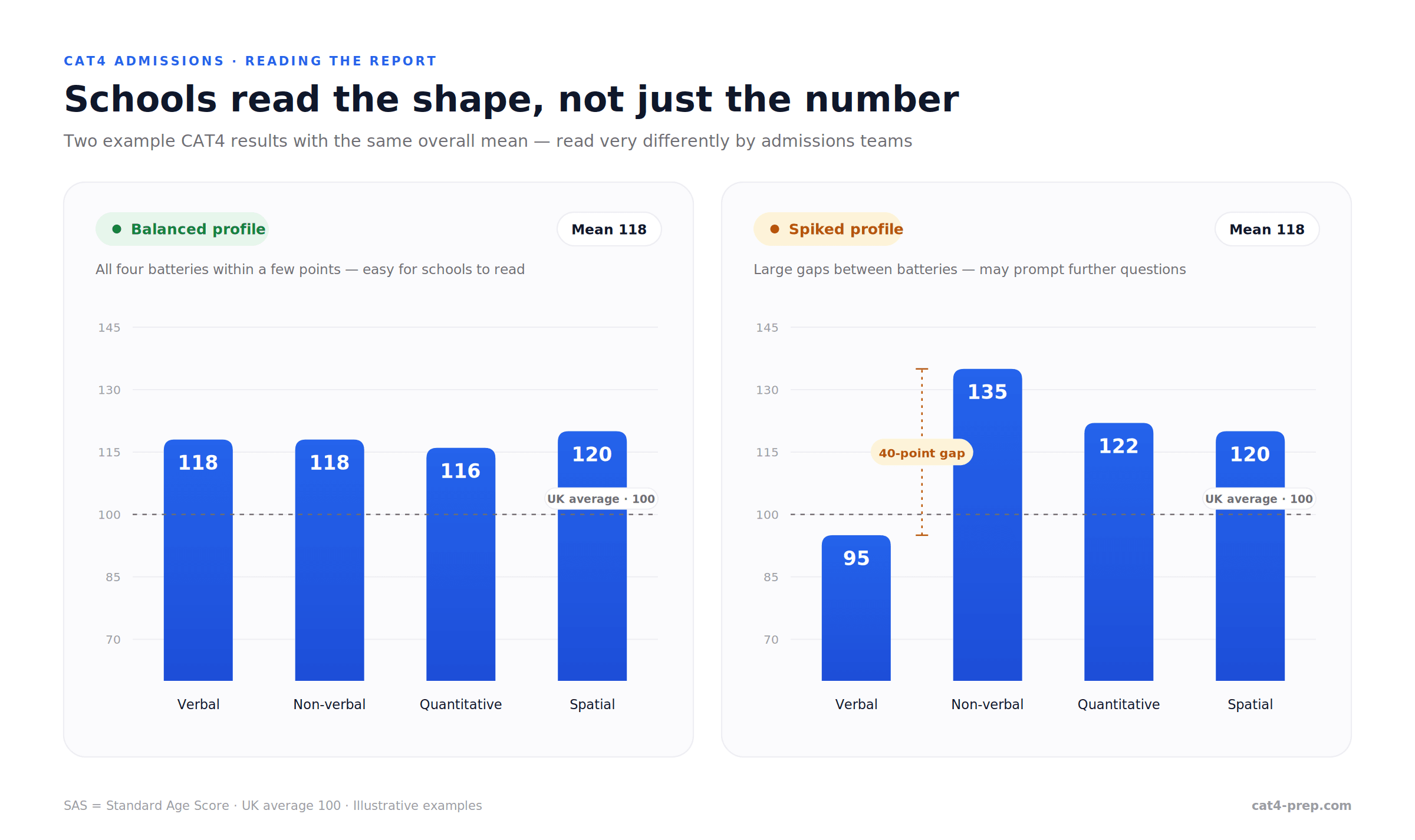
The cognitive profile plots all four battery scores next to the child's overall mean. A balanced profile keeps all four within about 10–12 SAS points of each other. A spiked profile has one or more batteries much higher or lower than the rest. Schools read this shape carefully — a big gap may lead to a conversation with parents or a note in the file.
For a full walkthrough of SAS, Stanines, percentiles, and how to read every part of a CAT4 report, see our CAT4 Test Results Explained guide.
When is CAT4 used in the admissions timeline?
The timing depends on the school type and country.
UK independent (Year 7 entry)
Usually taken in the autumn term of Year 6 (September to November), with offers in the spring term. Some schools test as early as Year 5 for deferred entry.
UK grammar (late transfer, Year 8–9)
Usually taken in the term before the planned entry point, with an interview.
UAE international (Year 7 entry)
The most competitive schools open applications 12–18 months ahead. CAT4 is usually sat between October and March during the cycle.
International schools (general)
Timing varies. Many accept applications and run CAT4 all year, especially for mid-year transfers.
How CAT4 is administered
When CAT4 is used for admissions, the process usually looks like this.
Where
At the school your child is applying to, or at their current school if the receiving school accepts results from elsewhere. Some international schools offer online supervised sittings for families overseas.
Format
Computer-based (through GL Assessment's Testwise platform) in most settings. A paper version exists but is now rare. All questions are multiple choice with five answer options.
Supervision
Taken in a quiet room with staff present. Students work alone — staff cannot help with answers. Each section starts with practice examples and audio instructions.
Duration
For Levels A–G (the levels used most in admissions), the timed content takes about 72 minutes across 8 subtests. With instructions, examples, and short breaks, the full session usually lasts around 2 hours.
What the school receives
A report with SAS, NPR, and Stanine scores for each battery, an overall mean, and a cognitive profile showing whether the child's reasoning is balanced or stronger in some areas.
CAT4 and SEN: can my child get extra time?
This is one of the most common questions parents ask, so it deserves a clear answer. According to GL Assessment's official guidance, extra time is not allowed for CAT4. The test measures not only whether a child reaches the right answer, but how they reason within set time limits. Giving extra time would make the score unfair to compare against the national norm group.
Allowed
- Prompts to help a child stay on task
- Coloured overlays for visual sensitivity
Not allowed
- Extra time
- A reader for the actual test questions (though staff may read the instructions aloud)
Case by case
- A practical assistant
- Page enlargement (paper version only)
Contact GL Assessment or the school for guidance on your child's specific needs.
If your child has a diagnosis that usually brings access arrangements in other exams, raise it with the admissions team before the test date. The school cannot change the timed format, but they can make sure your child sits in suitable conditions and that the admissions committee knows the background when they read the result.
How to prepare for CAT4 as an admissions test
GL Assessment says "no prior preparation is necessary" because CAT4 measures reasoning, not taught knowledge. This means you cannot raise your child's real reasoning ceiling by drilling content, and that is true. What it does not address is this: a child performing at their best on test day still needs to know the question formats. A child who sees Figure Analysis for the first time, under a timer, is not showing their reasoning ability — they are working out an unfamiliar format. Preparation does not inflate scores. It removes the penalty of seeing a question type for the first time.
Preparation helps for three practical reasons.
- Familiarity with question types. Some formats are new to most children — especially Figure Analysis (folding and unfolding shapes in your head) and Figure Recognition (finding a target shape hidden in a complex figure). Seeing these for the first time under a timer wastes time the child should spend reasoning.
- Timing and pace. CAT4 is strictly timed. Children who have practised at pace manage their time better and finish more questions.
- Confidence and less anxiety. A child who knows what to expect — the screen, the audio instructions, the flow of questions — feels calmer. Test nerves can pull scores down, and familiarity is the simplest fix.
What good preparation looks like
- Start 3–6 months before the test. This is enough time to cover all four batteries without pressure.
- Cover all four question types. Most children find Verbal Classification and Number Series fairly familiar. The areas that gain most from practice are Spatial Ability and Non-Verbal Reasoning — the types children rarely meet in normal schoolwork.
- Practise under timed conditions. Once your child knows the question types, add timed sessions that copy real test conditions. This builds pace and stamina.
- Review the reasons, not just the answers. The most useful part of practice is understanding why an answer is right. Ask your child to explain their thinking out loud — it deepens their grasp of the patterns.
- Do not over-prepare. CAT4 cannot be crammed. Weeks of long daily drilling backfire and raise anxiety. Short sessions (20–30 minutes, 3–4 times a week) over a few months work far better.
Start with free practice for your child's level
Download free CAT4 sample papers, or try a full online practice test with no sign-up needed.
CAT4 admissions: what schools won't always tell you
- CAT4 is rarely the only factor. Most schools use it alongside other evidence — school reports, teacher references, interviews, and sometimes extra English or Maths papers. A strong CAT4 score alone does not guarantee an offer, and a borderline score does not always mean a rejection.
- Schools read the profile, not just the mean. A school will look at the shape of the scores across the four batteries. A big gap (for example, Verbal SAS 130 but Spatial SAS 90) may lead to further questions or a chat with parents.
- EAL students are not automatically at a disadvantage. Many international schools, and some UK schools, are skilled at reading CAT4 profiles from EAL children. A lower verbal score alongside strong non-verbal, quantitative, and spatial scores is a known pattern, and many schools weigh the non-verbal batteries more heavily for these applicants.
- CAT4 is used for more than a yes/no decision. Even after admission, the results may guide class placement (setting or streaming), help spot students for gifted and talented programmes, or set baseline predictions for future GCSE or A-Level grades.
Can CAT4 be taken in other languages?
On the Testwise platform, students can choose Arabic for the instructions and practice questions. When a student selects Arabic, they see Arabic versions of the instructions before the test begins. Some versions also offer Mandarin and Malay instructions for international use.
The actual test questions, though, are in English. The non-verbal, quantitative, and spatial question types contain no language, so they work for any child. But the verbal battery needs English to answer. There is no full version of CAT4 where the reasoning questions themselves appear in another language.
CAT4 practice by level
Choose the CAT4 level that matches the year group your child is applying for. Each page has free sample questions, downloadable PDFs, and preparation tips.
| Entry point | Typical CAT4 level | Practice page |
|---|---|---|
| Year 2 entry | Level X or Y | Level X · Level Y |
| Year 3–4 entry (9+, 10+) | Level Pre-A or A | Level Pre-A · Level A |
| Year 5–6 entry (10+, 11+) | Level B or C | Level B · Level C |
| Year 7 entry (11+) | Level C or D | Level C · Level D |
| Year 8 entry (12+) | Level D or E | Level D · Level E |
| Year 9 entry (13+) | Level E or F | Level E · Level F |
| Year 10–11 entry (14+, 16+) | Level F or G | Level F · Level G |
Not sure which level? Use the CAT4 Levels Guide to find the right one.
Practise by battery
You can also prepare one reasoning area at a time. Each guide includes free sample questions and tips.
CAT4 Admissions Test — Frequently Asked Questions
Is CAT4 the same as the 11+?
No. The 11+ usually tests English, Maths, Verbal Reasoning, and Non-Verbal Reasoning, and it includes curriculum content. CAT4 tests reasoning only, across four batteries, with no curriculum content. Some schools use CAT4 instead of the 11+; others use both.
Is CAT4 the same as the ISEB Pre-Test?
No, but they are related. Both are run by GL Assessment, and they share similar Verbal and Non-Verbal Reasoning question styles. The ISEB Pre-Test also has English and Maths sections that test curriculum knowledge. CAT4 is reasoning only. Practice for one transfers well to the reasoning parts of the other.
Can my child get extra time for CAT4?
No. GL Assessment does not allow extra time for CAT4, because timing is part of what the test measures. Coloured overlays and prompts to stay on task are allowed. A reader for the actual questions is not (though instructions can be read aloud). If your child has a diagnosis, tell the school before the test so the admissions team understands the context.
Can my child take CAT4 at home?
CAT4 is normally taken in school under supervision. Some international schools offer remote supervised sittings for families applying from overseas. Unlike UKiset, CAT4 cannot be taken at a commercial test centre.
What is a good CAT4 score for admissions?
It depends on the school. SAS 100 is the national average. Most selective schools look for SAS 115 or higher. The most competitive schools expect 125+. For scholarships, 130+ is common. Always check with the specific school, as some describe their expectations as "above average" without giving a number.
What is a Stanine?
A Stanine ("standard nine") is a simple 1–9 score made from the SAS. Stanine 5 is average, and 7–9 is above average. Because it groups a range of SAS values into each band, it is useful for quick comparison but less precise than the SAS. You can read more in our CAT4 Test Results guide.
Why was my child's verbal score lower than the others?
The verbal battery needs English vocabulary, so children who speak English as an additional language often score lower there while scoring well on the other three batteries. This is a normal and recognised pattern. Many schools, especially international ones, weigh the non-verbal batteries more heavily for EAL applicants.
Can CAT4 be taken in Arabic or another language?
On the Testwise platform, the instructions and practice questions can be shown in Arabic, and some versions offer Mandarin and Malay. But the actual test questions, including the verbal battery, are in English. There is no full version of CAT4 with the reasoning questions translated into another language.
How is CAT4 different from an IQ test?
CAT4 is not an IQ test, though the format is similar. CAT4 measures "developed reasoning ability" — how a child reasons based on their experiences so far. IQ tests aim to measure innate intelligence. CAT4 scores can change over time as a child's reasoning grows, which is why schools sometimes re-test at different ages.
Can my child's score change if they are tested again?
Yes. CAT4 measures reasoning at one point in time, not a fixed ceiling. Scores can shift as a child's reasoning matures between Year 5 and Year 9, which is why some schools re-test at different year groups. If a sitting does not reflect your child's usual performance, raise it with the admissions team.
Can CAT4 scores be appealed?
CAT4 is a standardised test, so there is no formal appeal for the score itself. But if you believe test-day factors — illness, anxiety, or a technical problem — affected your child, raise it with the school. Many schools will consider a re-test or weigh other evidence more heavily when there are clear mitigating circumstances.
My child is applying to schools that use different tests. How much overlap is there?
There is a lot of overlap between CAT4, the ISEB Pre-Test, and UKiset in the reasoning sections. Verbal, Non-Verbal, and Quantitative/Mathematical Reasoning appear in all three. The main thing unique to CAT4 is the spatial battery (Figure Analysis and Figure Recognition), which the others do not have. If your child prepares for all four CAT4 batteries, they will have covered most of what the other tests need in reasoning.
Does my child need to prepare for CAT4?
GL Assessment says no preparation is needed. But getting familiar with the question formats — especially Spatial and Non-Verbal — lowers anxiety and helps your child perform to their real ability rather than losing time on an unfamiliar format. Short, regular practice over 3–6 months works better than last-minute cramming.
When is the best time to start preparing for CAT4?
For Year 7 entry (the most common point), start getting familiar in Year 5, then do structured practice 3–6 months before the test date. For mid-year or late-transfer applications, start as soon as you know CAT4 will be needed.
Next steps
If your child has been asked to take CAT4 as part of a school application, here is where to start.
- Confirm the level. Use the CAT4 Levels Guide, or ask the school which level they will use.
- Try a sample test. Download a free CAT4 practice PDF for your child's level, or take a free online practice test.
- Understand the scores. Read the CAT4 Test Results guide so you know what to expect on report day.
- Read the full guide. For background on the test itself, see the complete CAT4 guide.