
CAT4 Level Y (Year 3) Practice 2026: Free PDF, Sample Questions & Expert Tips
Clear guide for Year 3 families with a free CAT4 Level Y practice PDF, sample questions, and simple preparation tips.
- ✓Free CAT4 Level Y practice PDF with sample questions and clear guidance
- ✓Understand the Level Y format, timing, and all four CAT4 sections
- ✓Learn how to prepare calmly with age-appropriate strategies for Year 3 children
- ✓No sign-up needed to access the free guide and downloadable PDF
Test at a Glance
43 min timed questions · remaining time covers teacher instructions and practice examples per part
Who Takes This Test?
Level Y is a UK-only paper assessment — no international equivalent is available at this level.
What to Expect in the CAT4 Level Y Test
Why Schools Use the CAT4 Level Y Test
CAT4 plays a key role in how Year 3 schools understand each child — going beyond classroom marks to reveal underlying reasoning strengths.
Identify strengths and learning needs
Schools build a fuller picture of a child beyond traditional academic performance — useful for setting, support planning, and teacher guidance.
Support high-potential learners
CAT4 results can identify pupils who may benefit from gifted and talented programmes or more challenging work within Year 3.
Inform admissions and placement
Some schools use CAT4 data alongside other evidence as part of entry or setting decisions at Year 3 and beyond.
Results are always used alongside classroom work and teacher judgement — not as a standalone score. Understand what your child's CAT4 scores mean →
Pick the Best Prep for CAT4 Level Y
CAT4 Level Y Test Structure and Timing
Part 1 → Part 2
- Part 122 min→
- Part 221 min
Part 1
Non-Verbal + Verbal
- 12:00
Figures
12 min · Figure Classification
- 10:00
Words
10 min · Verbal Classification
Part 2
Quantitative + Spatial
- 10:00
Numbers
10 min · Number Series
- 11:00
Shapes
11 min · Spatial Patterns
How Is CAT4 Level Y Different from Other CAT4 Levels?
This is one of the questions parents ask most. CAT4 Level Y is not simply a harder version of Level X — it is a Year 3-specific assessment normed for children aged 7–8, sharing the same four-section paper format as Level X but with more demanding questions calibrated for that age band.
| Level X Year 2 · UK & international | THIS LEVEL Level Y Year 3 · UK only | Levels A–G Year 4 and above | |
|---|---|---|---|
| Age range (norms) | 6:00 – 7:11 | 7:01 – 8:11 | 7:06 and above |
| Sub-tests | 4 of 8 | 4 of 8 | 8 of 8 |
| Question types per section | 1 | 1 | 2 |
| Total timed time | 43 min | 43 min | ~72 min |
| Verbal section | Words (10 min) | Words (10 min) | Verbal Classification + Verbal Analogies |
| Non-verbal section | Figures (12 min) | Figures (12 min) | Figure Classification + Figure Matrices |
| Quantitative section | Numbers (10 min) | Numbers (10 min) | Number Analogies + Number Series |
| Spatial section | Shapes (11 min) | Shapes (11 min) | Figure Analysis + Figure Recognition |
| Delivery format | Paper only | Paper only | Paper or digital |
| Availability | UK & some international | UK only | UK & international |
Note: Level Y and Level X share the same four section names, timings, and one-question-type-per-section structure. The questions at Level Y are harder — normed for Year 3 children (ages 7:01–8:11) — but the format is identical to Level X. Unlike Level X, Level Y is available in the UK only and has no international equivalent.
The most important difference for preparation purposes: the jump from Level Y to Levels A–G is significant — eight subtests, two question types per battery, digital delivery, and approximately 72 minutes of timed questions. If your child is in Year 3, they are sitting Level Y. Moving to Year 4, their school will use Level A — a substantially different format with double the question types per section.
Free CAT4 Level Y Sample Questions
Practice CAT4 Level Y questions for Year 3 students — covering all four sections: Words, Figures, Numbers, and Shapes. Select your answer, then reveal the full step-by-step explanation.
Download our free CAT4 Level Y practice test PDF for more Year 3 sample questions.
Words Sample Questions
The Words section is part of CAT4 Level Y Part 1 and lasts 10 minutes. Each question shows three words that share a category or relationship. Your child must identify what the words have in common and choose the fourth word — from five options — that belongs to the same group. No numbers or shapes are involved — it is a pure vocabulary and categorisation task, testing how well a Year 3 child can think with words at an age-appropriate level. The vocabulary and category complexity is a step up from Level X, reflecting the Year 3 age norm. This section relates to Verbal Reasoning in the broader CAT4 framework.
Words · Verbal Classification
Which word belongs with these three?
Oak · Sunflower · Cactus
Words · CAT4 Level Y
Find what the three words have in common, name the category precisely, then pick the option that belongs to the same group.
Section
Words
Skill tested
Grouping by category
Difficulty
Medium
What to notice first
Start with the three given words, not the options. An Oak is a tree, a Sunflower is a flowering plant, and a Cactus is a desert plant — all three are plants. Now scan the options for the one word that is also a plant. That word is Fern. Mushroom is the trap — it grows in the ground like a plant, but it is a fungus, not a plant.
Step 1
Read the three words
Oak, Sunflower, Cactus — all living things that grow from soil and make their own food from sunlight.
Step 2
Name the category
The shared group is plants — not just "things that grow", but specifically plants with roots, stems, and leaves.
Step 3
Test each option
Only Fern is a plant. Mushroom grows in soil but is a fungus — a completely different kingdom of life.
Core rule
The category must be exact. "Things that grow" is too loose — mushrooms, coral, and feathers all grow in some sense. The precise category is plants, and only a plant passes the test.
Model the pattern
Step 1 — Read the three words together
Look at Oak, Sunflower, and Cactus. Ask: what do all three have in common? They are all plants — living things with roots, stems, and leaves that make food from sunlight. They are very different from each other in shape and size, but they all belong to the same scientific group.
Step 2 — Name the category precisely
Say it clearly: these are all plants. Not "living things" — that is too broad and would include animals. Not "things that grow outside" — that is too vague. The exact category is plants, and precision is what protects you from the Mushroom trap.
Step 3 — Test each option against the category
Go through A to E and ask: is this a plant? Fern is the only option that passes — it has roots, a stem, and fronds, and it grows from spores in soil. Mushroom looks like a plant but belongs to the fungus kingdom. Pebble, Coral, and Feather are not living plants at all.
Option check
Eliminate
Mushroom is the key distractor. It grows in soil and looks plant-like, but it is a fungus — it has no leaves, makes no food from sunlight, and belongs to a completely different kingdom from plants.
Eliminate
Pebble is not living. It is a piece of rock — it does not grow, feed, or reproduce. Eliminated immediately.
Correct
Fern is a plant. It has roots, a stem, and fronds, grows in soil, and makes food from sunlight — exactly like an Oak, a Sunflower, and a Cactus.
Eliminate
Coral grows underwater and can look like a plant, but it is an animal — made up of tiny creatures called polyps. It is not a plant.
Eliminate
Feather grows on a bird but is not a plant. It belongs to a completely different category — animal coverings.
Use this checklist on every Words question
- Read all three given words before looking at the options.
- Name the category as precisely as you can — "plants", not just "things that grow".
- Test each option against the exact category, not a looser version of it.
- Watch for distractors that share one surface feature with the stem words but belong to a different group entirely.
Reflection
Mushroom is a carefully placed distractor. Many Year 3 children associate mushrooms with the natural world and assume they are plants. The question specifically tests whether a child can name the category precisely enough to reject a convincing near-miss.
Bridge forward
At Level Y, distractors are chosen to share a visible or intuitive property with the stem words. Always ask: does this option belong to the exact same category — or does it just feel related? Feeling related is never enough.
Conclusion
The answer is C — Fern. Oak, Sunflower, Cactus, and Fern are all plants. Mushroom is a fungus, Pebble is rock, Coral is an animal, and Feather is an animal covering — none belong to the plant kingdom.
Words · Verbal Classification
Which word belongs with these three?
Doctor · Firefighter · Teacher
Words · CAT4 Level Y
Find what the three words have in common, name the category precisely, then pick the option that belongs to the same group.
Section
Words
Skill tested
Grouping by category
Difficulty
Medium
What to notice first
Start with the three given words, not the options. A Doctor helps sick people, a Firefighter keeps people safe from fire and danger, and a Teacher helps children learn — all three are people whose job is to help others in the community. Now scan the options for the one word that is also a community helping role. That word is Nurse. Builder is the trap — builders have an important job, but they construct things rather than directly helping people in need.
Step 1
Read the three words
Doctor, Firefighter, Teacher — all people with jobs that exist specifically to help others in the community.
Step 2
Name the category
The shared group is community helpers — people whose role is directly focused on the wellbeing, safety, or learning of others.
Step 3
Test each option
Only Nurse fits — a nurse works directly to care for people's health, just like a doctor. Builder, Chef, Footballer, and Pilot do not share that same core purpose.
Core rule
All jobs involve doing something for someone — so "jobs" alone is too broad a category here. The precise category is people who help others in the community as the central purpose of their role, not a side effect of it.
Model the pattern
Step 1 — Read the three words together
Look at Doctor, Firefighter, and Teacher. Ask: what do all three have in common? They all have jobs — but so does a chef and a pilot. Go deeper: their job exists specifically to help, protect, or educate people directly. That is the shared purpose that makes them a category.
Step 2 — Name the category precisely
Say it clearly: these are all community helpers — people whose job is centred on the direct wellbeing, safety, or learning of others. Not just "workers" or "people with uniforms" — those descriptions would include too many options and lead to the wrong answer.
Step 3 — Test each option against the category
Go through A to E and ask: is this person's job primarily to help, protect, or educate people in the community? Nurse is the only option that passes — caring for patients is exactly the same kind of direct community helping as a doctor or teacher does. Every other option fails the precise category test.
Option check
Eliminate
Builder is the key distractor. Builders do important work for the community, but their job is to construct things — not to directly help, protect, or educate people in need. The purpose of the role is different.
Eliminate
Footballer plays a sport professionally. This is not a community helping role — it is entertainment. Eliminated quickly.
Eliminate
Chef prepares food, which people enjoy and need — but the core purpose of the role is cooking, not directly helping people in the way a doctor or firefighter does.
Correct
Nurse is a community helper. Like a doctor, a nurse cares directly for people's health and wellbeing. The role exists specifically to help others — which is exactly the category shared by Doctor, Firefighter, and Teacher.
Eliminate
Pilot transports people safely, which involves skill and responsibility — but the core purpose is travel, not directly helping people in need. It does not share the community helping purpose of the stem words.
Use this checklist on every Words question
- Read all three given words before looking at the options.
- Name the category as precisely as you can — "community helpers", not just "jobs" or "workers".
- Test each option against the exact category purpose, not just surface similarity.
- Watch for distractors like Builder that seem to fit but fail the precise category test.
Reflection
Builder is a carefully chosen distractor because it is community-facing and purposeful. The question tests whether a Year 3 child can identify the specific shared purpose — helping people directly — rather than a looser property like "having a job" or "working outdoors".
Bridge forward
When all five options are jobs, the category cannot be "jobs" — it must be more specific. Always ask: what is the shared purpose of the three stem words, not just what they have on the surface?
Conclusion
The answer is D — Nurse. Doctor, Firefighter, Teacher, and Nurse are all community helpers — people whose job is directly focused on the wellbeing, safety, or learning of others. Builder constructs, Chef cooks, Footballer plays sport, and Pilot transports — none share that same core helping purpose.
Figures Sample Questions
The Figures section is part of CAT4 Level Y Part 1 and lasts 12 minutes — the longest single section in the test. Each question shows three figures that share a hidden rule. Your child must identify that rule and choose the option that follows it from five choices. No words or numbers are involved — it is a pure visual reasoning task. At Level Y the rules are more demanding than Level X — typically combining two attributes simultaneously, such as shape count and shading, rather than a single visible property. This section relates to Non-Verbal Reasoning in the broader CAT4 framework.
Figures · Figure Classification
Look at the three example figures. Find the hidden rule. Choose the option — A to E — that follows the same rule.
Figures · CAT4 Level Y
Check one attribute at a time across all three example figures, name the rule, then find the option that keeps both attributes.
Section
Figures
Skill tested
Two-attribute rule
Difficulty
Medium
What to notice first
Cover the options and study only the three examples. Each one shows a large outer shape drawn as an outline — a rectangle, an ellipse, a triangle. Look inside: each one contains one small shape that is fully filled (solid black). Two attributes, both present in every example. Now scan A to E for the only option that satisfies both rules simultaneously. That is C.
Step 1
Check attribute 1
Every example has a large outer shape drawn as an outline — not filled, just a border.
Step 2
Check attribute 2
Inside each outer shape sits exactly one small shape that is fully shaded — solid black, no outline only.
Step 3
Apply both to options
Only option C has an outline outer shape AND a filled inner shape. Every other option breaks at least one rule.
Core rule
At Level Y, Figures questions almost always combine two attributes. Spotting only one — for example, noticing the outer shape but missing whether the inner shape is filled — leads directly to a wrong answer. Check both before choosing.
Model the pattern
Step 1 — Cover the options, look only at the examples
Study all three examples before touching the options. Example 1: rectangle (outline) containing a filled circle. Example 2: ellipse (outline) containing a filled rectangle. Example 3: triangle (outline) containing a filled ellipse. The outer shape changes each time. The inner shape changes each time. What never changes: outer is always outline, inner is always filled.
Step 2 — Name both rules before looking at options
Rule 1: large outer shape, outline only. Rule 2: one small shape inside, fully filled. Say both rules clearly before moving to the options. Children who look at options too early latch onto surface similarity — "that looks like the examples" — rather than testing both rules precisely.
Step 3 — Test each option against both rules in order
For each option ask: does it have an outline outer shape? If no, eliminate. If yes, ask: does it have a filled inner shape? If no, eliminate. Only option C passes both checks — triangle outer (outline) with a filled rectangle inside.
Option check
Eliminate
A has an outer ellipse (outline) — rule 1 passes. But the inner triangle is also an outline, not filled — rule 2 fails. This is the most tempting wrong answer: the structure looks right, but the shading is wrong.
Eliminate
B has an outer rectangle (outline) — rule 1 passes. But there is no inner shape at all — rule 2 fails immediately. Easy to eliminate once you know both rules.
Correct
C has a triangle drawn as an outline — rule 1 passes. Inside sits a small filled rectangle — rule 2 passes. Both attributes are present. This is the only option that satisfies the complete rule.
Eliminate
D has an outer triangle (outline) — rule 1 passes. But the inner circle is drawn as an outline only, not filled — rule 2 fails. D fails in exactly the same way as A: correct structure, wrong shading.
Eliminate
E shows a single fully filled ellipse — no outer container, no inner shape. This reverses the relationship entirely. Both rules fail at once.
Use this checklist on every Figures question
- Cover the options and study all three examples first.
- Check one attribute at a time — count, then shading, then position.
- Name both rules before looking at the options.
- Test each option against every rule — one passing attribute is not enough.
Reflection
Options A and D are the precision distractors. Both have correct structure — an outer shape containing an inner shape — but the inner shape is outline only. A child who spots only rule 1 will hesitate between A, C, and D. Only checking rule 2 (filled vs outline) resolves the question instantly.
Bridge forward
At Level Y, always assume two rules are in play. Once you have spotted one rule, immediately ask: what else is consistent across all three examples? The second rule is usually about shading, count, orientation, or size — and it is always the one that separates the correct answer from the distractors.
Conclusion
The answer is C. Every example figure has a large outline outer shape containing exactly one small filled inner shape. Option C — a triangle containing a filled rectangle — is the only option that satisfies both rules. A and D fail because their inner shapes are outlines only. B has no inner shape. E has no outer shape.
Numbers Sample Questions
The Numbers section is part of CAT4 Level Y Part 2 and lasts 10 minutes. Each question shows a sequence of numbers that follow a hidden rule. Your child must identify the pattern — such as counting in multiples, adding increasing steps, or alternating between two rules — and choose the next number in the sequence from five options. No words or shapes are involved — it is a pure numerical reasoning task. At Level Y the patterns are more demanding than Level X — sequences may involve two-step rules or larger intervals rather than simple counting, reflecting the Year 3 age norm. This section relates to Quantitative Reasoning in the broader CAT4 framework.
Numbers · Number Series
What is the next number in the sequence?
3 · 5 · 8 · 12 · 17 · ?
Numbers · CAT4 Level Y
Write out the gaps between each pair of terms first. Once you can see the gaps, the rule becomes visible — then extend it one step further.
Section
Numbers
Skill tested
Increasing step rule
Difficulty
Medium
What to notice first
Do not look at the options yet. Write the gap between each pair of terms: 5−3=2, 8−5=3, 12−8=4, 17−12=5. The gaps are 2, 3, 4, 5 — each one increases by 1. The next gap must be 6. So the next term is 17+6=23.
Step 1
Find the gaps
5−3=2 · 8−5=3 · 12−8=4 · 17−12=5. Gaps are 2, 3, 4, 5.
Step 2
Find the rule in the gaps
Each gap increases by 1. The next gap must be 5+1=6.
Step 3
Apply to find the answer
17+6=23. The next number in the sequence is 23.
Core rule
When the gaps between terms are not equal, do not guess — write them all out. The rule is almost always hidden in how the gaps change, not in the terms themselves.
Model the pattern
Step 1 — Subtract each pair of neighbouring terms
Work left to right: 5−3=2, 8−5=3, 12−8=4, 17−12=5. Write these gap values underneath the sequence as you go. This is the most important habit in Number Series — never try to spot the rule by eye alone.
Step 2 — Look at the gaps as their own sequence
The gaps are 2, 3, 4, 5. These increase by 1 each time — a secondary sequence inside the primary one. This is an increasing step rule, the most common Level Y pattern. The next gap must follow the same secondary rule: 5+1=6.
Step 3 — Add the next gap to the last term
The last term is 17. The next gap is 6. So the answer is 17+6=23. Check it: does 23 fit the pattern? The sequence would be 3, 5, 8, 12, 17, 23 — gaps of 2, 3, 4, 5, 6. Yes, every gap increases by exactly 1.
Option check
Eliminate
21 would mean a gap of 4 — repeating the gap before last. This comes from noticing that 12−8=4 and adding that again. It ignores the increasing pattern in the gaps entirely.
Eliminate
22 would mean a gap of 5 — repeating the most recent gap instead of increasing it by 1. This is the most common mistake: children spot the last gap correctly but do not realise it needs to grow.
Correct
23 follows from a gap of 6 — the next step in the increasing gap sequence 2, 3, 4, 5, 6. Both the primary sequence and the secondary gap sequence are consistent.
Eliminate
24 would mean a gap of 7, skipping one step in the gap sequence. A child who adds +7 instead of +6 has over-extended the pattern by one increment.
Eliminate
25 would mean a gap of 8. This is too large — a child who added the last two gaps together (5+3=8) or guessed upward without checking the rule.
Use this checklist on every Numbers question
- Write out every gap before looking at the options.
- Treat the gaps as their own sequence — find the rule within the gaps.
- Extend the gap rule by one step, then add it to the last term.
- Check your answer fits: does the full sequence now make sense?
Reflection
Option B (22) is the precision distractor — it catches children who correctly identify the last gap as 5 but treat it as fixed rather than growing. The question is specifically designed to distinguish children who spot one gap from those who track the gap sequence.
Bridge forward
Increasing step sequences appear frequently at Level Y and Level A. Once you build the habit of writing gaps underneath every sequence, this question type becomes reliable and fast — the rule is always visible in the gaps.
Conclusion
The answer is C — 23. The gaps between terms are 2, 3, 4, 5 — each increasing by 1. The next gap is 6, giving 17+6=23. Option B (22) is the key distractor — it uses the correct last gap but fails to increase it.
Numbers · Number Series
What is the next number in the sequence?
2 · 6 · 4 · 8 · 6 · 10 · ?
Numbers · CAT4 Level Y
When the gaps are inconsistent, split the sequence into two interleaved sub-sequences — odd positions and even positions — and find the rule in each one separately.
Section
Numbers
Skill tested
Alternating two-rule
Difficulty
Hard
What to notice first
Write the gaps: 6−2=+4, 4−6=−2, 8−4=+4, 6−8=−2, 10−6=+4. The gaps alternate +4 and −2 — a clear signal that two separate rules are running in parallel. Split the sequence: odd positions (1st, 3rd, 5th, 7th) give 2, 4, 6, ? and even positions (2nd, 4th, 6th) give 6, 8, 10. The 7th term is the next odd-position term: 6+2=8.
Step 1
Write the gaps
+4, −2, +4, −2, +4. Alternating gaps signal two interleaved rules.
Step 2
Split into two sub-sequences
Odd positions: 2, 4, 6, ? (+2 each). Even positions: 6, 8, 10 (+2 each).
Step 3
Find the 7th term
The 7th term is the 4th odd-position term: 6+2=8.
Core rule
Alternating gaps — one positive, one negative — always mean two rules running side by side. Never try to find a single rule that explains every gap. Split the sequence first, then solve each half separately.
Model the pattern
Step 1 — Write the gaps and spot the alternation
Gaps: +4, −2, +4, −2, +4. The sequence goes up, then down, then up, then down — a regular alternation. This is the signal to split. A single rule cannot produce alternating positive and negative gaps.
Step 2 — Read every other term as its own sequence
Underline positions 1, 3, 5, 7: 2, 4, 6, ? — these increase by 2 each time. Circle positions 2, 4, 6: 6, 8, 10 — these also increase by 2 each time. Two clean, separate +2 sequences are running in parallel, offset by one position.
Step 3 — Identify which sub-sequence the missing term belongs to
The question mark is in position 7 — an odd position. It belongs to the odd sub-sequence: 2, 4, 6, ?. The rule is +2 each time, so the next term is 6+2=8. The even sub-sequence (6, 8, 10) is a distractor — 10 is already in the sequence and the next even-position term would be 12, but that is not what is being asked.
Option check
Eliminate
6 is already in the sequence at position 5. A child who repeats the last odd-position term without advancing it lands here. The sub-sequence is 2, 4, 6 — the next term must be higher, not a repeat.
Correct
8 is the next term in the odd sub-sequence 2, 4, 6, 8 — each step adds 2. Position 7 is an odd position, so this is the correct sub-sequence to extend.
Eliminate
10 is already in the sequence at position 6. A child who continues the even sub-sequence (6, 8, 10...) without realising position 7 is odd lands here. This is the most tempting wrong answer — 10 feels like a natural next step when looking only at the last two terms (6 and 10).
Eliminate
12 is the next even-position term — correct for position 8, not position 7. A child who extends the even sub-sequence one step further than needed arrives here.
Eliminate
14 would require adding +4 to 10 — continuing the +4 gap without switching back. This comes from treating the last gap (+4) as the only rule and applying it once more.
Use this checklist on every Numbers question
- Write every gap before looking at the options.
- If gaps alternate between positive and negative, split into two sub-sequences immediately.
- Identify which position the missing term occupies — odd or even.
- Extend only the correct sub-sequence, not the other one.
Reflection
Option C (10) is the precision distractor — it is the next logical term if a child follows the even sub-sequence instead of the odd one. The question is specifically designed to test whether a child can identify which sub-sequence the 7th position belongs to, not just whether they can spot the two rules.
Bridge forward
Alternating two-rule sequences become more common at Level A and beyond. The split method — underline odd positions, circle even positions — is the single most reliable technique for this question type and transfers directly to harder levels.
Conclusion
The answer is B — 8. The sequence contains two interleaved sub-sequences: odd positions 2, 4, 6, 8 (+2 each) and even positions 6, 8, 10 (+2 each). The 7th term is the 4th odd-position term: 6+2=8. Option C (10) is the key distractor — it extends the even sub-sequence instead of the odd one.
Shapes Sample Questions
The Shapes section is part of CAT4 Level Y Part 2 and lasts 11 minutes — the longest section in Part 2. Each question shows one test shape. Your child must find the one answer option in which that shape appears in exactly the same orientation — not rotated, not reflected — even though it may be surrounded by extra lines designed to distract. No words or numbers are involved — it is a pure spatial reasoning task. At Level Y the questions are more demanding than Level X — they frequently test whether a shape has been rotated or reflected, rather than simply matching a static property, reflecting the Year 3 age norm. This section relates to Spatial Ability in the broader CAT4 framework.
Shapes · Spatial Patterns
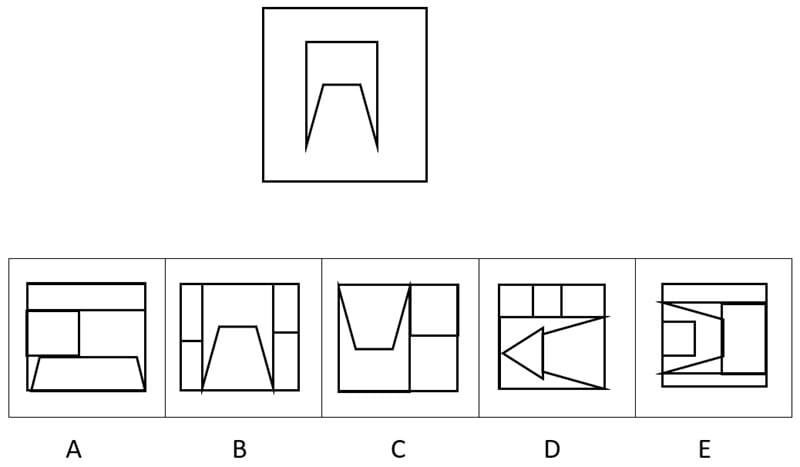
Look at the test shape in the box above. Find the answer option — A to E — in which the test shape appears in exactly the same position and orientation.
Shapes · CAT4 Level Y
Identify the key features of the test shape, then check each option for those exact features in the same orientation — not rotated, not reflected.
Section
Shapes
Skill tested
Orientation constancy
Difficulty
Medium
What to notice first
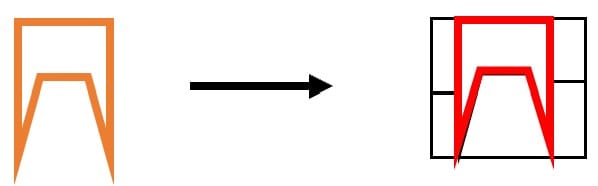
Study the test shape before looking at the options. It is a rectangular arch: a flat top edge, two vertical sides, and two diagonal legs that angle inward from the base of each side and meet at a point near the centre bottom — like a doorway or tunnel entrance viewed from the front. The point where the legs meet faces downward, and the arch has a specific width and height. Both of these — the direction the point faces, and the exact proportions — are the features to lock onto. Now scan A to E: only option B matches on both counts.
Step 1
Name the key features
Flat top, vertical sides, two diagonal legs meeting at a point. Note both the direction the point faces and the arch's width and height.
Step 2
Filter by direction
Eliminate any option where the point doesn't face downward. This removes C (faces up), D (faces left), and E (faces right) in one pass.
Step 3
Filter by size
Of the two left — A and B — check the proportions. A is wider with a shorter arch. B matches exactly.
Core rule
The shape must match the test shape in two ways: the direction its point faces, and its exact proportions. A shape can face the right direction and still be the wrong size — always check both before choosing.
Model the pattern
Step 1 — Study the test shape and name its features precisely
Look at the test shape for at least five seconds before touching the options. Name what you see: flat top, two vertical sides, two diagonal legs angling inward from the bottom corners toward a point at the centre. That point faces downward. The shape is taller than it is wide. Fix these features in your mind before moving on.
Step 2 — Filter by the direction the point faces
Use the most distinctive feature — the direction the point where the two diagonal legs meet is facing — as your first filter. Scan all five options and eliminate any where that point faces anywhere other than down. This removes C (point faces up), D (point faces left), and E (point faces right) in one pass, leaving A and B.
Step 3 — Check the remaining options for size
After the first filter, only A and B remain — both show the point facing downward. Now check the second feature: does the width and the height of the arch match the test shape exactly? A is wider than the test shape and its arch isn't as tall — the direction is right, but the size is wrong. Only B matches the test shape's proportions exactly.
Option check
Eliminate
A contains an outline that's loosely similar to the test shape — flat top, vertical sides, diagonal legs meeting at a point facing down — but it's wider than the test shape, and the arch between the legs isn't as tall. The direction is right; the proportions are wrong.
Correct
B shows the test shape in its original upright orientation. The flat top faces up, both diagonal legs angle symmetrically inward from the base, and the point where they meet faces downward — an exact match, in both direction and proportion. The surrounding lines are there to make it harder to spot, but the shape itself is unchanged.
Eliminate
C shows the same shape flipped vertically — the diagonal legs now angle upward from the top instead of down from the base, so the point faces up instead of down. This is a vertical flip, not a left-right mirror.
Eliminate
D shows a similar shape rotated clockwise — the point where the legs meet now faces left instead of down.
Eliminate
E shows a similar shape rotated anti-clockwise — the point where the legs meet now faces right instead of down.
Use this checklist on every Shapes question
- Study the test shape for several seconds before looking at the options.
- Name its most distinctive feature — the direction the point or opening faces.
- Use that feature to eliminate options in one fast scan.
- Check remaining options against size and proportion too — the right direction doesn't guarantee the right size.
- Remember: flipped and rotated shapes look similar but are not correct matches.
Reflection
C, D, and E are each tricky in the same general way — all three keep the arch's basic structure recognisable, just facing a different direction (up, left, or right instead of down), so it's easy to spot "the shape" and stop checking direction. A is tricky in the opposite way — it faces the right direction but is the wrong size. B is the only option that gets both direction and proportion right.
Bridge forward
The feature-lock method — name the features, filter by the most distinctive one, then check the rest — works on every Shapes question at Level Y and beyond. The surrounding lines in each option always change. The test shape, when present, never does.
Conclusion
The answer is B. Option B is the only choice that matches the test shape exactly — a rectangular arch with the point facing downward and the correct proportions. A shows the right direction but is wider with a shorter arch. C is flipped vertically, its point facing up. D is rotated clockwise, its point facing left. E is rotated anti-clockwise, its point facing right.
Get full access to 1,000+ CAT4 Level Y practice questions with expert tips, mock exams, and step-by-step explanations.
Get Full Practice⭐️⭐️⭐️⭐️⭐️
"We used the premium CAT4 prep and my daughter scored in the top 5%. It was exactly what we needed."
– Maria L. US Parent
Download Your Free CAT4 Level Y Sample Questions PDF
Prepare your child for the CAT4 Level Y (Year 3) test with our free, printable sample questions PDF — designed to match the four sections of the real paper-based test.
- ✓ Realistic sample questions covering all four Level Y sections: Words, Figures, Numbers, and Shapes
- ✓ Printable format — ideal for timed at-home practice on paper, just like the real test
- ✓ Free to download — no sign-up required
Tip: Print the PDF and have your child work through it under timed conditions — 43 minutes total, split across two parts — to build familiarity with the paper format before test day.
Support
Spotted something that needs fixing?
If you notice an error, broken link, or unclear explanation, email us and we’ll review it.
What is the Purpose of the Year 3 CAT Test?
The CAT4 Level Y is not a curriculum test — it does not assess what your child has been taught in class. Developed by GL Assessment and standardised against 25,000 students, it measures how a child reasons and thinks across four areas: Words, Figures, Numbers, and Shapes. The goal is to reveal cognitive strengths and areas for development that standard classroom work and grades may not show.
At Year 3, schools use the results to build a learning profile for each child and to begin making informed decisions about grouping, support, and challenge. This helps teachers identify pupils who may benefit from extra support, those who need greater stretch, and students whose classroom performance does not yet reflect their underlying ability. Because the test measures reasoning rather than knowledge, it can surface potential that has not yet had the chance to show up in written work or reading assessments.
CAT4 Level Y is not a pass or fail test and is not used for high-stakes school selection at Year 3. Results are reported as a Standard Age Score (SAS), a National Percentile Rank (NPR), and stanines — all benchmarked against children of the same age nationally. Schools use this data to inform teaching and grouping decisions, not to label children. It is one of the earliest points at which CAT4 data may begin to inform how a child is supported within their year group.
Strategies and Tips for the CAT4 Level Y Test
Because Level Y is paper-based and teacher-administered, most of the preparation happens at home before test day. These tips are written for parents of Year 3 children — not for the child to read alone.
- ✓ Keep practice sessions short. Fifteen to twenty minutes at a time is enough for a 7–8 year old. Work through one section per session — Words one day, Figures the next — rather than all four at once.
- ✓ Practise on paper, not a screen. CAT4 Level Y is a paper-based test. Print the free Level Y PDF so your child practises in the same format as the real test.
- ✓ Teach "look first, choose second." For Figures and Shapes, children who rush straight to the options often pick a wrong answer that looks familiar. Teach your child to study the example first, describe it in one sentence, then look at the options.
- ✓ Always attempt every question. There is no penalty for a wrong answer on CAT4. If your child is unsure, a best guess is always better than leaving a blank. Make sure they know this before test day.
- ✓ Remind your child to listen during the teacher's instructions. Each section starts with the teacher reading instructions and working through practice examples aloud. This is the most important moment — it tells the child exactly what to do.
- ✓ Keep it low pressure. CAT4 Level Y is a diagnostic tool, not a high-stakes exam — results inform teaching decisions, not pass or fail outcomes. A good night's sleep and a normal breakfast matter more than last-minute cramming. If your child experiences broader test anxiety, YoungMinds has a practical parent guide worth reading.
What Do CAT4 Level Y Scores Mean for Year 3?
CAT4 Level Y results are reported using three standardised score types, developed by GL Assessment to measure reasoning ability consistently across the national cohort. Each one gives schools and parents a different angle on how a Year 3 child's cognitive abilities compare with pupils of the same age nationally. Because Level Y assesses children at ages 7–8 — at the start of lower KS2, when schools begin to use cognitive data more actively to inform grouping and support decisions — these scores are used to build a learning profile and identify children who may need additional support or greater challenge within their year group.
Standard Age Score (SAS)
The main score used to measure a child's performance against other children of exactly the same age. SAS scores run from 60 to 140, with 100 set as the national average and a standard deviation of 15. A score above 100 means the child performed better than the typical child of that age; below 100 means below average. On CAT4 Level Y, the SAS is age-standardised specifically for Year 3 pupils, giving schools a reliable baseline of cognitive reasoning ability at ages 7–8.
National Percentile Rank (NPR)
Expresses a child's result as a position within the national population. An NPR of 75, for example, means the child scored higher than 75 out of every 100 same-age pupils nationally. NPR values range from 1 to 99. For Year 3 CAT4 Level Y results, the NPR is one of the clearest ways for parents to understand where their child's reasoning profile sits within the full national Year 3 cohort — without needing to interpret a precise standardised number.
Stanine
A nine-point performance band that maps directly from the NPR. Stanines run from 1 (Very Low) to 9 (Very High) and group pupils into broad, easy-to-read bands. They help parents and teachers get a clear at-a-glance picture of where a child sits without needing to interpret a precise number. In CAT4 Level Y reports, stanines are particularly useful for communicating a Year 3 child's reasoning strengths across the four sections in a format that is immediately actionable for classroom planning, grouping decisions, and targeted support.
Learn more about CAT4 scores and what they mean for Year 3 pupils →
What is a Good CAT4 Score in Year 3?
All CAT4 scores are centred on a national average of 100, standardised by GL Assessment against the full Year 3 cohort. Knowing which band your child's CAT4 Level Y score falls into helps you understand their reasoning profile in context — not as a verdict, but as a starting point. At Year 3, CAT4 Level Y results inform how your child is taught and supported within their year group — they are a diagnostic tool, not a pass or fail outcome. Most Year 3 pupils score between 85 and 115. Scores above 120 are uncommon and typically indicate a child whose reasoning development is running noticeably ahead of their peers.
Average (90–110)
Scores within this range are considered typical for a child's age. A score of exactly 100 is the national average; scores between 90 and 110 indicate reasoning ability broadly in line with same-age peers. For CAT4 Level Y, this band represents the majority of the national Year 3 cohort and reflects solid, age-appropriate cognitive development at the start of lower KS2.
Above Average (111–119)
Scores in this range indicate reasoning ability above the national average for the child's age. Children scoring here are performing meaningfully better than most same-age peers, though not yet in the high-ability band. On CAT4 Level Y, an above-average score in Year 3 is a strong signal — one that schools may use to ensure the child receives appropriate stretch and challenge as they move through lower KS2.
High Ability (120–129)
Scores in the 120–129 range point to strong reasoning skills and are often seen in children who grasp new concepts quickly and show curiosity across different types of problems. On the CAT4 Level Y assessment, a score in this band places a Year 3 child in the top 10% nationally — a useful indicator for schools planning enrichment provision and more challenging grouping from Year 3 onwards.
Gifted and Talented (130+)
A score of 130 or above is typically classified as Gifted and Talented , reflecting exceptional reasoning ability compared with pupils of the same age across the country. On CAT4 Level Y, a score of 130 or above places a Year 3 child in the top 2% of their national age group — a significant early signal for schools and parents planning longer-term learning provision as the child progresses through KS2.
Get full access to 1,000+ CAT4 Level Y practice questions with expert tips, mock exams, and step-by-step explanations.
Get Full PracticeCAT4 Level Y (Year 3) — Frequently Asked Questions
What is CAT4 Level Y and who takes it?
CAT4 Level Y is a paper-based cognitive ability assessment developed by GL Assessment for Year 3 pupils in the UK, typically aged 7–8. It measures four types of reasoning: verbal (Words), non-verbal (Figures), quantitative (Numbers), and spatial (Shapes). It is a UK-only assessment with no international equivalent at this level.
How long does the CAT4 Level Y test take?
The total timed question time is 43 minutes, split across two parts. Part 1 covers Figures (12 minutes) and Words (10 minutes). Part 2 covers Numbers (10 minutes) and Shapes (11 minutes). The full session is longer once teacher instructions and practice examples are included — typically around 60 minutes in total.
Which question types appear in CAT4 Level Y?
Level Y contains four question types — one per section: Verbal Classification (Words), Figure Classification (Figures), Number Series (Numbers), and Spatial Patterns (Shapes). Each section uses a single question type throughout, unlike Levels A–G which use two question types per battery.
Can I see free CAT4 Level Y sample questions?
Yes. This page includes free CAT4 Level Y sample questions covering all four sections — Words, Figures, Numbers, and Shapes — each with a full step-by-step explanation. You can also download the free CAT4 Level Y sample test PDF, which requires no sign-up. Jump to the sample questions section above or download the PDF directly from the button at the top of this page.
How should my child prepare for CAT4 Level Y?
Practise on paper — Level Y is a paper-based test, so print the free PDF rather than using a screen. Keep sessions to 15–20 minutes at a time and focus on one section per session. Teach your child to study the example before looking at the answer options, and remind them there is no penalty for a wrong answer so they should attempt every question. A good night's sleep before test day matters more than last-minute revision.
How are CAT4 Level Y results used in schools?
Schools use CAT4 Level Y results alongside classroom performance and teacher judgement to build a learning profile for each Year 3 child. Results are reported as a Standard Age Score (SAS), a National Percentile Rank (NPR), and stanines — all benchmarked against children of the same age nationally. At Year 3, results may begin to inform grouping and support decisions within school. CAT4 Level Y is not a pass or fail test and is not used for high-stakes school selection.
What is a good CAT4 Level Y score?
CAT4 scores are standardised with a national average of 100 and a standard deviation of 15. Most Year 3 pupils score between 85 and 115. A score of 111–119 is considered above average, 120–129 is high ability (top 10%), and 130 or above is typically classified as Gifted and Talented (top 2%). Scores below 90 may indicate a child who would benefit from additional support.
What are common mistakes to avoid in CAT4 Level Y?
The most common mistakes are: rushing to the answer options before studying the example carefully; spending too long on one question and running out of time; leaving answers blank (there is no penalty for guessing); and not listening to the teacher's instructions at the start of each section, which include worked examples. For Figures and Shapes questions specifically, children often eliminate options by how they look rather than checking all attributes of the rule.
Is CAT4 Level Y available outside the UK?
No. CAT4 Level Y is a UK-only paper assessment. It has no international digital equivalent. International British-curriculum schools that wish to assess Year 3-age pupils typically use CAT4 Level Pre-A, which is a digital assessment available internationally. Level X — the level below Y — is available to some international schools, but Level Y is not.