
CAT4 Level X (Year 2) Practice 2026: Free PDF, Sample Questions & Expert Tips
Clear guide for Year 2 families with a free CAT4 Level X practice PDF, sample questions, and simple preparation tips.
- ✓Free CAT4 Level X practice PDF with sample questions and clear guidance
- ✓Understand the Level X format, timing, and all four CAT4 sections
- ✓Learn how to prepare calmly with age-appropriate strategies for Year 2 children
- ✓No sign-up needed to access the free guide and downloadable PDF
Test at a Glance
43 min timed questions · remaining time covers teacher instructions and practice examples per part
Who Takes This Test?
What to Expect in the CAT4 Level X Test
Pick the Best Prep for CAT4 Level X
CAT4 Level X Test Structure and Timing
Part 1 → Part 2
- Part 122 min→
- Part 221 min
Part 1
Non-Verbal + Verbal
- 12:00
Figures
12 min · Figure Classification
- 10:00
Words
10 min · Verbal Classification
Part 2
Quantitative + Spatial
- 10:00
Numbers
10 min · Number Series
- 11:00
Shapes
11 min · Spatial Patterns
How Is CAT4 Level X Different from Other CAT4 Levels?
This is one of the questions parents ask most. CAT4 Level X is not simply an easier version of Level Y — it is an earlier-stage assessment built specifically for children aged 6–7, before the more structured reasoning format used from Year 3 onwards.
| Level Y Year 3 · UK only | THIS LEVEL Level X Year 2 · UK & international | Levels A–G Year 4 and above | |
|---|---|---|---|
| Age range (norms) | 7:01 – 8:11 | 6:00 – 7:11 | 8:06 and above |
| Sub-tests | 4 of 8 | 4 of 8 | 8 of 8 |
| Question types per section | 1 | 1 | 2 |
| Total timed time | 43 min | 43 min | ~72 min |
| Verbal section | Words (10 min) | Words (10 min) | Verbal Classification + Verbal Analogies |
| Non-verbal section | Figures (12 min) | Figures (12 min) | Figure Classification + Figure Matrices |
| Quantitative section | Numbers (10 min) | Numbers (10 min) | Number Analogies + Number Series |
| Spatial section | Shapes (11 min) | Shapes (11 min) | Figure Analysis + Figure Recognition |
| Delivery format | Paper only | Paper only | Paper or digital |
| Availability | UK only | UK & some international | UK & international |
Note: Level X and Level Y share the same four section names, timings, and one-question-type-per-section structure. The questions at Level Y are harder — normed for Year 3 children (ages 7:01–8:11) — but the format is identical. Level X is the only CAT4 Young Learners level available to some international British-curriculum schools; Level Y is UK only.
The most important difference for preparation purposes: the jump from Level X or Y to Levels A–G is significant — eight subtests, two question types per battery, digital delivery, and approximately 72 minutes of timed questions. If your child is in Year 2, they are sitting Level X. Moving to Year 3, their school may use Level Y — a harder version of the same format, UK only.
Free CAT4 Level X Sample Questions
Practice CAT4 Level X questions for Year 2 students and their international equivalents — covering all four sections: Words, Figures, Numbers, and Shapes. Select your answer, then reveal the full step-by-step explanation.
Download our free CAT4 Level X practice test PDF for more Year 2 sample questions.
Words Sample Questions
The Words section is part of CAT4 Level X Part 1 and lasts 10 minutes. Each question shows three words that share a category or relationship. Your child must identify what the words have in common and choose the fourth word — from five options — that belongs to the same group. No numbers or shapes are involved — it is a pure vocabulary and categorisation task, testing how well a Year 2 child can think with words at an age-appropriate level. This section relates to Verbal Reasoning in the broader CAT4 framework.
Words · Verbal Classification
Which word belongs with these three?
Ball · Bicycle · Toy car
Words · CAT4 Level X
Find what the three words have in common, name the category, then pick the option that belongs to the same group.
Section
Words
Skill tested
Grouping by category
Difficulty
Easy
What to notice first
Start with the three given words, not the options. Ball, Bicycle, and Toy car are all things children play with — they are all toys. Now look at the options and find the one word that is also a toy. That word is Doll.
Step 1
Read the three words
Ball, Bicycle, Toy car — all things children use for play.
Step 2
Name the category
The shared group is toys — things made for children to play with.
Step 3
Test each option
Only one option is also a toy. That is Doll.
Core rule
The correct word must belong to the exact same category as all three given words — not just be related to one of them in some other way.
Model the pattern
Step 1 — Read the three words
Look at Ball, Bicycle, and Toy car together. Ask yourself: what do all three have in common? They are all toys — things you play with, not things you sit on, wear, or read.
Step 2 — Name the category clearly
Say it simply: these are all toys. Being precise about the category stops you from accepting a word that is only loosely connected.
Step 3 — Test each option against the category
Go through A to E and ask: is this a toy? Doll is the only option that passes. Everything else belongs to a different group — furniture, clothing, or books.
Option check
Eliminate
Book is something you read, not a toy you play with. It belongs to a different category.
Correct
Doll is a toy — just like a ball, a bicycle, and a toy car. It fits the category perfectly.
Eliminate
Chair is furniture. You sit on it; you do not play with it.
Eliminate
Hat is clothing. It belongs to a completely different category.
Eliminate
Table is furniture, like Chair. It does not belong to the toys group.
Use this checklist on every Words question
- Read all three given words before looking at the options.
- Name the shared category in one simple word or phrase.
- Test each option: does it belong to that exact category?
- Reject words that are only loosely connected — the match must be exact.
Reflection
This question is straightforward once you name the category. The tricky distractor is Book — children use books, but reading is not playing, so it does not belong with toys.
Bridge forward
Always name the category before looking at options. Children who jump to the options first often pick a word that feels familiar rather than one that truly fits the group.
Conclusion
The answer is B — Doll. Ball, Bicycle, Toy car, and Doll are all toys. Every other option belongs to a different category.
Words · Verbal Classification
Which word belongs with these three?
Slide · Swing · Seesaw
Words · CAT4 Level X
Find what the three words have in common, name the category precisely, then pick the option that belongs to the same group.
Section
Words
Skill tested
Grouping by category
Difficulty
Easy–Medium
What to notice first
Start with the three given words, not the options. A Slide, a Swing, and a Seesaw are all things fixed in a playground for children to play on. They are playground equipment — not things you take home or ride away. Now look at the options and find the one word that is also playground equipment. That word is Roundabout.
Step 1
Read the three words
Slide, Swing, Seesaw — all fixed in a playground for children to play on.
Step 2
Name the category
The shared group is playground equipment — fixed structures built for children to play on outdoors.
Step 3
Test each option
Only Roundabout is playground equipment. Everything else belongs to a different category.
Core rule
Watch out for Ladder — you do climb it, like a slide, but a ladder is a tool used at home or on a building site, not a piece of playground equipment. The correct word must fit the exact category, not just share one feature with the given words.
Model the pattern
Step 1 — Read the three words together
Look at Slide, Swing, and Seesaw. Where do you find all of these? In a playground. What do you do with them? Play on them. They are fixed to the ground and built for children to use in a play area.
Step 2 — Name the category clearly
Say it simply: these are all pieces of playground equipment. Now you have a precise rule to test every option against — not "things children use" or "things that move," but specifically: is this fixed playground equipment?
Step 3 — Test each option
Go through A to E. Ask: would you find this fixed in a playground? Roundabout is the only option — you spin on it in a playground. Sofa and Table are indoor furniture. Bicycle is transport you take home. Ladder is a tool, not playground equipment.
Option check
Eliminate
Sofa is indoor furniture — it belongs in a living room, not a playground.
Correct
Roundabout is a spinning piece of playground equipment — just like a slide, swing, and seesaw, it is fixed in a playground for children to play on.
Eliminate
Bicycle is a vehicle children ride, but it is not fixed playground equipment — you ride it away from the playground.
Eliminate
Table is indoor furniture — it belongs in a home or classroom, not a playground.
Eliminate
Ladder is the trickiest distractor here — you do climb it, like a slide. But a ladder is a tool used at home or on a building site, not a piece of playground equipment built for children to play on.
Use this checklist on every Words question
- Read all three given words before looking at the options.
- Name the category as precisely as you can — "playground equipment," not just "things children use."
- Test each option against the exact category, not just a shared feature.
- Watch for tricky distractors that share one feature with the given words but belong to a different category — like Ladder here.
Reflection
Ladder is the key distractor in this question. Children who focus on "you climb it" rather than "it is playground equipment" will choose Ladder incorrectly. Naming the precise category first prevents this error entirely.
Bridge forward
Words questions often include one distractor that shares a surface feature with the given words but belongs to a different category. Always name the category first and use it as your filter — surface similarity alone is never enough.
Conclusion
The answer is B — Roundabout. Slide, Swing, Seesaw, and Roundabout are all fixed pieces of playground equipment. Sofa and Table are furniture, Bicycle is transport, and Ladder is a tool — none of them belong in a playground.
Figures Sample Questions
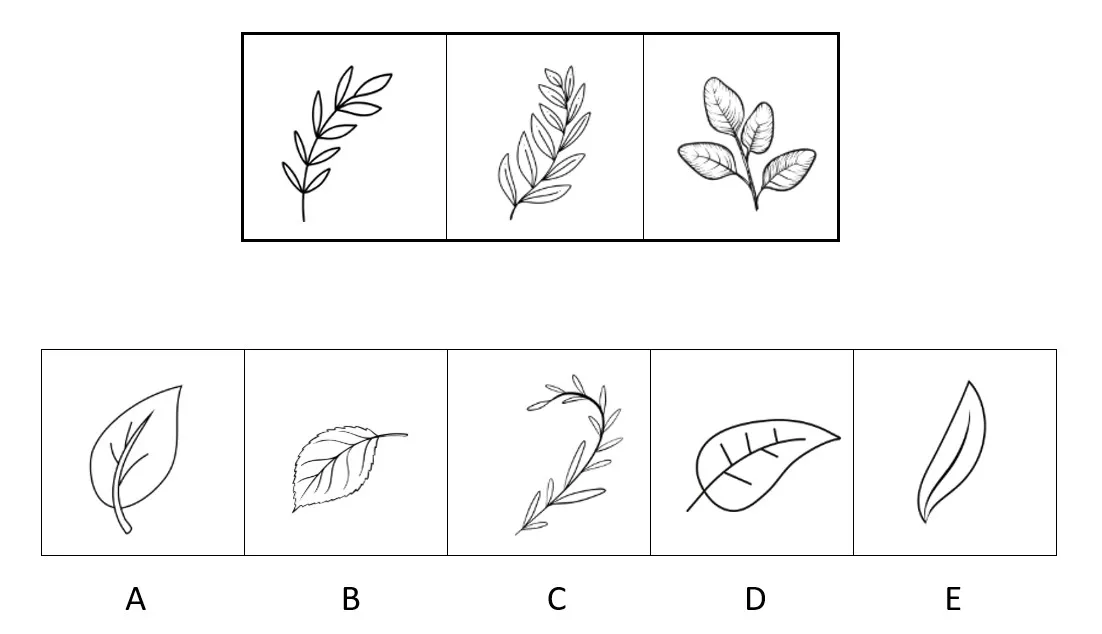
The Figures section is part of CAT4 Level X Part 1 and lasts 12 minutes — the longest single section in the test. Each question shows three figures that share a hidden rule. Your child must identify that rule and choose the option that follows it from five choices. No words or numbers are involved — it is a pure visual reasoning task, making it one of the most accessible sections for Year 2 children regardless of reading level. This section relates to Non-Verbal Reasoning in the broader CAT4 framework.
Figures · Figure Classification
Look at the three example figures. Find the hidden rule. Choose the option — A to E — that follows the same rule.
Figures · CAT4 Level X
Check one attribute at a time across all three example figures, name the rule, then find the option that keeps it.
Section
Figures
Skill tested
Spotting a shared visual rule
Difficulty
Easy
What to notice first
Look only at the three example figures first — ignore the options entirely. Each one shows more than one leaf growing from a single stem. That is the rule: multiple leaves, one stem. Now scan A to E for the option that also shows multiple leaves on one stem. That is option C.
Step 1
Look at the examples
All three figures show leaves attached to a stem. Focus on how many leaves each one has.
Step 2
Name the rule
Every example has multiple leaves on one shared stem — not a single leaf.
Step 3
Apply to the options
Only option C shows more than one leaf on a single stem. All others show one leaf only.
Core rule
In Figures questions, check one attribute at a time — count first, then connection, then shape. Ignore shading or size unless they change consistently across all three examples.
Model the pattern
Step 1 — Look at the three example figures
Cover the options with your hand and study only the examples. Ask: what do all three have in common? Each one shows leaves growing from a stem. Now ask: how many leaves? More than one — every time.
Step 2 — Name the rule clearly
Say it simply: multiple leaves on one stem. Naming the rule stops you from drifting toward options that look similar but do not follow it.
Step 3 — Test each option against the rule
Go through A to E. Ask: does this show more than one leaf on a single stem? Only option C passes. A, B, D, and E each show a single leaf — they break the rule immediately.
Option check
Eliminate
Shows a single leaf on a stem. The rule requires more than one — eliminate immediately.
Eliminate
Also shows a single leaf. Fails the leaf-count rule at the first check.
Correct
Shows multiple leaves on one stem — exactly matching the rule shared by all three example figures.
Eliminate
Single leaf only. Does not follow the multiple-leaves rule.
Eliminate
Single leaf only. Fails the same check as A, B, and D.
Use this checklist on every Figures question
- Cover the options and study only the three example figures first.
- Check one attribute at a time — count, then connection, then shape.
- Name the rule out loud or in your head before looking at options.
- Eliminate any option that breaks the rule, even slightly.
Reflection
This question rewards the child who looks at leaf count first. Once you see "multiple leaves on one stem," four of the five options disappear immediately — the answer becomes obvious.
Bridge forward
Children who look at the options before studying the examples often get distracted by similar-looking shapes. Always fix the rule from the examples first, then use it to judge each option.
Conclusion
The answer is C. All three example figures show multiple leaves growing from a single stem. Option C is the only choice that follows the same rule. A, B, D, and E each show a single leaf and are eliminated.
Numbers Sample Questions
The Numbers section is part of CAT4 Level X Part 2 and lasts 10 minutes. Each question shows a sequence of numbers that follow a hidden rule. Your child must identify the pattern — such as counting up, doubling, or alternating steps — and choose the next number in the sequence from five options. No words or shapes are involved — it is a pure numerical reasoning task, testing how well a Year 2 child can spot and extend simple number patterns. This section relates to Quantitative Reasoning in the broader CAT4 framework.
Numbers · Number Series
What is the next number in this series?
5 · 10 · 15 · 20 · 25 · ?
Numbers · CAT4 Level X
Check the jumps between numbers, name the rule, then apply it to find the next term.
Section
Numbers
Skill tested
Arithmetic sequences
Difficulty
Easy
What to notice first
Look at the gaps between each pair of numbers: 5 to 10 is +5, 10 to 15 is +5, 15 to 20 is +5, 20 to 25 is +5. The difference is the same every time — that means the rule is add 5. Apply it once more: 25 + 5 = 30.
Step 1
Check the jumps
5 → 10 → 15 → 20 → 25. Each jump is exactly +5. The difference is steady.
Step 2
Name the rule
Steady difference = arithmetic sequence. The rule is add 5 each time.
Step 3
Apply once more
25 + 5 = 30. The next number is 30.
Core rule
Always subtract each pair of neighbouring numbers to find the difference. If the difference is the same every time, just add it once more to the last number.
Model the pattern
Step 1 — Write out the differences
Write the series: 5, 10, 15, 20, 25. Under each gap write the difference: +5, +5, +5, +5. The pattern is immediately clear — it never changes.
Step 2 — Confirm the rule is steady
Every difference is +5 with no exception. A steady difference means the sequence is arithmetic — the simplest and most common pattern at Level X.
Step 3 — Apply to the last term
Take the last number in the series (25) and add the rule (+5). 25 + 5 = 30. Check option B — it matches.
Option check
Eliminate
28 — 25 + 3 = 28. The jump would be +3, not +5. Breaks the rule.
Correct
30 — 25 + 5 = 30. Follows the constant +5 rule exactly.
Eliminate
32 — 25 + 7 = 32. The jump would be +7, not +5. Breaks the rule.
Eliminate
35 — 25 + 10 = 35. Doubles the step. Breaks the rule.
Eliminate
40 — 25 + 15 = 40. Far too large a jump. Breaks the rule immediately.
Use this checklist on every Numbers question
- Write the difference between each pair of neighbouring numbers.
- If the difference is the same every time, add it once more to the last number.
- If the difference is not steady, move on to testing multiplication or division.
- Check your answer by verifying it fits the rule before selecting.
Reflection
This is a straightforward +5 sequence — one of the most common patterns at Level X. Children who spot the steady jump quickly will have plenty of time left for harder questions.
Bridge forward
Always write the differences rather than guessing. Even when the pattern looks obvious, confirming it stops careless errors under timed conditions.
Conclusion
The answer is B — 30. Each number in the series is 5 more than the previous one. 25 + 5 = 30. Every other option breaks the constant +5 rule.
Numbers · Number Series
What is the next number in this series?
2 · 4 · 8 · 16 · 32 · ?
Numbers · CAT4 Level X
Check the differences first. If they are not steady, test whether each term is being multiplied by the same number.
Section
Numbers
Skill tested
Geometric sequences
Difficulty
Medium
What to notice first
Check the differences: 2 to 4 is +2, 4 to 8 is +4, 8 to 16 is +8, 16 to 32 is +16. The differences are not steady — they keep doubling. That signals a multiplication rule, not addition. Test: is each number multiplied by 2? 2 × 2 = 4, 4 × 2 = 8, 8 × 2 = 16, 16 × 2 = 32. Yes — the rule is multiply by 2. Apply it once more: 32 × 2 = 64.
Step 1
Check the differences
+2, +4, +8, +16 — the gaps keep growing. Addition alone will not work here.
Step 2
Test multiplication
Each term is exactly double the one before it. The rule is multiply by 2.
Step 3
Apply once more
32 × 2 = 64. The next number is 64.
Core rule
When differences keep growing rather than staying the same, switch from addition to multiplication. Divide any term by the one before it — if the result is always the same number, that is your multiplier.
Model the pattern
Step 1 — Write the differences and notice they grow
2, 4, 8, 16, 32. Differences: +2, +4, +8, +16. Each difference is double the one before — that is a strong signal to test multiplication.
Step 2 — Divide each term by the previous one
4 ÷ 2 = 2. 8 ÷ 4 = 2. 16 ÷ 8 = 2. 32 ÷ 16 = 2. The result is always 2 — confirming the rule is × 2.
Step 3 — Apply to the last term
Multiply the last number (32) by 2: 32 × 2 = 64. Check option B — it matches exactly.
Option check
Eliminate
36 — 32 + 4 = 36. This adds only 4, not doubling. Breaks the ×2 rule.
Correct
64 — 32 × 2 = 64. Follows the doubling rule exactly across all five terms.
Eliminate
48 — 32 + 16 = 48. Adds 16 instead of multiplying. Breaks the rule.
Eliminate
72 — 32 + 40 = 72. No consistent rule produces this from 32.
Eliminate
96 — 32 × 3 = 96. Uses the wrong multiplier. The rule is ×2, not ×3.
Use this checklist on every Numbers question
- Always check the differences between terms first.
- If differences are steady, the rule is addition or subtraction.
- If differences keep growing, switch to testing multiplication.
- Divide any term by the one before it to confirm the multiplier.
Reflection
The key insight here is recognising that growing differences signal multiplication. Children who only look for addition rules will stall on this question — testing ×2 immediately unlocks it.
Bridge forward
Doubling sequences appear regularly in CAT4 Numbers questions. Recognising the pattern — 2, 4, 8, 16 — on sight saves time and reduces errors under pressure.
Conclusion
The answer is B — 64. Each term is multiplied by 2: 2, 4, 8, 16, 32, 64. Every other option either adds too little, adds too much, or uses the wrong multiplier.
Shapes Sample Questions
The Shapes section is part of CAT4 Level X Part 2 and lasts 11 minutes — the longest section in Part 2. Each question shows a set of example shapes that share a hidden rule based on attributes such as symmetry, edge count, orientation, or number of parts. Your child must identify the rule and choose the option — from five choices — that keeps all the same attributes. No words or numbers are involved — it is a pure spatial reasoning task, testing how well a Year 2 child can observe and apply visual rules about shape and structure. This section relates to Spatial Ability in the broader CAT4 framework.
Shapes · Spatial Patterns
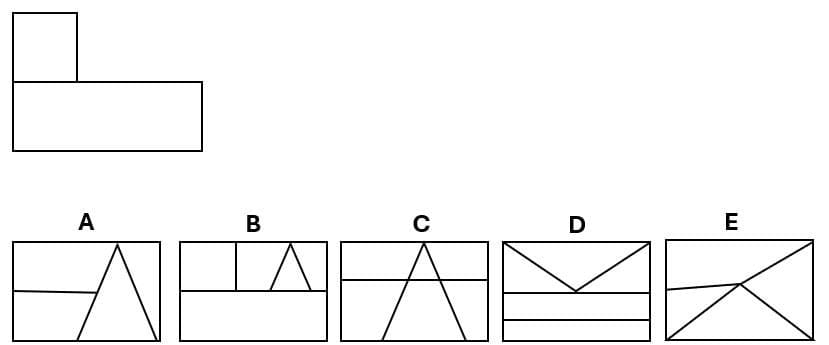
Study the example shape. Choose the option — A to E — that has the same structure.
Shapes · CAT4 Level X
Describe the example shape — note the position and size of each part — then find the option whose internal layout matches that arrangement.
Section
Shapes
Skill tested
Matching position and proportion
Difficulty
Medium
What to notice first
The example is a clean L-shape with no internal lines at all — just an outline. Study its layout: a small square sits in the upper-left, and a larger rectangle extends below and to the right. That arrangement — small element upper-left, larger element lower-right — is the rule to match. Now look at options A to E. Only option B mirrors this: a vertical line on the left creates a small rectangular section in the upper-left, with a larger triangular section filling the rest. The position and proportion match.
Step 1
Read the example
Clean L-shape outline, no internal lines. Small square upper-left, large rectangle lower-right.
Step 2
Name the rule
Small section on the upper-left, larger section extending to the right. Position is the key attribute.
Step 3
Find the match
Only B has a small rectangular section on the upper-left. A, C, D, and E all have different internal arrangements.
Core rule
When the example has no internal lines, the rule is about overall shape and proportion — not about what is drawn inside a rectangle. Focus on where the small part sits and where the large part extends.
Model the pattern
Step 1 — Describe the example in two facts
Fact 1: small square, upper-left. Fact 2: large rectangle, lower-right. No internal lines — just those two parts making an L. Write these two facts down mentally before looking at the options.
Step 2 — Check each option for a small section on the upper-left
Go through A to E and ask: does this option have a clearly defined small section in the upper-left corner? Most options fill the left side with large triangles, diagonal lines, or horizontal strips — none of those match. Only B places a small rectangular section on the left.
Step 3 — Confirm the proportion in option B
In option B, a vertical line close to the left edge creates a small rectangular section on the left, with a larger triangular section filling the right — matching the small-left, large-right proportion of the L-shape example. The answer is B.
Option check
Eliminate
A diagonal line and a horizontal line divide the rectangle — the large triangle sits on the right, not a small section on the left. Position is wrong.
Correct
A vertical line near the left edge creates a small rectangular section on the upper-left, with a triangle filling the larger right area — matching the small-left, large-right arrangement of the L-shape.
Eliminate
A symmetrical triangle is centred in the upper half with a horizontal line below. Nothing is positioned specifically on the left — the layout is centred and symmetrical, unlike the L-shape.
Eliminate
Multiple horizontal strips with diagonal lines creating an envelope-like pattern. No small left section — the diagonals run across the full width.
Eliminate
Two diagonal lines crossing the full rectangle in an X pattern. Symmetrical across both directions — no small section on the left at all.
Use this checklist on every Shapes question
- Describe the example in two facts: where is the small part, where is the large part?
- Note whether the example has internal lines or is just an outline — that changes what to look for.
- Check each option for the same position and proportion, not just a similar shape type.
- Eliminate options where the small section is missing or in the wrong position.
Reflection
The L-shape has no internal lines — so the rule is entirely about position and proportion. Children who look for internal line patterns will search the wrong thing entirely. The question is: where is the small part?
Bridge forward
When an example shape has no internal lines, always describe its overall layout first — small part where? Large part where? That single observation will point to the correct option faster than any other strategy.
Conclusion
The answer is B. The L-shape example shows a small section in the upper-left and a larger section extending right — no internal lines. Option B is the only choice that mirrors this arrangement, with a small rectangular section on the left and a larger triangular area to the right. Options A, C, D, and E all have different internal arrangements that do not match the position and proportion of the L-shape.
Get full access to 1,000+ CAT4 Level X practice questions with expert tips, mock exams, and step-by-step explanations.
Get Full PracticeDownload Your Free CAT4 Level X Sample Questions PDF
Prepare your child for the CAT4 Level X (Year 2) test with our free, printable sample questions PDF — designed to match the four sections of the real paper-based test.
- ✓ Realistic sample questions covering all four Level X sections: Words, Figures, Numbers, and Shapes
- ✓ Printable format — ideal for timed at-home practice on paper, just like the real test
- ✓ Free to download — no sign-up required
Tip: Print the PDF and have your child work through it under timed conditions — 43 minutes total, split across two parts — to build familiarity with the paper format before test day.
What is the Purpose of the Year 2 CAT Test?
The CAT4 Level X is not a curriculum test — it does not assess what your child has been taught in class. Developed by GL Assessment and standardised against 25,000 students, it measures how a child reasons and thinks across four areas: Words, Figures, Numbers, and Shapes. The goal is to reveal cognitive strengths and areas for development that standard classroom work and grades may not show.
At Year 2, schools use the results to build an early learning profile for each child. This helps teachers identify pupils who may benefit from extra support, those who need greater challenge, and students whose classroom performance does not yet reflect their underlying ability. Because the test measures reasoning rather than knowledge, it can surface potential that has not yet had the chance to show up in written work or reading assessments.
CAT4 Level X is not a pass or fail test and is not typically used for high-stakes school selection at Year 2. Results are reported as a Standard Age Score (SAS), a National Percentile Rank (NPR), and stanines — all benchmarked against children of the same age nationally. Schools use this data to inform teaching decisions, not to label children.
Strategies and Tips for the CAT4 Level X Test
Because Level X is paper-based and teacher-administered, most of the preparation happens at home before test day. These tips are written for parents of Year 2 children — not for the child to read alone.
- ✓ Keep practice sessions short. Ten to fifteen minutes at a time is enough for a 6–7 year old. Work through one section per session — Words one day, Figures the next — rather than all four at once.
- ✓ Practise on paper, not a screen. CAT4 Level X is one of the few CAT4 levels delivered on paper. Print the free Level X PDF so your child practises in the same format as the real test.
- ✓ Teach "look first, choose second." For Figures and Shapes, children who rush straight to the options often pick a wrong answer that looks familiar. Teach your child to study the example first, describe it in one sentence, then look at the options.
- ✓ Always attempt every question. There is no penalty for a wrong answer on CAT4. If your child is unsure, a best guess is always better than leaving a blank. Make sure they know this before test day.
- ✓ Remind your child to listen during the teacher's instructions. Each section starts with the teacher reading instructions and working through practice examples aloud. This is the most important moment — it tells the child exactly what to do.
- ✓ Keep it low pressure. CAT4 Level X is not high-stakes at Year 2. A good night's sleep and a normal breakfast matter more than last-minute cramming. If your child experiences broader test anxiety, YoungMinds has a practical parent guide worth reading.
Support
Spotted something that needs fixing?
If you notice an error, broken link, or unclear explanation, email us and we’ll review it.
What Do CAT4 Level X Scores Mean for Year 2?
CAT4 Level X results are reported using three standardised score types, developed by GL Assessment to measure reasoning ability consistently across the national cohort. Each one gives schools and parents a different angle on how a Year 2 child's cognitive abilities compare with pupils of the same age nationally. Because Level X assesses children at ages 6–7 — before formal academic tracking has begun — these scores are primarily used to build an early learning profile and identify children who may need additional support or greater challenge from the very start of primary school.
Standard Age Score (SAS)
The main score used to measure a child's performance against other children of exactly the same age. SAS scores run from 60 to 140, with 100 set as the national average and a standard deviation of 15. A score above 100 means the child performed better than the typical child of that age; below 100 means below average. On CAT4 Level X, the SAS is age-standardised specifically for Year 2 pupils, giving schools a reliable early baseline of cognitive reasoning ability at ages 6–7.
National Percentile Rank (NPR)
Expresses a child's result as a position within the national population. An NPR of 75, for example, means the child scored higher than 75 out of every 100 same-age pupils nationally. NPR values range from 1 to 99. For Year 2 CAT4 Level X results, the NPR is one of the clearest ways for parents to understand where their child's reasoning profile sits within the full national Year 2 cohort — without needing to interpret a precise standardised number.
Stanine
A nine-point performance band that maps directly from the NPR. Stanines run from 1 (Very Low) to 9 (Very High) and group pupils into broad, easy-to-read bands. They help parents and teachers get a clear at-a-glance picture of where a child sits without needing to interpret a precise number. In CAT4 Level X reports, stanines are particularly useful for communicating a Year 2 child's early reasoning strengths across the four sections in a format that is immediately actionable for classroom planning and early support.
Learn more about CAT4 scores and what they mean for Year 2 pupils →
What is a Good CAT4 Score in Year 2?
All CAT4 scores are centred on a national average of 100, standardised by GL Assessment against the full Year 2 cohort. Knowing which band your child's CAT4 Level X score falls into helps you understand their early reasoning profile in context — not as a verdict, but as a starting point. At Year 2, CAT4 Level X results are not used for high-stakes school selection; they are used to inform how your child is taught. Most Year 2 pupils score between 85 and 115. Scores above 120 are uncommon at this age and typically indicate a child whose reasoning development is running noticeably ahead of their peers.
Average (90–110)
Scores within this range are considered typical for a child's age. A score of exactly 100 is the national average; scores between 90 and 110 indicate reasoning ability broadly in line with same-age peers. For CAT4 Level X, this band represents the majority of the national Year 2 cohort and reflects solid, age-appropriate cognitive development at the start of primary school.
Above Average (111–119)
Scores in this range indicate reasoning ability above the national average for the child's age. Children scoring here are performing meaningfully better than most same-age peers, though not yet in the high-ability band. On CAT4 Level X, an above-average score in Year 2 is an encouraging early signal — one that schools may use to ensure the child is given appropriate stretch and challenge from the outset of their primary education.
High Ability (120–129)
Scores in the 120–129 range point to strong reasoning skills at an early age and are often seen in children who grasp new concepts quickly and show early curiosity across different types of problems. On the CAT4 Level X assessment, a score in this band places a Year 2 child in the top 10% nationally — a useful early indicator for schools planning enrichment provision in the early primary years.
Gifted and Talented (130+)
A score of 130 or above is typically classified as Gifted and Talented , reflecting exceptional reasoning ability compared with pupils of the same age across the country. On CAT4 Level X, a score of 130 or above places a Year 2 child in the top 2% of their national age group — an early signal worth noting for schools and parents planning the child's longer-term learning provision from the very beginning of primary school.
Get full access to 1,000+ CAT4 Level X practice questions with expert tips, mock exams, and step-by-step explanations.
Get Full PracticeCAT4 Level X — Frequently Asked Questions
What is CAT4 Level X?
CAT4 Level X is the Cognitive Abilities Test designed for children aged 6–7 in UK Year 2. Developed by GL Assessment, it measures reasoning ability across four sections — Words, Figures, Numbers, and Shapes — to help schools understand how a child thinks and learns at the start of primary school.
Who takes Level X and when in the school year?
Level X is taken by Year 2 pupils aged 6–7. Schools choose their own testing window, but GL Assessment recommends that the whole cohort is tested as close together as possible so that results can be fairly compared across the year group.
What does Level X assess?
Level X assesses four areas of reasoning through four age-appropriate sections: Words (verbal reasoning), Figures (non-verbal reasoning), Numbers (quantitative reasoning), and Shapes (spatial ability). The test measures how a child thinks and reasons — not what they have been taught in class.
How is the test structured?
Level X is divided into two parts with a total of 43 minutes of timed question time. Part 1 covers Figures (12 minutes) and Words (10 minutes). Part 2 covers Numbers (10 minutes) and Shapes (11 minutes). Each section begins with the teacher reading instructions and working through practice examples with the class before the timed questions begin.
Is Level X paper or online?
Level X is always administered on paper — there is no digital option at this level. Unlike CAT4 levels A to G, which can be delivered digitally via GL Assessment's Testwise platform, Level X uses paper booklets which are completed by the child and returned to GL Assessment for scoring.
What are CAT4 results used for at this age?
At Year 2, CAT4 Level X results are used to build an early learning profile for each child. Schools use the data to identify pupils who may benefit from additional support or greater challenge. The results are not typically used for high-stakes school selection at this age.
When will I receive my child's CAT4 Level X results?
Because Level X is paper-based, completed booklets must be returned to GL Assessment for scoring. According to GL Assessment's own documentation, report generation takes up to 15 working days from the date booklets are received. Once reports are ready, schools access them via their account and decide when and how to share them with parents — there is no fixed deadline for this step. Most schools share results within a few weeks of testing, either in a written report sent home or discussed at a parent meeting. If you have not heard anything after four to six weeks, it is reasonable to ask your child's class teacher.
How are CAT4 scores reported?
CAT4 Level X reports show three standardised score types: Standard Age Scores (SAS), National Percentile Ranks (NPR), and stanines. All three are benchmarked against same-age Year 2 peers nationally, giving schools and parents a clear picture of where a child's reasoning profile sits within the national cohort.
Can my child prepare for Level X?
GL Assessment officially advises against drilling for the CAT4, as the test is designed to measure reasoning ability rather than learned knowledge. That said, familiarity with the question formats — what Words, Figures, Numbers, and Shapes questions look like — can help reduce anxiety on test day. Short, calm sessions of 10 to 15 minutes using age-appropriate practice materials are a reasonable approach for most Year 2 children.
Can the test be split over different days?
The two parts are typically administered in one session or on the same day. GL Assessment recommends that the whole cohort is tested as close together as possible to ensure results are fairly comparable across the year group.