
CAT4 Level Pre-A (Year 3) Practice Test 2026: Free PDF, Sample Questions & Tips

Clear guide for Year 3 families with a free CAT4 Level Pre-A practice PDF, sample questions, and simple preparation tips.

  • Free CAT4 Level Pre-A practice PDF with sample questions and clear guidance
  • Understand the Pre-A format, timing, and all four CAT4 batteries
  • Learn how to prepare calmly with age-appropriate strategies for Year 3 children
  • No sign-up needed to access the free guide and downloadable PDF

Test at a Glance

37 minDuration
4 of 8Sub-tests
7–8Year group age
Paper / DigitalFormat

Who Takes This Test?

United KingdomAges 7–8
Year 3
GlobalAges 7–8
Grade 2
Free — no sign-up required · Updated for 2026 · Covers all 4 CAT4 batteries · Trusted by UK & international families

What to Expect in the CAT4 Level Pre-A Test

What Is CAT4 Level Pre-A?

CAT4 Level Pre-A is a cognitive ability assessment designed for Year 3 children (ages 7–8). It is part of the GL Assessment CAT4 test family, used widely by UK independent and grammar schools, as well as international schools in the UAE and beyond, to understand how children think and reason.

Unlike a curriculum test, CAT4 Level Pre-A does not assess what your child has learned in class. It assesses how your child thinks — how they spot patterns, make connections, and work through unfamiliar problems. Schools use the results to understand a child's reasoning strengths, identify areas where extra support may help, and in some cases as part of an admissions process.

Key point for parents

There is no school subject to revise for CAT4 Level Pre-A. The best preparation is helping your child feel comfortable with the puzzle-style formats before test day.

How Is CAT4 Level Pre-A Different from Other CAT4 Levels?

This is one of the questions parents ask most. CAT4 Level Pre-A is not simply an easier version of Level A — it is a structurally different test, built specifically for younger children.

Level Y Year 3 · UK only This level Level Pre-A Year 3 · UK & international Levels A–G Year 4 and above
Age range (norms)7:01 – 8:118:06 and above
Sub-tests4 of 88 of 8
Question types per battery12
Total timed time43 min~72 min
Verbal sectionWords (10 min)Verbal Classification + Verbal Analogies
Non-verbal sectionFigures (12 min)Figure Classification + Figure Matrices
Quantitative sectionNumbers (10 min)Number Analogies + Number Series
Spatial sectionShapes (11 min)Figure Analysis + Figure Recognition
Delivery formatPaper onlyPaper or digital
AvailabilityUK onlyUK & international

Note: Pre-A's norm range starts at age 6:06 — younger than Level Y's 7:01. Pre-A is not strictly a harder version of Level Y for the same age group; it spans a wider and slightly younger age band, and is the only Year 3 level available to international schools.

The most important difference for preparation purposes: Pre-A uses one question type per battery rather than two. This means the test is shorter and more focused, but each section still requires genuine reasoning — not guessing.

CAT4 Level Pre-A Test Structure and Timing

Batteries Verbal Non-Verbal Quantitative Spatial

Part 1 → Part 2

  1. Part 120 min
  2. Part 217 min

Part 1

Non-Verbal · Verbal

20 min
  • Figure Classification

    10 min · Non-Verbal Reasoning

    10:00
  • Verbal Classification

    10 min · Verbal Reasoning

    10:00

Part 2

Quantitative · Spatial

17 min
  • Number Series

    8 min · Quantitative Reasoning

    8:00
  • Figure Recognition

    9 min · Spatial Ability

    9:00

CAT4 Level Pre-A (Year 3): 4 batteries · 4 timed sub-tests · 2 parts totalling 37 minutes.

Timings exclude instructions, built-in practice examples, settling time, and breaks. Schools typically plan a longer session than the timed total suggests.

Source: GL Education Support — What happens on the day?

Free CAT4 Level Pre-A Sample Questions with Explanations

Each section below includes a sample question in the same format as the real CAT4 Level Pre-A test, followed by a full step-by-step explanation. Try the question before opening the explanation.

Verbal Classification

Children are shown a group of words that all belong together in some way, then asked to choose the word from the options that belongs to the same group. Categories at Pre-A level are age-appropriate and familiar — animals, foods, colours, vehicles, places.

How to practise at home

Encourage your child to say the connection out loud before choosing an answer — for example, "These are all fruits, so I need to find another fruit." Saying the category aloud is the single most effective habit to build for this question type.

Verbal Reasoning · Verbal Classification

dog, cat, rabbit

Verbal Classification · CAT4 Level Pre-A

Name the group first — then choose the answer that belongs inside it, not just near it.

Category-naming method — works on all Verbal Classification questions

Question type

Verbal Classification

Skill tested

Grouping words by shared category

Difficulty

Introductory

What to notice first

Dog, cat, and rabbit are all pets — animals that people keep at home. The correct answer must be another pet. It is not enough for an option to remind you of these animals or be connected to them in some way. The answer must itself be a pet.

Check 1

Name the shared category

Dog, cat, and rabbit are all animals kept at home as pets.

Check 2

Be strict about the category

Do not choose something connected to pets — such as what they eat, what they look like, or who looks after them. The answer must be a pet itself.

Check 3

Test each option directly

Ask: is this a pet, or is it an object, a property, a person, or a place?

Core rule

Choose the word that belongs inside the same group as dog, cat, and rabbit — not one that is merely associated with animals or pet care.

Model the pattern

1

Step 1 — Name the shared category

Read the three stem words together. Dog, cat, and rabbit are all common pets — animals that live with families at home.

2

Step 2 — Fix a short label

Say it simply: pets. Every correct answer must be an animal that people keep at home.

3

Step 3 — Check each option against the label

The right answer must be a pet — not something a pet eats, not a feature of a pet, not a person who cares for pets, and not a place where pets live.

Option check

A

Eliminate

Bone is something a dog chews — an object connected to pets, not a pet itself.

B

Correct

Hamster is a pet, just like dog, cat, and rabbit. It fits the shared category exactly.

C

Eliminate

Fur is a feature that these animals have — a property, not an animal.

D

Eliminate

Vet is a person who looks after animals — not an animal or a pet.

E

Eliminate

Garden is a place where some of these animals spend time — a location, not a pet.

Use this on every Verbal Classification question

  • Say the shared category of the stem words out loud in one short phrase.
  • Only choose an option that belongs inside that category — not one that is related to it.
  • Reject objects, properties, people, and places — even if they remind you of the stem words.

Reflection

This question tests category control. Bone, fur, vet, and garden all connect to pets in some way — but only hamster is itself a pet. Noticing that difference is exactly what Verbal Classification at Pre-A level is testing.

Bridge forward

On every Verbal Classification question, say the category name before looking at the options. That single step usually makes the correct answer clear and the wrong ones easy to dismiss.

Conclusion

The answer is B — hamster. Dog, cat, rabbit, and hamster are all pets. Every other option belongs to a different category: an object, a property, a person, or a place.

Number Series

Children are shown a short sequence of numbers with one number missing. The task is to find the rule — such as adding or subtracting the same number each step — and use it to work out the missing number. No advanced maths is required: the skill being tested is spotting the pattern, not calculating.

How to practise at home

Ask your child to say the rule out loud before choosing an answer — for example, "It goes up by 3 each time, so the missing number is 12." Finding the rule first, then applying it, is the habit that makes this section feel manageable under time pressure.

Quantitative Reasoning · Number Series

3 — 6 — 9 — ___ — 15

Number Series · CAT4 Level Pre-A

Find the rule first — then use it to work out the missing number. Do not guess from the options.

Gap-checking method — works on all Number Series questions

Question type

Number Series

Skill tested

Finding a fixed counting rule

Difficulty

Introductory

What to notice first

Look at the numbers you can see: 3, 6, 9 and then 15. The sequence is going up. Find the gap between the first two numbers — 6 − 3 = 3. Check the next gap — 9 − 6 = 3. The rule is: add 3 each time. Apply that rule to find the missing number: 9 + 3 = 12. Then confirm it: 15 − 12 = 3. ✓

Check 1

Find the gap between the first two numbers

6 − 3 = 3. The sequence goes up by 3.

Check 2

Confirm the gap holds

9 − 6 = 3. The same rule applies to every step.

Check 3

Apply the rule and verify

9 + 3 = 12. Check: 15 − 12 = 3. ✓ The rule holds across the whole sequence.

Core rule

Always confirm the gap works between every pair of numbers in the sequence — not just the first two. One check is not enough.

Model the pattern

1

Step 1 — Find the gap between the first two numbers

6 − 3 = 3. The sequence is going up by 3 each time. Say this out loud: "It adds 3 each step."

2

Step 2 — Confirm the rule holds for the next pair

9 − 6 = 3. The same gap appears again. The rule is confirmed: add 3 every step.

3

Step 3 — Calculate the missing number and verify

The number after 9 must be 9 + 3 = 12. Verify by checking the number after the gap: 12 + 3 = 15. ✓ The full sequence reads 3, 6, 9, 12, 15.

Option check

A

Eliminate

11 would mean adding 2 from 9. But the gap in this sequence is 3, not 2. The sequence would not reach 15.

B

Correct

12 is 9 + 3, and 12 + 3 = 15. The rule holds across the full sequence.

C

Eliminate

13 would mean adding 4 from 9. But 13 + 4 = 17, not 15. The sequence would break.

D

Eliminate

14 would mean adding 5 from 9. But 14 + 5 = 19, not 15. This breaks the rule.

E

Eliminate

15 is already the last number shown in the sequence. Repeating it would break the pattern entirely.

Use this on every Number Series question

  • Find the gap between the first two numbers and name the rule out loud.
  • Confirm the same gap appears between the next two numbers before using it.
  • Calculate the missing number using the rule, then verify it against the number on the other side of the gap.

Reflection

The four wrong options each represent a different error: adding 2, adding 4, adding 5, or simply repeating the last visible number. Every one of them breaks the rule when you check the full sequence.

Bridge forward

The verify step — checking the number on the other side of the gap — takes only a second and rules out every wrong answer. Build this habit early and it becomes automatic under time pressure.

Conclusion

The answer is B — 12. The sequence adds 3 each step: 3, 6, 9, 12, 15. Checking both sides of the gap — 9 + 3 = 12 and 12 + 3 = 15 — confirms the rule holds throughout.

Figure Classification

Figure Classification is the non-verbal reasoning question type at Level Pre-A. Children are shown a group of shapes or figures that all share a common visual rule, then must choose the option that belongs to the same group.

At Pre-A level, the rules are visually clear — common features include shape type, shading, size, direction, or number of elements. The key skill is looking at the group systematically rather than guessing from appearance alone.

How to practise at home

Encourage children to look for the simplest shared feature first — shape, colour, size, position, or direction. Saying the rule out loud ("They all have a smaller copy of themselves inside") helps a lot before choosing an answer.

Non-Verbal Reasoning · Figure Classification
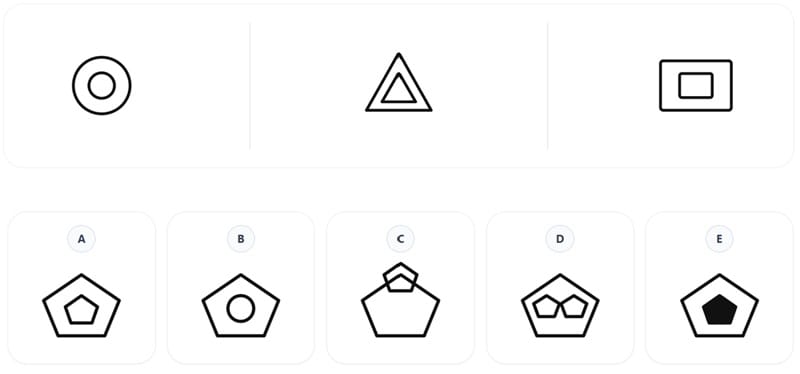
CAT4 Level Pre-A Figure Classification sample question. Group: a large circle with a smaller circle inside, a large triangle with a smaller triangle inside, a large rectangle with a smaller rectangle inside. Five answer options labelled A to E, each showing a large pentagon with a different inner shape or arrangement.
Look at the three shapes in the group. They all follow the same rule. Choose the option — A, B, C, D or E — that belongs to the same group.

Figure Classification · CAT4 Level Pre-A

Find the one rule that is true for all three group shapes — then choose the option that follows exactly the same rule.

Same-shape-inside method — works on all Figure Classification questions

Question type

Figure Classification

Skill tested

Matching shape families

Difficulty

Introductory

What to notice first

Look at the three group shapes one at a time. The large circle has a smaller circle inside it. The large triangle has a smaller triangle inside it. The large rectangle has a smaller rectangle inside it. In every case, the shape inside is a smaller outline copy of the shape outside — centred, and matching exactly. That is the rule: each large shape contains one smaller outline copy of itself.

Check 1

Does the inner shape match the outer?

Circle inside circle. Triangle inside triangle. Rectangle inside rectangle. Yes — same shape family every time.

Check 2

Is there exactly one inner shape?

Yes — one smaller shape inside each large shape. Not two, not zero.

Check 3

Is the inner shape outline only?

Yes — all inner shapes are outline, not filled solid. The fill matters.

Core rule

Each large shape contains one smaller outline copy of itself, centred inside. The inner shape must match the outer shape exactly — same family, outline only, one copy.

Model the pattern

1

Step 1 — Name the rule in one sentence

Look at all three group shapes and ask: what is true for every single one? "Each shape has a smaller copy of itself inside." That sentence is your rule.

2

Step 2 — Note the details of the rule

The inner shape matches the outer shape. There is only one inner shape. The inner shape is outline — not filled solid. All three details must be present in the correct answer.

3

Step 3 — Test each option against the rule

The answer options all show a large pentagon. Ask for each one: does the inner shape match the outer pentagon, is there exactly one, and is it outline only?

Option check

A

Correct

One smaller outline pentagon inside a larger pentagon. The inner shape matches the outer, there is one copy, and it is outline only. All three parts of the rule are satisfied.

B

Eliminate

The inner shape is a circle, not a pentagon. The rule requires the inner shape to match the outer shape. A circle inside a pentagon breaks the rule.

C

Eliminate

The smaller pentagon is outside the larger one, not inside it. The rule requires the smaller copy to sit inside the large shape.

D

Eliminate

There are two smaller pentagons inside, not one. The rule uses exactly one inner copy in every group shape.

E

Eliminate

The inner pentagon is filled solid black. Every inner shape in the group is outline only. A filled shape breaks that part of the rule.

Use this on every Figure Classification question

  • Look at all three group shapes before checking the options — find the one rule that is true for every single one.
  • State the rule clearly: shape, number, and fill all count.
  • Test each option against every part of the rule — not just the most obvious one.

Reflection

Each wrong option breaks a different part of the rule — wrong shape (B), wrong position (C), wrong count (D), wrong fill (E). This means a child who has understood the full rule will eliminate all four confidently, not just guess between two.

Bridge forward

On every Figure Classification question, check shape, number, and fill before choosing. These three features cover the most common rules at Pre-A level and above.

Conclusion

The answer is A. It shows one smaller outline pentagon centred inside a larger pentagon — exactly matching the rule: each large shape contains one smaller outline copy of itself.

Figure Recognition

Figure Recognition is the spatial reasoning question type at Level Pre-A. Children are shown a target shape and must identify the same shape from five options — even when it appears rotated, reflected, or placed within a more complex image. The core skill is careful observation: looking at outline, size, and orientation systematically rather than reacting to the first option that looks familiar.

How to practise at home

Before looking at the options, encourage your child to notice two things about the target shape: what it looks like, and which direction it faces. Those two observations are usually enough to find the correct answer and eliminate all four wrong ones.

Spatial Ability · Figure Recognition · Challenge
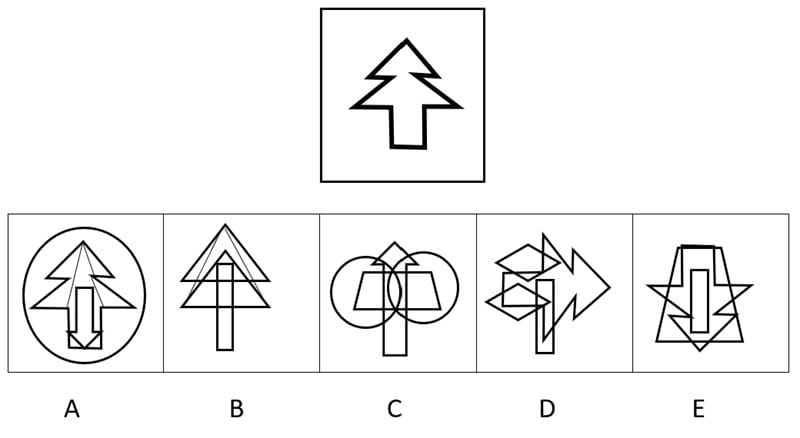
CAT4 Level Pre-A Figure Recognition challenge question. Target shape: a pine tree outline sitting on top of a hollow upward-pointing arrow, shown in a bordered box. Five answer options labelled A to E: A shows the same tree-arrow shape inside an oval with additional overlapping lines; B shows a tree-cross arrangement; C shows two overlapping circles with a trapezoid shape; D shows the shape rotated to point right within a larger arrow; E shows the shape inverted inside a star outline.
Study the shape in the box carefully — its outline and direction. Choose the option — A, B, C, D or E — that shows the same shape facing the same direction.

Figure Recognition · CAT4 Level Pre-A · Challenge

Study the target shape carefully before looking at the options — its outline and direction are the only two things that matter.

Direction-first method — works on all Figure Recognition questions

Question type

Figure Recognition

Skill tested

Identifying a shape by outline and orientation

Difficulty

Challenge — harder than typical Pre-A

What to notice first

The target shape is a pine tree outline sitting on top of a hollow upward-pointing arrow. The tree points upward. The arrow points upward. The shape is not rotated or reflected. That is all you need to hold in your head: tree on top, arrow pointing up. Now look for exactly that in the five options — ignoring any extra lines or backgrounds around it.

Check 1

What is the shape?

A pine tree outline on top of a hollow upward arrow. One combined shape.

Check 2

Which direction does it face?

Upward — both the tree point and the arrow stem point up. It is not rotated or flipped.

Check 3

Find it in the options

Look past any surrounding shapes or extra lines. Find the option where the tree-arrow points upward and the outline matches.

Core rule

The correct answer shows the same shape in the same direction as the target. Extra lines or a surrounding shape in the option do not change the answer — focus only on whether the target outline is present and facing the same way.

Model the pattern

1

Step 1 — Describe the target shape in one sentence

Say it out loud: "It is a pine tree on top of an upward arrow, and it is not turned or flipped." That sentence is your only checklist.

2

Step 2 — Eliminate options where the direction is wrong

Any option where the arrow points right, left, or down is immediately wrong — eliminate it without looking further.

3

Step 3 — Check the outline of what remains

For any option still in play, look past surrounding shapes and check whether the target outline — tree on top, hollow arrow below — is present and intact.

Option check
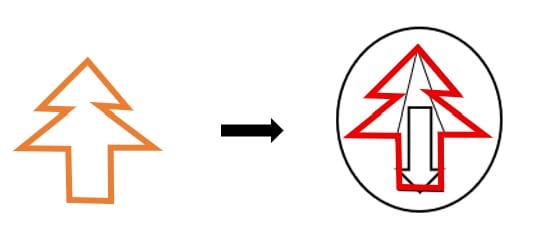
Step-by-step visual explanation showing the pine tree arrow shape highlighted in red within answer option A, confirming it matches the target shape in direction and outline.
The target shape highlighted within option A — same outline, same upward direction.
A

Correct

The tree-arrow shape is present inside the oval, pointing upward, with the same outline as the target. The oval is extra — ignore it. The shape itself matches exactly.

B

Eliminate

The arrow stem has been replaced by a cross shape. The outline no longer matches the target — this is a different figure.

C

Eliminate

The shape is entirely different — two overlapping circles with a trapezoid form. No tree, no arrow. Does not match the target at all.

D

Eliminate

The shape has been rotated to point right. The target always faces upward. A rightward rotation breaks the direction rule immediately.

E

Eliminate

The arrow is pointing downward inside a star shape. The direction is inverted — the target always points upward.

Use this on every Figure Recognition question

  • Describe the target shape and its direction before looking at the options.
  • Eliminate any option where the direction is wrong — this removes most wrong answers immediately.
  • For remaining options, check whether the outline matches — ignoring any extra lines or surrounding shapes.

Reflection

This is a harder Figure Recognition question than you would typically see at Pre-A level — the correct answer (A) is surrounded by an oval and extra overlapping lines, which makes it harder to spot. At Pre-A level, the correct shape usually appears more clearly. The same method applies regardless of difficulty: direction first, then outline.

Bridge forward

The direction-first habit is the most transferable skill in Figure Recognition. Students who check direction before anything else eliminate two or three wrong options before they have to look closely at a single one.

Conclusion

The answer is A. It is the only option that shows the pine tree outline on top of an upward-pointing arrow — the same shape, the same direction as the target. The oval surrounding it in option A is extra context that does not change the shape itself.

Get full access to 1,000+ CAT4 Level Pre-A practice questions with expert tips, mock exams, and step-by-step explanations.

Get Full Practice

What Do CAT4 Level Pre-A Scores Mean for Year 3?

CAT4 Level Pre-A results are reported using the same three standardised score types used across all CAT4 levels from Pre-A to G — Standard Age Score (SAS), National Percentile Rank (NPR), and Stanines. Each score gives schools and parents a different angle on how a Year 3 child's reasoning compares with pupils of the same age nationally. At Pre-A, these scores are best understood as an early diagnostic profile — a picture of how a child thinks at age 7–8 — rather than a fixed measure of long-term ability.

Standard Age Score (SAS)

The primary score used to compare a child's performance against other children of exactly the same age, measured in years and months. SAS scores have a national average of 100 and a standard deviation of 15. At Pre-A level, the SAS range runs up to 141 — the same ceiling as Levels A–G, higher than the 131 ceiling for Levels X and Y. A score above 100 means the child performed better than the typical child of that age; below 100 means below average. Because scores at age 7–8 are naturally more variable than at older ages, the SAS at Pre-A is most useful as a starting point rather than a definitive label.

National Percentile Rank (NPR)

Shows where a child's result sits within the national population of same-age pupils. An NPR of 60, for example, means the child scored higher than 60 out of every 100 same-age pupils nationally. NPR values run from 1 to 99, with 50 representing the national average. For Pre-A results, the NPR is often the clearest number for parents to interpret — it answers the question "where does my child sit compared with others their age?" without requiring knowledge of standardised scales.

Stanine

A nine-point band that maps directly from the SAS, running from 1 (Very Low) to 9 (Very High), with stanines 4–6 representing the average range. Stanines are particularly useful at Pre-A level because they give an at-a-glance view of a child's reasoning profile across all four batteries without encouraging over-interpretation of small score differences. A one-stanine difference between batteries is generally not significant; a gap of two or more is worth noting.

Important for parents

CAT4 Level Pre-A scores reflect reasoning at a single point in time, aged 7–8. At this age, scores are more sensitive to test-day factors — tiredness, nerves, unfamiliarity with the format — than at older levels. The most useful outcome is the profile across all four batteries, not any single number. Always discuss results with your child's teacher before drawing conclusions.

Learn more about CAT4 scores and what they mean →

What Is a Good CAT4 Score at Pre-A Level?

All CAT4 scores are centred on a national average of 100. At Pre-A level, most Year 3 children score within the broadly average range. Because this is one of the earliest points at which children receive a standardised reasoning profile, scores should be read as a baseline for understanding how a child learns — not as a ceiling on what they can achieve.

Average (90–110)

Scores within this range indicate reasoning ability broadly in line with same-age peers nationally. A score of exactly 100 is the national average. For most Year 3 children sitting Pre-A, this band represents solid, age-appropriate cognitive development. The majority of children who sit CAT4 Level Pre-A score within or close to this range.

Above Average (111–119)

Scores in this range indicate reasoning ability meaningfully above the national average for the child's age. At Pre-A level, an above-average score is an encouraging early signal — but at age 7–8, it is more useful as a prompt to provide appropriately stretching activities than as a firm ability classification.

High Ability (120–129)

Scores in the 120–129 range indicate strong reasoning skills for the child's age and place a Year 3 child in approximately the top 10% nationally. At Pre-A, a score in this band is a notable early indicator — but should always be considered alongside classroom performance and teacher observation, as test-day variability is highest at this age.

Very High Ability (130+)

A score of 130 or above places a Year 3 child in the top 2–3% of their national age group and is a strong early signal of advanced reasoning development. At Pre-A level, scores in this range may prompt schools to consider enrichment or early identification for able learners — though, as with all Pre-A results, they should be interpreted alongside other evidence and not treated as fixed.

Five Essential Tips to Prepare for CAT4 Level Pre-A

The most effective preparation for CAT4 Level Pre-A is not intensive revision — it is building calm familiarity with the puzzle formats before test day. These five habits make the biggest difference for Year 3 children.

  1. Keep sessions short and regular

    Children aged 7–8 make more progress with 10–15 minutes of calm, focused practice three or four times a week than with one long session before the test. Short sessions build the habit without creating anxiety around it.

  2. Make pattern-spotting a daily habit

    Simple games at home build the reasoning skills CAT4 tests directly: spot-the-difference books, shape sorting, card sequences, category games ("name three things that are all..."). These feel like play but practise exactly what all four Pre-A sections require.

  3. Ask your child to explain their thinking

    If a child can say why an answer fits — "I chose that one because they're all animals" — they are building exactly the reasoning skill the test measures. At this age, the process behind an answer matters more than whether the answer is correct.

  4. Use practice formats that match the real test

    Familiarity with the format is one of the most reliable ways to reduce test-day nerves. Working through sample questions, online quizzes, and printable PDFs that match the Pre-A style means the test itself feels far less unfamiliar when the day comes.

  5. Never frame it as a memorisation test

    CAT4 Level Pre-A tests how a child thinks, not what they have learned in class. There is nothing to memorise or revise. The best preparation is helping your child feel confident and familiar with the puzzle types — not learning content.

Support

Spotted something that needs fixing?

If you notice an error, broken link, or unclear explanation, email us and we'll review it.

CAT4 Level Pre-A — Frequently Asked Questions

What is CAT4 Level Pre-A, and who is it for?

CAT4 Level Pre-A is a cognitive ability assessment designed for children in Year 3, typically aged 7–8. It is one of the earlier levels in the CAT4 test family — which runs from Level X (Year 2) to Level G (Year 11–12) — and uses shorter, simpler puzzle-style tasks than the standard levels. Schools use it to understand how younger children reason across four areas: verbal, non-verbal, quantitative, and spatial. It is not a revision test and does not require any specific school knowledge. Results provide a profile of how a child thinks, highlighting natural strengths and areas where support may be beneficial.

What kinds of questions appear in CAT4 Level Pre-A?

CAT4 Level Pre-A contains four question types — one for each reasoning battery:

  • Verbal Classification — grouping words and identifying what belongs together.
  • Number Series — finding the rule in a short number sequence and identifying the missing number.
  • Figure Classification — spotting the shared visual rule in a group of shapes or figures.
  • Figure Recognition — identifying a target shape accurately, even when it has been rotated or presented differently.

Each section uses age-appropriate content and begins with built-in practice examples before the timed questions start.

How is CAT4 Level Pre-A different from Level A?

The key difference is structure. CAT4 Level Pre-A has four sections — one per battery — while Level A (and all levels from A to G) has eight sections, with two question types per battery. Pre-A also has shorter timed sections (8–10 minutes each, totalling around 37 minutes) compared to the longer A–G format (approximately 72 minutes total). The question types at Pre-A are also simpler in scope: for example, the non-verbal battery at Pre-A covers Figure Classification only, while Level A adds Figure Matrices.

How long does CAT4 Level Pre-A take on the day?

The timed testing time is approximately 37 minutes across four sections. Schools typically deliver it in two parts with a break between them. Allow additional time for settling children in, working through the built-in practice examples at the start of each section, and any administrative steps on the day. The total time in the room is usually longer than 37 minutes.

Should we practise for CAT4 Level Pre-A, or let it happen naturally?

A modest amount of practice is genuinely helpful at this age — not to train for a score, but to make the formats feel familiar before the test. Children who have seen the puzzle types before are significantly less anxious on the day, which directly affects how well they can demonstrate their natural ability. Even three or four short preparation sessions can make the experience feel much less daunting. The goal is format familiarity and calm confidence, not intensive preparation.

My child struggles with the verbal word questions — what should we do?

For Verbal Classification at Pre-A level, almost every question comes down to identifying a basic category: animals, foods, places, colours, vehicles, and so on. The most effective home practice is conversational — play simple category games, discuss word connections out loud, and encourage your child to name the group before choosing an answer. If they encounter an unfamiliar word in the options, they can usually still find the right answer by identifying what the group words have in common and checking which option fits that category, even without knowing every word individually.

How can we make Number Series practice less stressful for a seven-year-old?

Treat it as a pattern game rather than a maths exercise. The question to ask is always "What is the rule?" — not "What is the answer?" Practical approaches that work well at this age include using physical objects (blocks, cards, coins) to build the sequence visually, asking your child to say the rule out loud ("It goes up by 2 each time"), and playing short sequencing games rather than sitting at a worksheet. At Pre-A level, the patterns are simple by design. If your child is spending a long time calculating, they are likely overcomplicating it — bring them back to spotting the rule first.

What if my child gets anxious about timed questions?

Confidence is as important as ability at this age. The most effective approach is keeping practice sessions short — around 10 minutes — so they feel achievable rather than pressured. Praise the process rather than the score: commenting on how your child checked the pattern, or noticed what the shapes had in common, reinforces the right habits more effectively than focusing on how many they got right. One practical habit that helps on the day: if a question feels very hard, choose the best-available answer and move on rather than sitting with it. Practising this during preparation sessions means it comes naturally during the test.