
How is CAT4 used in UAE schools?
CAT4 is the Cognitive Abilities Test, Fourth Edition — a standardised reasoning assessment made by GL Assessment. In the UAE it is the most widely used reasoning assessment across British-curriculum and IB international schools, and student progress in KHDA-rated Dubai schools is routinely benchmarked against it. In short: if your child is applying to a British or IB school in the UAE at Year 3 or above, expect CAT4 to be part of the process.
Unlike the UK, where CAT4 is mostly an internal tracking tool used after a child has joined, UAE schools lean on it as an admissions instrument — a curriculum-neutral way to judge academic fit before offering a place. At oversubscribed Dubai schools, the CAT4 profile can be the difference between an offer, a waiting-list place, or a polite redirection. Across the Emirates, it serves three purposes:
- Admissions decisions. Particularly from Year 3 onwards. The most competitive entry point is Year 7, where CAT4 Level D is the standard reasoning assessment at nearly all British-curriculum secondary schools in Dubai.
- Scholarship eligibility. Some scholarship programmes set an explicit CAT4 threshold. The clearest published example is the ACES programme at Raffles International School and Collegiate International School, which requires a CAT4 mean score of 130 or higher (details in the score table below).
- Progress tracking and value-added reporting. Schools compare GCSE and IGCSE outcomes against each student's earlier CAT4 indicators. "Grades above CAT4 targets" has become a standard measure of school effectiveness in the UAE, and several schools publish it openly.
When is CAT4 used? Assessment by year group
Entry assessment in UAE international schools follows a recognisable pattern that scales with age. The table below reflects the process published by schools such as Kent College Dubai, JESS and Nord Anglia, and the standard Abu Dhabi admissions workflow under ADEK.
| Stage | How schools typically assess | CAT4 involved? |
|---|---|---|
| FS1 – Year 1 | Stay-and-play style observation and a teacher-led readiness check | No |
| Year 2 | Short literacy and numeracy tasks; a minority of schools baseline with CAT4 Level X | Occasionally |
| Years 3 – 6 | A computerised CAT4 sitting (roughly 60–90 minutes at most schools) plus a writing sample; some schools add a reading check or use InCAS instead | Yes — Levels Pre-A to C |
| Years 7 – 9 | CAT4 alongside the school's own English and Maths papers; an interview at selective schools | Yes — Levels D and E |
| Years 10 – 11 | Predicted GCSE/IGCSE grades and a subject interview; CAT4 is sometimes added for baselining | Sometimes |
| Sixth Form | Predicted grades and a subject-specific interview; CAT4 may sit in the admissions file | Sometimes |
Pattern compiled from published admissions pages (Kent College Dubai, JESS, Nord Anglia Dubai) and Abu Dhabi admissions guidance. Individual schools vary — always confirm the exact assessment with the registrar.
Year 7 is the main competitive entry point. Most British-curriculum secondary schools in the UAE use CAT4 Level D (designed for ages 11–12) as the core reasoning assessment for Year 7, with assessment windows typically running November to March for the following August intake.
Which UAE schools use CAT4?
The schools below are listed in two tiers — the same standard we use on our CAT4 in the USA page. Schools we have checked against a published admissions, scholarship or results page are marked Confirmed; schools where CAT4 is the usual assessment for their network or emirate — but which we have not yet individually confirmed — are marked Likely, so you can see where to look while knowing what still needs checking.
Confirmed — checked against published admissions information
JESS (Jumeirah English Speaking School) Arabian Ranches & Jumeirah, Dubai Confirmed
British + IB Diploma, KHDA Outstanding. CAT4 forms part of entry assessment (particularly from Year 4 upwards) and mid-year transfers. JESS describes itself as a non-selective school — entry runs on debentures and heavily oversubscribed waiting lists rather than a published cut-off score, so a balanced CAT4 profile strengthens an application where places are limited. Personal Year 7 applications open roughly two years ahead.
Source checked July 2026 — admissions page.
Dubai College Al Sufouh, Dubai Confirmed
British (GCSE, A Level), KHDA Outstanding. Existing CAT4 scores are requested as part of the admissions file, and the College runs its own online adaptive entrance assessment covering English, Maths and non-verbal reasoning — similar in style to CAT4 and GL Progress tests. Year 7 entrance assessments for August 2026 were held in November 2025. Note that Dubai College openly advises against tutoring: its guidance is that families who feel tutoring is essential "may wish to question whether this would be the right school" for their child.
Source checked July 2026 — admissions page.
Kings' School Al Barsha Al Barsha, Dubai Confirmed
British, Kings' Education group. CAT4 is used in admissions alongside English, Maths and interview, and reasoning data supports scholarship profiles. Kings' offers GCSE and Sixth Form scholarships of up to 50% of fees; the currently published academic criteria for Sixth Form are grade-based — a minimum of eight GCSEs at Grade 8+, including at least three at Grade 9.
Source checked July 2026 — scholarships page.
Nord Anglia International School Dubai Al Barsha, Dubai Confirmed
English National Curriculum + IGCSE + A Level, KHDA Outstanding. CAT4 is used for admissions from Year 5 upwards — Years 5–6 sit online CAT4 with reading and writing samples; Years 7–8 sit CAT4 plus English and Maths papers. Part of the Nord Anglia global network, with a STEAM partnership with MIT and a performing arts programme linked to Juilliard.
Source checked July 2026 — entry requirements.
Repton School Dubai Nad Al Sheba, Dubai Confirmed
British + IB Diploma + IBCP + A Levels, KHDA Outstanding. CAT4 is used for admissions from Year 3 to Year 12 as part of its computer-based assessment, with Level D for Year 7 entry; applications typically open September–October, with sittings running November to March. One of the largest British schools in the Middle East, with a strong record of Oxbridge, Russell Group and top US university acceptances.
Source checked July 2026 — admissions page.
Brighton College Dubai Al Barsha, Dubai Confirmed
British. CAT4 provides the reasoning component of the admissions assessment, sat alongside English and Maths papers.
Source checked July 2026 — admissions page.
Dubai British School Jumeirah Park Jumeirah Park, Dubai Confirmed
British (Taaleem group), KHDA Outstanding. CAT4 is used for Year 7+ admissions and progress tracking — the school reports students exceeding CAT4-predicted grades by an average of more than one grade at GCSE.
Source checked July 2026 — school website.
Dubai British School Emirates Hills Emirates Hills, Dubai Confirmed
British (Taaleem group), KHDA Outstanding. CAT4 is used for admissions and internal benchmarking.
Source checked July 2026 — school website.
Safa British School Al Safa, Dubai Confirmed
British, FS1–Year 13. CAT4 sets each student's GCSE "flightpath" target and anchors the school's value-added reporting. In 2025, 82% of all GCSE grades came in above CAT-predicted levels, with students averaging 1.8 grades above their CAT4 baselines (the first cohort in 2024 averaged +1.9).
Source checked July 2026 — GCSE results page.
Dubai International Academy Al Barsha Al Barsha, Dubai Confirmed
IB (PYP, MYP, DP). CAT4 provides the reasoning element of admissions, alongside English and Maths, for IB pathway entry.
Source checked July 2026 — school website.
GEMS Wellington International School Al Sufouh, Dubai Confirmed
British National Curriculum + IB Diploma. CAT4 is used for admissions and benchmarking. One of Dubai's longest unbroken runs of KHDA Outstanding ratings.
Source checked July 2026 — school website.
Hartland International School Sobha Hartland, Dubai Confirmed
British. CAT4 (or an equivalent reasoning test) is used for Year 7+ admissions.
Source checked July 2026 — admissions page.
Kent College Dubai Nad Al Sheba, Dubai Confirmed
British (Kent College Canterbury family). CAT4 is used for admissions from Year 3 — Years 3–6 sit a computerised CAT4 of roughly 60–90 minutes plus a writing sample, and secondary applicants add an interview with senior leadership. Senior school scholarships (Academic, Arabic, Arts, Sporting) offer up to 50% off KHDA-approved fees for two years, judged on criteria including critical thinking, attendance and contribution.
Source checked July 2026 — fees & scholarships page.
Raffles International School Umm Suqeim, Dubai Confirmed
British (Innoventures Education). CAT4 is used in admissions and anchors the ACES scholarship programme (Academic and Co-Curricular Excellence Scholarship, Year 5 to Year 13): eligibility requires a CAT4 mean score of 130 or higher plus a minimum of 98% attendance over the past two academic years, for up to 20% off KHDA-approved fees.
Source checked July 2026 — published ACES criteria.
Collegiate International School Umm Suqeim, Dubai Confirmed
Innoventures Education. CAT4 is used in admissions and the same ACES scholarship programme as sister school Raffles — CAT4 mean of 130+, 98% attendance over two years, up to 20% off fees (Grades 4–12).
Source checked July 2026 — published ACES criteria.
British International School Abu Dhabi Zayed Sports City, Abu Dhabi Confirmed
British (Nord Anglia network). CAT4 is used for admissions and student profiling, following the same Nord Anglia assessment approach as NAS Dubai.
Source checked July 2026 — school website.
Cranleigh Abu Dhabi Saadiyat Island, Abu Dhabi Confirmed
British (IGCSE, A Level), ADEK Outstanding. Applicants entering Year 3 and above sit a reasoning and English assessment — typically CAT4 or the school's own written and oral test. Year 7 and Year 12 are the most competitive entry points, and application windows open only briefly due to demand.
Source checked July 2026 — Abu Dhabi admissions guide.
GEMS Cambridge International Private School Sharjah Confirmed
British / Cambridge. CAT4 is used in admissions. The school reported 45% of IGCSE entries graded 9–8 (A*) in 2024.
Source checked July 2026 — school website.
Likely — network or emirate pattern (confirm before preparing)
The schools below either belong to a group whose sister campuses confirm CAT4, or follow the standard Abu Dhabi assessment pattern (reasoning test plus English and Maths from primary upwards) without publishing which reasoning test they administer. Treat these as likely rather than verified — and check directly with admissions before preparing.
| School | Location | Group / curriculum | Status |
|---|---|---|---|
| The British School Al Khubairat (BSAK) | Al Mushrif, Abu Dhabi | British · ADEK + BSO Outstanding | Likely |
| Repton School Abu Dhabi | Reem Island, Abu Dhabi | British (Repton family — Dubai campus confirms CAT4) | Likely |
| Brighton College Abu Dhabi | Al Reem area, Abu Dhabi | British (Brighton family — Dubai campus confirms CAT4) | Likely |
This is not an exhaustive list — many other British and IB schools across the UAE use CAT4. School details are checked against published admissions pages, inspection reports and reported exam results. Know a UAE school that belongs here? Email us and we'll verify and add it.
What CAT4 score is competitive in the UAE?
There is no official pass mark for CAT4 — each school sets its own expectations and most do not publish cut-offs. Based on published admissions guidance, published scholarship criteria and the benchmarks used by UAE tutoring providers, these ranges are widely referenced:
| Context | Indicative SAS range | What it means |
|---|---|---|
| Dubai premium schools | SAS 115+ | JESS, Dubai College, Kings', Repton — heavily oversubscribed; a strong, balanced profile across all four batteries is expected |
| Dubai mid-tier British schools | SAS 105–115 | Competitive but more accessible |
| Abu Dhabi international schools | SAS 110+ | Strong expectations, slightly less oversubscribed than top Dubai schools |
| Sharjah competitive schools | SAS 108+ | Growing demand |
| ACES academic scholarships | SAS 130+ mean | Raffles & Collegiate — roughly the top 2% of the norm group, plus a minimum 98% attendance over two academic years |
Ranges reflect published criteria and commonly cited UAE tutoring benchmarks, not official school policy. Only the ACES scholarship figure is a formally published threshold.
See where your child stands before test day
Start with free level-matched sample questions across all four batteries — then move to full timed practice tests when you're ready.
Year group to CAT4 level: which test does my child take?
UAE international schools follow the British year-group system, and CAT4 levels are designed to match age groups. The table below shows the standard mapping used internationally.
| UAE year group | Typical age | Recommended CAT4 level | Key entry point? |
|---|---|---|---|
| Year 2 | 6–7 | Level X | — |
| Year 3 | 7–8 | Level Pre-A (UK schools: Level Y) | — |
| Year 4 | 8–9 | Level A | — |
| Year 5 | 9–10 | Level B | — |
| Year 6 | 10–11 | Level C (Level D when sitting early for Year 7 entry) | Some schools |
| Year 7 | 11–12 | Level D | Main entry point |
| Year 8 | 12–13 | Level E | Mid-year transfers |
| Year 9 | 13–14 | Level F | — |
| Year 10 | 14–15 | Level F | GCSE entry |
| Year 11 | 15–16 | Level F or G | — |
| Year 12–13 | 16–17+ | Level G | Sixth Form entry |
Source: GL Education — choosing a test type and level (international recommended year groups). CAT4 levels have overlapping age norms, and Level Y is a UK-only, paper-based level that is not available in the UAE — internationally, Year 3 sits Level Pre-A. A selective school may occasionally test one level above the age-standard version. If in doubt, age is the primary factor.
Not sure which level fits your child's age? See the full CAT4 Levels Guide.
How CAT4 compares to other tests used in UAE schools
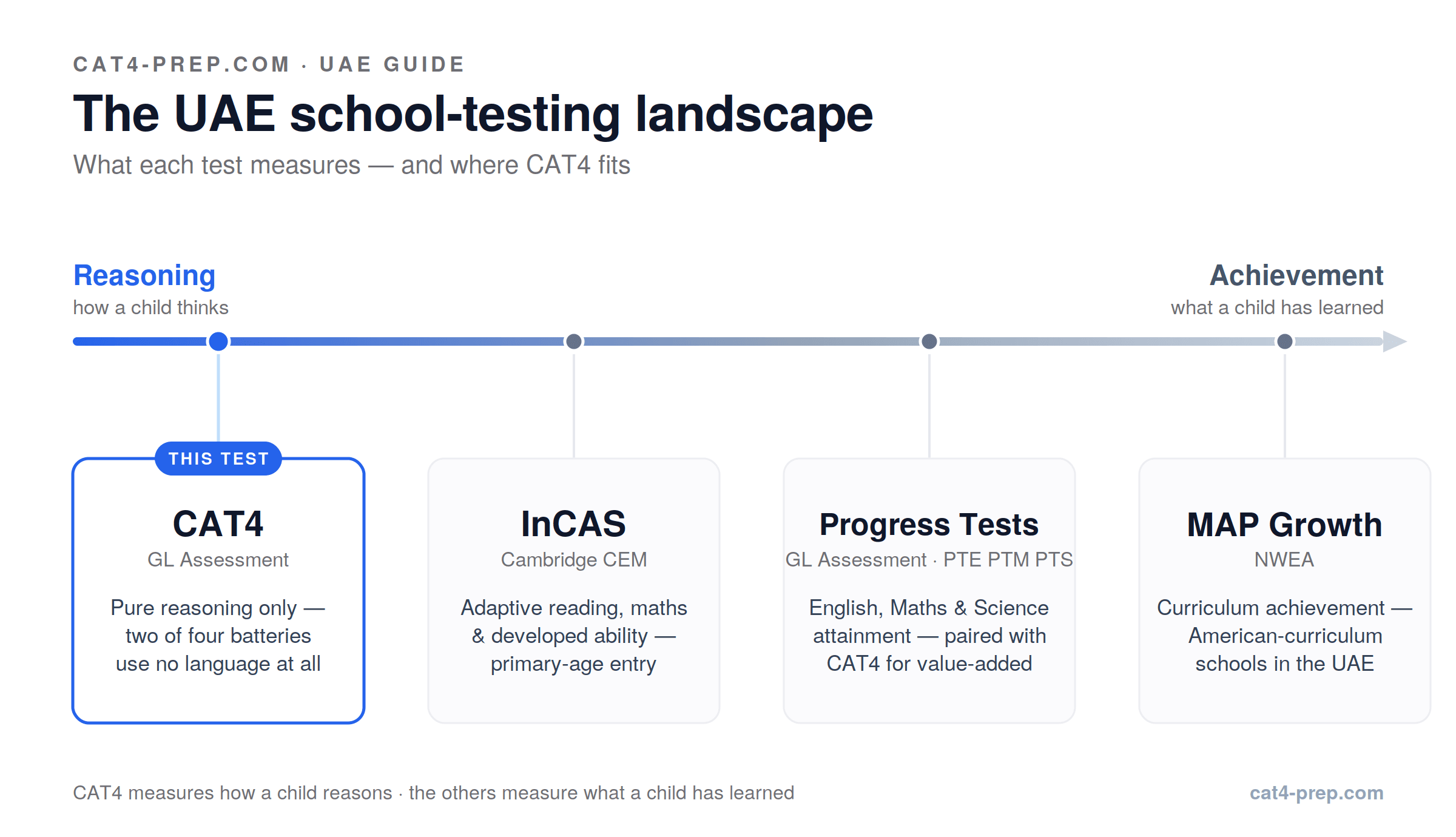
If your child has taken MAP, GL Progress Tests or InCAS, you may be wondering how CAT4 fits alongside them. The short answer: CAT4 is a reasoning test — it measures how your child thinks, not what they have learned. That is why UAE schools pair it with attainment tests rather than replace them. (Relocating from the US? Our CAT4 in the USA guide covers CogAT, MAP, SSAT and ISEE in depth.)
At a glance
| This test CAT4 GL Assessment | MAP Growth NWEA | GL Progress Tests GL Assessment | InCAS Cambridge CEM | |
|---|---|---|---|---|
| Type | Reasoning / ability | Achievement | Achievement | Adaptive attainment + ability |
| Measures | Verbal, Non-Verbal, Quantitative, Spatial reasoning | Math, reading, language, science | English, Maths, Science attainment | Reading, maths, developed ability |
| Format | 4 batteries · 8 subtests · ~72 min timed | Computer-adaptive | Annual papers or digital | Computer-adaptive |
| Language load | 2 of 4 batteries language-free | Heavily English / curriculum | English-based | English-based |
| Typical UAE use | Admissions + value-added tracking, Years 3–13 | American-curriculum schools | Paired with CAT4 for value-added reports | Primary entry, especially Abu Dhabi |
The big difference: CAT4 is the only one of these that is pure reasoning — no reading passages, no curriculum content — and two of its four batteries use no language at all. That is why it travels across school systems, and why an EAL child's reasoning can shine on CAT4 even while their English is still developing.
CAT4 vs MAP Growth
MAP Growth (NWEA) is an adaptive achievement test widely used by American-curriculum schools in the UAE. It measures reading, language and maths against a curriculum; CAT4 measures reasoning potential without reference to any curriculum. Schools that see both use them for different jobs — MAP shows current attainment, CAT4 shows underlying potential.
CAT4 vs GL Progress Tests (PTE, PTM, PTS)
Many UAE schools administer both. The Progress Tests measure attainment in English, Maths and Science; combined with CAT4 they create a value-added profile — is the student performing above, at, or below their cognitive potential? This combination report is a standard tool in KHDA-rated British schools, and it is why you will see schools advertise results as "X grades above CAT4 targets".
CAT4 vs InCAS
InCAS (Cambridge CEM) is an adaptive assessment of reading, maths and developed ability used by some UAE schools — particularly in Abu Dhabi — for primary-age applicants, either alongside CAT4 or in place of it for Years 2–6. If a school names InCAS rather than CAT4 for a younger child, the preparation logic is similar: familiarity with on-screen adaptive testing matters more than any specific content.
CAT4 vs in-house entrance exams
A few schools — most notably Dubai College — run their own entrance assessment instead of a standard CAT4 sitting. These in-house tests are typically close cousins: online, adaptive, and covering English, Maths and non-verbal reasoning in a format very similar to CAT4 and GL Progress tests. A child who has practised CAT4 question types will find them familiar.
Relocating to the UAE with an existing CAT4 score
If your child has already taken CAT4 in the UK, Ireland, Hong Kong, Singapore or elsewhere, that score travels — the scoring system (SAS, National Percentile Rank, stanines) is identical worldwide. Here is what to consider.
If the school accepts your score
Request the official CAT4 report from your child's current school — most can provide the Individual Student Report or Parent Report, showing SAS, percentile rank and stanines for each battery. Most UAE schools will accept a report from within the last 12–18 months without a re-sit. See our CAT4 Results Guide for what each score means.
If a new sitting is required
Some selective schools prefer to administer their own sitting even when a recent score exists. Families applying from overseas are usually tested remotely under proctored conditions, or at the child's current school — ask the registrar which they arrange.
Transfer Certificate (TC)
No UAE school can complete enrolment without a Transfer Certificate from the previous school. Within the UAE the TC is approved through KHDA or ADEK; from abroad it generally needs attestation by the education authority in the country you are leaving, with requirements varying by region. Budget two to three weeks for the TC itself — and be aware that attesting the full document pack (birth certificate, reports) from some countries can stretch to a month or two. Delayed paperwork, not test scores, is what most often stalls offers.
Fees & deposits
Application fees at UAE schools commonly run AED 500–1,500 (regulated caps apply in Dubai), and once an offer is made most schools require a seat-securing deposit that is usually non-refundable. Budget for these alongside preparation — they are due quickly once an offer lands.
EAL considerations
If your child speaks English as an additional language, their Verbal Reasoning score may understate their true ability. UAE admissions teams read this pattern constantly — strong Non-Verbal, Quantitative and Spatial scores with a weaker Verbal score is a familiar international-school profile and will not automatically count against your child. In GL's own interpretation guidance, a gap of 10 or more SAS points between Verbal and the other batteries is the signal worth investigating. Many schools offer EAL support programmes; expect an English benchmark check for entry from around Year 3.
Example EAL profile — reasoning strong, English still developing
Common relocation scenarios
- 🇬🇧 From the UK. Your child likely has a recent CAT4 score from their UK school — request the report and submit it with the application. Start the Transfer Certificate attestation in parallel; it is the slower piece.
- 🇺🇸 From the US. Your child may have CogAT or MAP scores but no CAT4 — the UAE school will usually require a CAT4 sitting. CogAT experience transfers well to three of the four batteries (Verbal, Quantitative, Non-Verbal); the Spatial Ability battery will be new, and it is where targeted familiarisation pays off most. See our CAT4 in the USA guide for the full comparison.
- 🇭🇰 From Hong Kong or Singapore. CAT4 is common in British international schools in both, so a recent report transfers directly — the scoring is identical.
- 🔁 Within the UAE. Moving between emirates still requires a TC approved through KHDA or ADEK, and the receiving school may prefer its own CAT4 sitting even if one is on file. Ask both schools before preparing.
Questions to ask your UAE school about CAT4
These eight questions will tell you exactly what to expect from any UAE school's process.
- At which year group does CAT4 become part of the admissions assessment?
- Which CAT4 level will my child sit?
- Is CAT4 the only assessment, or will there also be English, Maths and interview components?
- Can we submit an existing CAT4 score from our current school — and how recent does it need to be?
- Does the school use CAT4 results for class placement or streaming after admission?
- What score range does the school typically look for? (Many won't give a number, but some will say "above average" or "well above average".)
- How are children with special educational needs supported during the assessment?
- Is CAT4 used for scholarship decisions — and if so, what are the published criteria?
Real parent scenarios
Common questions we hear from UAE and relocating families, with short answers.
We are relocating from the UK to Dubai — can we use our child's existing CAT4 score?
Yes. Request the report from your child's UK school and submit it with the application. If the score is within the last 12–18 months, most Dubai schools will accept it, though you may still sit English and Maths papers separately. Start the Transfer Certificate attestation in parallel — it's the slower piece.
My child is in Year 5 at a Dubai school — do they need CAT4 for Year 7 applications?
Almost certainly. Year 7 is the main competitive entry point and most British-curriculum secondaries require CAT4 Level D. Timelines are the trap: assessment windows run roughly November to March, and JESS accepts personal Year 7 applications around two years before entry — so Year 5 is exactly when to plan.
We're at a GEMS school and want to transfer to JESS or Kings' — will our child take CAT4 again?
Possibly. If your child has a recent CAT4 on file from the current school, the receiving school may accept it — but some prefer to administer their own sitting. Ask both schools before preparing, and check availability first: at JESS, most year groups run oversubscribed waiting lists.
My child scored SAS 108 — is that good enough for a premium Dubai school?
It depends on the school and year group. SAS 108 is above average (the mean is 100) and competitive at many mid-tier schools. At the most selective Dubai schools the commonly referenced range is SAS 115+, and a balanced profile across all four batteries helps as much as the headline number.
Our child is strong in Maths but weaker in English — how will schools read the profile?
UAE admissions teams are highly experienced with uneven profiles. Strong Quantitative and Non-Verbal with a lower Verbal score is common among EAL students and children from non-British curricula. Schools consider the whole profile and may offer EAL support on entry.
Can my child prepare for CAT4?
Worth knowing first: GL Assessment officially advises against practising for CAT4 and doesn't endorse any practice materials, since the test aims to measure underlying reasoning. Our independent view — shared by most UAE families — is that format familiarity is different from coaching: knowing the eight question types across the four batteries, especially the unfamiliar Spatial Ability tasks, and working under timed on-screen conditions removes surprise so ability can show through. In the UAE's competitive context, starting 3–6 months before the assessment window is typical.
CAT4 practice for each year group
Choose the CAT4 level that matches your child's year group. Each page has free sample questions, downloadable PDFs, and preparation tips.
| UAE year group | Practice page (free) |
|---|---|
| Year 2 | Level X |
| Year 3 | Level Pre-A (Level Y is UK-only) |
| Year 4 | Level A |
| Year 5 | Level B |
| Year 6 | Level C · Level D (if sitting early for Year 7 entry) |
| Year 7 | Level D |
| Year 8 | Level E |
| Years 9–11 | Level F |
| Years 11–13 | Level G |
Not sure which level? The year-group table above shows the match by age, or see the full CAT4 Levels Guide.
Practice by battery
You can also prepare one reasoning area at a time. Each guide includes free sample questions and tips.
CAT4 in the UAE — Frequently Asked Questions
Is CAT4 used by all schools in the UAE?
No. CAT4 is standard across most British-curriculum and IB schools, particularly in Dubai, Abu Dhabi and Sharjah. American-curriculum schools more commonly use MAP Growth, and Indian-curriculum (CBSE) schools may use different assessments. Always check with the specific school.
Which CAT4 level is used for Year 7 entry?
Almost all UAE schools use CAT4 Level D for Year 7 admissions. Level D is designed for students aged 11–12.
What is a good CAT4 score for Dubai schools?
There is no universal answer. SAS 100 is the mean of the norm group. For mid-tier British schools, SAS 105–115 is typically competitive; for premium schools such as JESS, Kings' and Repton, SAS 115+ is the widely referenced range. The ACES scholarships at Raffles and Collegiate formally require a CAT4 mean of 130+.
How long is the CAT4 test?
For levels A–G, the timed content takes about 72 minutes across eight subtests; including instructions, examples and breaks, the full session is typically around two hours, often split into three parts. UAE admissions sittings are often shorter (around 60–90 minutes at many schools) because schools may administer selected parts. The younger levels (Pre-A, X) are shorter still.
Can my child take CAT4 at home?
CAT4 is normally administered in school under supervised conditions. Some schools arrange online, remotely proctored sittings for families applying from overseas — or allow the test to be taken at the child's current school. Check with the school directly.
How often can my child take CAT4?
Each school sets its own rules. Many allow a re-sit after 6–12 months; others accept only one sitting per admissions cycle. Short gaps between sittings of the same level risk practice effects that muddy the result, which is why schools tend to space them out. Ask the school for its policy before planning a retake.
Is CAT4 harder in the UAE than in the UK?
The test itself is identical — same questions, same scoring, same norms worldwide. What differs is the competitive threshold: at oversubscribed UAE schools the score needed to stand out can feel higher than at a comparable UK school, particularly on the Quantitative, Non-Verbal and Spatial batteries where international-school cohorts tend to perform strongly.
Does KHDA regulate CAT4 testing?
KHDA regulates schools, not specific tests. But CAT4 is embedded in the practice of KHDA-rated British schools in Dubai — student progress is routinely benchmarked against it, and many schools cite CAT4-predicted grades in inspection reporting as a value-added measure.
My child has special educational needs — can they get accommodations?
Support exists, but with one important limit: CAT4 is a timed test and GL Assessment's guidance is that extra time is not permitted, because it undermines the reliability of the standardised scores. What schools can do: use a reader for the introductory and practice sections (the timed sections must be completed independently), omit the Verbal battery where appropriate, or run an untimed paper administration — with the caveat that the resulting scores may be inflated. Raise your child's needs with the school at first contact and bring supporting documentation (such as an Educational Psychologist report); admissions teams read CAT4 profiles in that context.
When should we start preparing?
For Year 7 entry — the most competitive point — most families start 3–6 months before the expected assessment window, and many begin planning in Year 5. Note that GL Assessment officially advises against practising for CAT4; our view is that format familiarity across all eight question types — especially Spatial Ability, usually the least familiar — is what removes surprise on the day.
Next steps
If your child needs to take CAT4 for a UAE school, here is where to start.
- Confirm the level. Use the year-group table above, or see the CAT4 Levels Guide.
- Try a sample test. Download a free CAT4 practice PDF for your child's level, or take a free online practice test.
- Understand the scores. Read the CAT4 Results Guide so you know what to expect on report day.
- Go deeper. For structured, level-matched practice tests across all four batteries, visit Pretest Plus.
Last reviewed July 2026. School details are reviewed every six months and updated periodically. If you spot an error or know of a UAE school that uses CAT4, email us.