
CAT4 Non-Verbal Reasoning Guide: Sample Questions, Tips and Practice
Clear guide with CAT4 non-verbal sample questions, video walkthroughs, preparation tips, and step-by-step explanations for Figure Classification and Figure Matrices.
- ✓ Learn what CAT4 Non-Verbal Reasoning is really testing
- ✓ Understand Figure Classification and Figure Matrices question types
- ✓ Use sample questions, video walkthroughs, and explanations to prepare more effectively
- ✓ Build confidence spotting patterns, relationships, and visual changes
Guide at a glance
Who is this guide for?
Introduction to CAT4 Non-Verbal Reasoning
The CAT4 test is made up of four main parts, and one of them is Non-Verbal Reasoning. This section measures how well students can spot patterns, relationships, and changes in shapes, symbols, and visual sequences.
On this page, you will learn:
- what CAT4 Non-Verbal Reasoning is really testing
- why it matters for CAT4 success
- tips and resources to prepare effectively
- sample questions with explanations
👉 Before diving in, we recommend reading our full CAT4 Test Guide to understand the complete structure and scoring system.
The Structure of the CAT4 Non-Verbal Reasoning Battery
The CAT4 Non-Verbal Reasoning battery is split into two main parts. Each question type tests a slightly different form of visual logic, so it helps to understand how each one works before practising.
Figure Classification
What it tests: Figure Classification measures how well a student can identify the common rule linking a group of shapes or figures.
How it works
- 1You will see a small group of figures.
- 2These figures all share a common feature or rule.
- 3Your task is to choose the option that belongs to the same group.
- 4To solve it, look for shared patterns such as shape, shading, position, rotation, or number of elements.
Tip
Always check the shape, shading, size, position, and rotation first. In many CAT4 questions, the rule is simpler than it first appears.
CAT4 Figure Classification Example Video
This video goes through a real CAT4 Figure Classification question and shows you step by step how to answer it.
What students learn from this example
- ✓how to identify the shared rule
- ✓how to eliminate answer choices quickly
- ✓how to confirm the correct option with confidence
Why this helps: Watching worked examples helps students understand how to think through the pattern, not just how to guess the answer.
Figure Matrices
What it tests: Figure Matrices measure how well a student can spot visual rules and apply them to complete a missing part of a pattern.
How it works
- 1You will see a grid of figures with one missing box.
- 2The figures change according to a hidden rule.
- 3The rule may work across rows, down columns, or both.
- 4Your task is to choose the option that correctly completes the pattern.
Tip
Look at one feature at a time — shape, number, rotation, shading, or position. This makes complex-looking patterns much easier to solve.
CAT4 Figure Matrices Example Video
In this video, we solve a real CAT4 Figure Matrices question step by step.
What students learn from this example
- ✓how to compare rows and columns clearly
- ✓how to spot what changes and what stays the same
- ✓how to test the rule before choosing an answer
Why this helps: This helps students build confidence with visual logic and avoid rushing into the wrong answer.
What Is Tested in the CAT4 Non-Verbal Reasoning Battery?
Non-Verbal Reasoning uses shapes instead of words deliberately: it removes the advantage of language skills and measures how well you can find relationships, spot rules, and apply them precisely. The key skill is always the same — find the exact rule, not a rough guess.
It includes two question types:
- Figure Classification — identifying the rule that connects a group of figures
- Figure Matrices — finding the missing figure in a visual pattern
These questions show how well a student can:
- recognise patterns quickly
- compare shapes and visual relationships
- notice changes in position, size, shading, and rotation
- apply logic without relying on language
This is an important skill for learning across many subjects because it supports reasoning, flexible thinking, and problem-solving.
CAT4 Non-Verbal Reasoning Practice Examples with Explanations
To really understand how CAT4 Non-Verbal Reasoning works, it helps to see real examples.
Below you will find sample questions — two for Figure Classification and two for Figure Matrices. Each example should include a step-by-step explanation so students can understand the logic behind the answer.
👉 Practising with explained examples is one of the fastest ways to build confidence before the real CAT4 test.
CAT4 Figure Classification — Sample Question & Step-by-Step
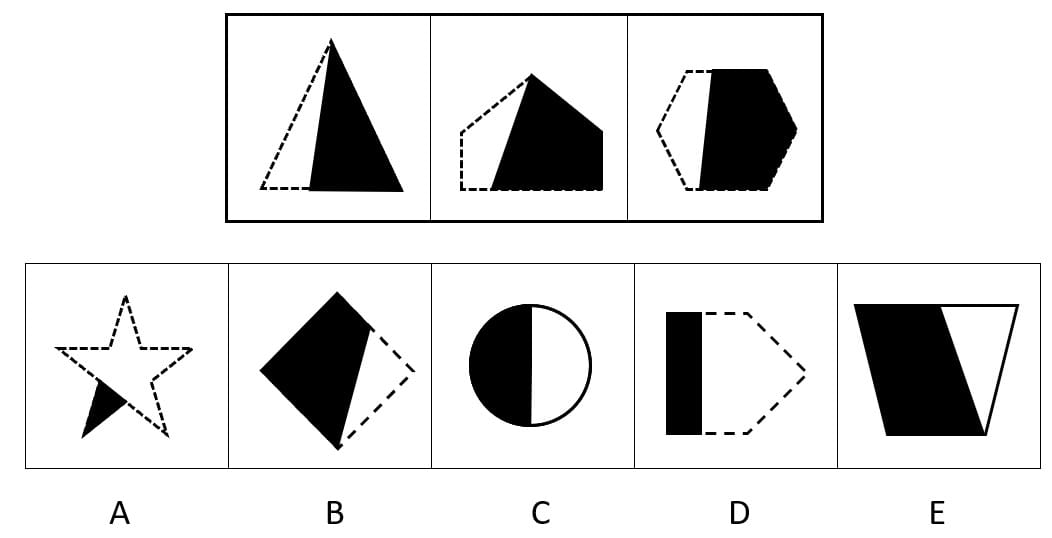
Figure Classification · Question
The quickest way to solve this one is to focus on two features together: a dashed outer outline and a shape that is mostly filled in black.
Question type
Figure Classification
Skill tested
Matching a shared visual rule
Difficulty
Medium
What to notice first
All three stem figures follow the same visual idea. The outer shape is shown with a dashed outline, and about three quarters of that outer shape is coloured in black. So the correct answer must keep both parts of the rule: the dashed outline must still be part of the figure, and most of the shape must be black rather than white.
Check 1
Look at the outer shape
In each stem figure, the outside boundary is still visible as a dashed outline.
Check 2
Check how much is shaded
The black region covers most of the shape, roughly three quarters, not just a thin strip or a small corner.
Check 3
Match both features together
The answer must show the same pattern: dashed outline outside, large black area inside.
Core rule
Choose the option with a dashed outer outline and about three quarters of the outer shape coloured black.
Model the pattern
Step 1
Start with the three stem figures and ignore the exact shape name. The important point is not triangle, pentagon, or hexagon. The important point is the visual rule they all share.
Step 2
Notice that each stem keeps a dashed outer outline. Then notice that most of that outlined shape is filled in black, leaving only a smaller unfilled section.
Step 3
Now test the options using that exact rule. The correct choice must preserve both the dashed outline and the mostly black interior. Option B is the only one that does this clearly.
Option check
Eliminate
This has a dashed outline, but only a small section is black. It does not match the rule that most of the outer shape should be coloured in.
Correct
This matches the rule best. The outer shape is shown with a dashed outline, and about three quarters of that shape is coloured black.
Eliminate
This figure is half black and half white, but there is no dashed outer outline, so it breaks the shared stem pattern.
Eliminate
This includes a dashed outline, but the black part is only a narrow section. It is not close to three quarters black.
Eliminate
This is mostly black, but the outer shape is not shown with a dashed outline, so it misses an essential part of the rule.
Use this quick checklist next time
- Find the one visual feature that repeats in all three stem figures.
- Check both outline style and shading amount, not just one of them.
- Reject options that look similar overall but miss part of the exact rule.
Reflection
This question is about discipline, not guessing. Once you lock onto the two key features, most of the distractors fall away quickly.
Bridge forward
In similar figure-classification questions, try to describe the shared rule in one short sentence before you look at the options.
Conclusion
Option B is correct because it is the only choice that keeps the dashed outer outline and shows about three quarters of the outer shape coloured in black.
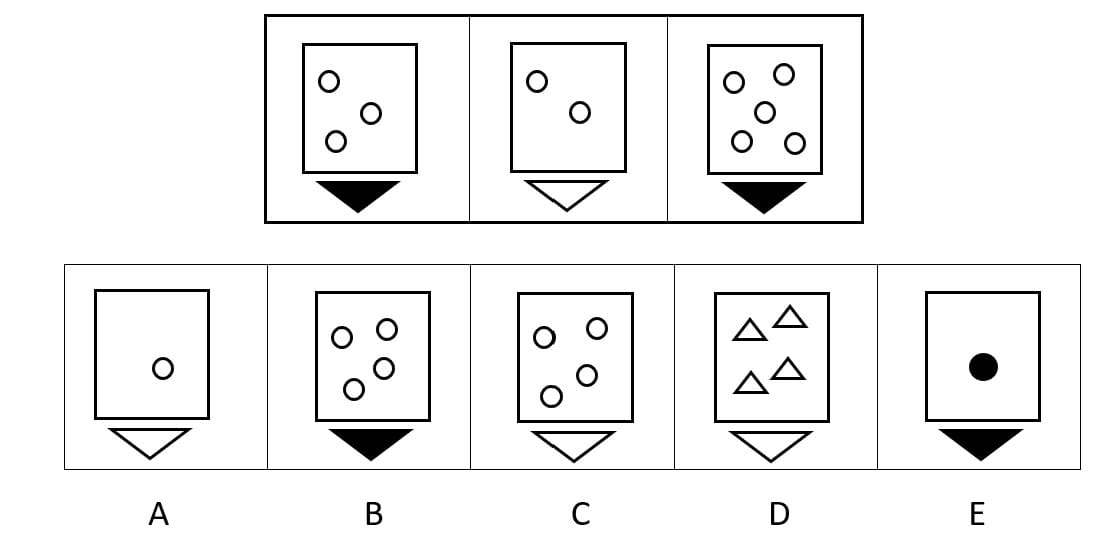
Figure Classification · Question
The quickest way to solve this one is to count the white circles first, then match the outside triangle to whether that number is odd or even.
Question type
Figure Classification
Skill tested
Counting rule with odd and even numbers
Difficulty
Medium
What to notice first
All three stem figures follow the same counting rule. First count the number of white circles inside the square. If that number is odd, the outside triangle is coloured black. If that number is even, the outside triangle stays uncoloured. So the correct answer must use the same odd-even rule with white circles.
Check 1
Count the white circles
The first stem has 3 white circles, the second has 2, and the third has 5.
Check 2
Match odd and even
3 and 5 are odd, so those triangles are black. 2 is even, so that triangle is uncoloured.
Check 3
Apply the same rule to the options
The answer must contain white circles and an outside triangle that matches the odd-even rule correctly.
Core rule
Odd number of white circles means a black triangle; even number of white circles means an uncoloured triangle.
Model the pattern
Step 1
Start by ignoring the exact positions of the circles. What matters first is how many white circles appear inside each square.
Step 2
Check the three stem figures. The first has 3 white circles and a black triangle. The second has 2 white circles and an uncoloured triangle. The third has 5 white circles and a black triangle. That reveals the rule clearly.
Step 3
Now test each option. Count only the white circles, then ask whether the outside triangle should be black or uncoloured. Option C is the only one that fits.
Option check
Eliminate
This has 1 white circle, which is odd. The triangle should therefore be black, but it is uncoloured.
Eliminate
This has 4 white circles, which is even. The triangle should therefore be uncoloured, but it is black.
Correct
This has 4 white circles, which is an even number, and the outside triangle is uncoloured. That matches the rule exactly.
Eliminate
This uses triangles inside the square instead of white circles, so it does not match the stem pattern that the rule is based on.
Eliminate
This does not show white circles in the same way as the stem figures, so it breaks the rule before you even apply the odd-even test.
Use this quick checklist next time
- Count the relevant items first before looking at decoration or position.
- Work out whether the rule depends on odd numbers or even numbers.
- Check that the answer keeps both the correct item type and the correct outer feature.
Reflection
This question is easier than it first looks. Once you spot that the rule is about odd and even numbers, the distractors become much weaker.
Bridge forward
In similar figure-classification questions, try counting first. Number rules often control colour, shading, or the extra shape outside the box.
Conclusion
Option C is correct because it has an even number of white circles, so the outside triangle should remain uncoloured.
CAT4 Figure Matrices — Sample Question & Step-by-Step
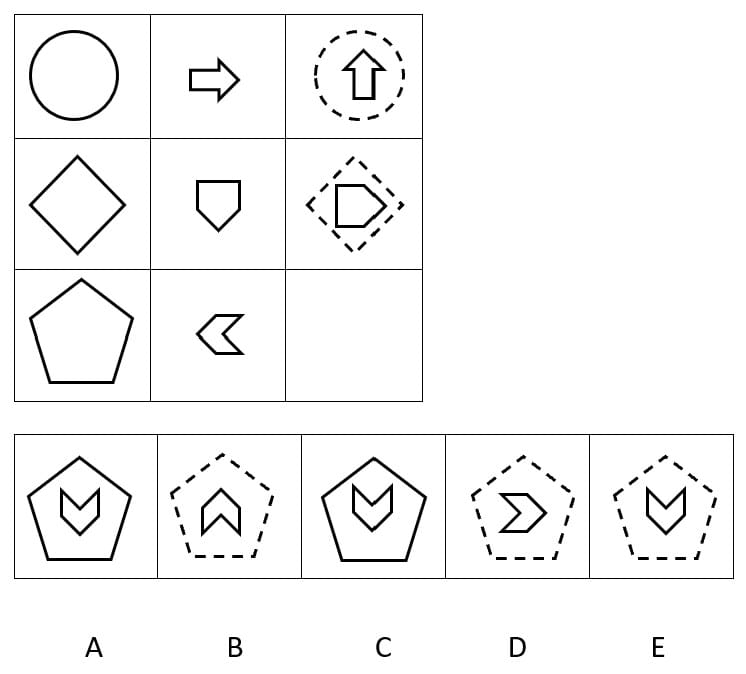
Figure Matrices · Question
The rule works across each row. In the third column, the first shape becomes the dashed outer shape, and the second shape is rotated 90 degrees to the left and placed inside it.
Question type
Figure Matrices
Skill tested
Row pattern, rotation, and shape combination
Difficulty
Medium
What to notice first
Do not treat the third box as a brand-new drawing. It is built from the first two boxes in the same row. The shape from the first column becomes the outer shape in the third column, and that outer shape is shown with a dashed outline. Then the shape from the second column is rotated 90 degrees to the left and placed inside. The missing box in the last row must follow that same rule.
Check 1
Use the row rule
Row 1 and Row 2 both show the same pattern, so Row 3 must work the same way.
Check 2
Build the outer shape
Take the first-column shape in the row and place it in the third column as the outer dashed shape.
Check 3
Rotate the inner shape
Take the second-column shape, rotate it 90 degrees to the left, and place it inside the dashed outer shape.
Core rule
In each row, Column 3 contains a dashed version of Column 1 on the outside and a 90-degrees-left rotation of Column 2 on the inside.
Model the pattern
Step 1
Check Row 1. The circle from Column 1 becomes the dashed outer circle in Column 3. The right-pointing arrow from Column 2 is rotated 90 degrees to the left, so it becomes an upward arrow inside.
Step 2
Check Row 2. The diamond from Column 1 becomes the dashed outer diamond in Column 3. The middle shape is rotated 90 degrees to the left and placed inside.
Step 3
Now apply the rule to Row 3. The pentagon from Column 1 must become a dashed outer pentagon. The left-pointing inner shape from Column 2 must rotate 90 degrees to the left, so it becomes a downward-pointing shape inside. That gives Option E.
Option check
Eliminate
The inner shape points the right way after rotation, but the outer pentagon is solid instead of dashed, so the row rule is broken.
Eliminate
The outer shape is correctly dashed, but the inner shape is not the right rotated result. It does not match the 90-degrees-left rotation from the second column.
Eliminate
The inner shape is closer, but the outer pentagon is solid instead of dashed. Column 3 must always use a dashed version of the first shape.
Eliminate
The outer pentagon is dashed, but the inner shape is still pointing in the wrong direction. The second-column shape should be rotated 90 degrees to the left, not kept in a sideways position.
Correct
This matches both parts of the rule. The pentagon from Column 1 becomes the dashed outer shape, and the second-column shape is rotated 90 degrees to the left and placed inside.
Use this quick checklist next time
- Decide whether the pattern moves across the row or down the column.
- Check whether one box becomes the outer shape in the final box.
- Test whether the second shape is rotated before being placed inside.
Reflection
This question becomes much easier once you stop guessing visually and instead rebuild the third box from the first two boxes in the row.
Bridge forward
In other figure-matrices questions, look for a construction rule like copy, rotate, reflect, or combine. That usually reveals the answer faster than comparing options one by one.
Conclusion
Option E is correct because the third box in each row is built from a dashed outer version of the first shape and a 90-degrees-left rotation of the second shape placed inside.
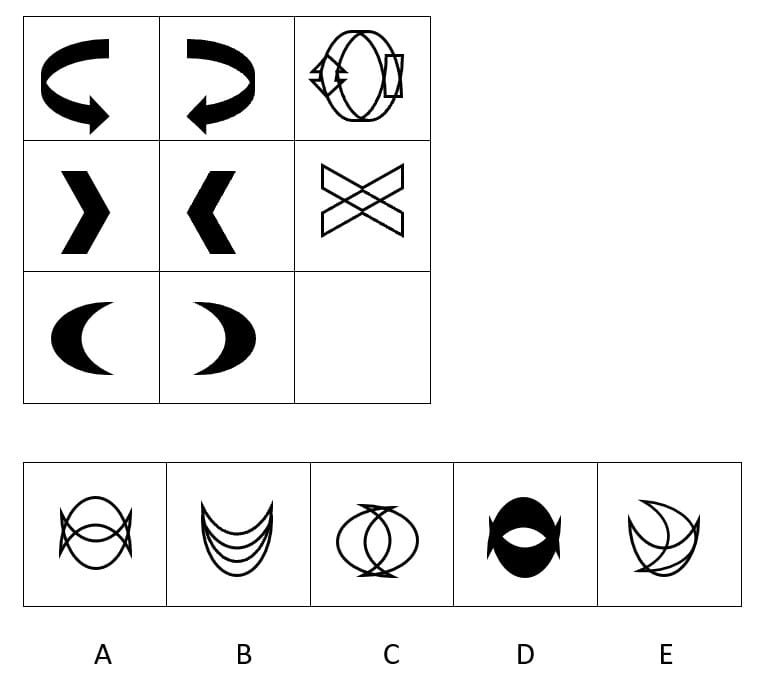
Figure Matrices · Question
The rule moves across each row: the first and second shapes are rotated 90 degrees and then placed on top of each other, and the final combined shape is shown in white outline.
Question type
Figure Matrices
Skill tested
Row pattern, rotation, and overlay
Difficulty
Medium
What to notice first
Do not try to match the missing box by general appearance alone. The pattern works across the row. In each row, the first shape and the second shape are each rotated 90 degrees and then placed on top of each other. After that, the colour changes, so the final combined figure is shown as a white outline rather than a filled black shape. The missing box in the last row must follow that same rule.
Check 1
Work across the row
Row 1 and Row 2 show the same construction rule, so Row 3 must be built the same way.
Check 2
Rotate both source shapes
The first and second shapes in the row are turned 90 degrees before they are combined.
Check 3
Overlay and change colour
The rotated shapes are placed on top of each other, and the final figure is drawn as a white outline.
Core rule
Across each row, rotate the first and second shapes by 90 degrees, place them on top of each other, and show the result in white outline.
Model the pattern
Step 1
Look at Row 1. The two black curved arrow shapes are the starting figures. When they are rotated and overlaid, they produce the white outlined combined figure in the third box.
Step 2
Row 2 confirms the same rule. The two black angled shapes are rotated 90 degrees, placed on top of each other, and the result is again shown as a white outlined figure.
Step 3
Now apply that to Row 3. Start with the two black crescent-like shapes, rotate them 90 degrees, place them on top of each other, and then switch the result to white outline. Only Option A matches that full construction.
Option check
Correct
This matches the rule best. It shows the two rotated shapes overlaid into one combined figure, and the final result is shown in white outline.
Eliminate
This is an outlined shape, but it does not match the correct overlay result from rotating and combining both source figures.
Eliminate
This has some of the right curved features, but the arrangement is wrong. The two rotated shapes are not overlaid in the same way as in the stem rows.
Eliminate
This uses a dark filled result, but the row rule says the final combined figure changes to white outline.
Eliminate
This is close in style, but the overlay structure is not correct. The rotated source shapes do not sit on top of each other in the right way.
Use this quick checklist next time
- First decide whether the rule moves across the row or down the column.
- Check whether the source shapes are rotated before they are combined.
- Always verify whether the final figure changes colour, fill, or outline style.
Reflection
This question becomes much easier once you stop comparing the options loosely and instead rebuild the missing box from the two shapes in the row.
Bridge forward
In other figure-matrices questions, look for a construction rule such as rotate, reflect, overlay, or recolour. That usually reveals the answer faster than shape-by-shape guessing.
Conclusion
Option A is correct because the pattern moves across the row: the first and second shapes are rotated 90 degrees, placed on top of each other, and the final combined figure changes to white outline.
Explore our full range of CAT4 practice materials, including verbal, non-verbal, quantitative, and spatial reasoning — across all levels.
Golden Tips for CAT4 Non-Verbal Reasoning
Use this as one tips block below the examples.
- Look for what stays the same
Consider beginning your analysis by identifying the one constant feature. - Check one visual feature at a time
The CAT4 assesses shape, size, colour/growth (shading) as well as number, position and rotation (orientation) as key skills. - Do not rush because the question is visual
These Non-Verbal questions may look easy but make sure you compare all the details. - Use elimination
Even if you don’t know the exact answer, it can be helpful to start with incorrect solutions that clearly violate the rule rather than simply guessing randomly. - Check the full rule
A pattern must work for the whole question, not just one part of it. - Practise on different levels
Students improve faster when they see a range of visual patterns, not just one type.
Editor’s tip:
CAT4 Non-Verbal Reasoning is rarely about complicated drawings. It is usually about seeing a small, logical visual rule clearly.
Figure classification rule families
1. Fill / shading
All shapes share the same fill type: solid, outline, or striped. The most common single-dimension rule.
e.g. “All three are outline shapes"
2. Shape type / sides
All shapes belong to the same category by number of sides or curve type (circle, triangle, quadrilateral, polygon).
e.g. “All three are quadrilaterals (4 sides)"
3. Count of elements
Each example contains the same number of objects. Size, fill, and position may vary; count is constant.
e.g. “Each example contains exactly 2 shapes"
4. Orientation
All shapes face the same direction, or the same sub-element appears in the same position within each shape.
e.g. “All triangles point upward"
5. Size relationship
All shapes are the same size category (all large, all small), or a consistent size ratio holds within each example.
e.g. “All examples have a large outer and small inner shape"
6. Combined rule (stretch)
Two dimensions work together. A single rule leaves two options; a second narrows it to one. Common in harder items.
e.g. “Outline fill AND 4 or more sides"
“These shapes belong together because they are all ___.”
Three distractor traps to expect
- Thematic lure — a shape that looks visually similar to the examples but fails the rule (e.g. appears in the same scene or context). Don't choose by appearance alone.
- Partial match — a shape that passes one part of a two-part rule but fails the other (e.g. right shape type, wrong fill). Always test every dimension of your rule.
- Wrong dimension — a shape that satisfies a different, plausible rule based on just one or two examples. Check that your rule holds for all three examples, not just two.
Support
Spotted something that needs fixing?
If you notice an error, broken link, or unclear explanation, email us and we’ll review it.
How to Prepare Effectively for CAT4 Non-Verbal Reasoning
The best way to prepare for CAT4 Non-Verbal Reasoning is through consistent practice with visual patterns, figure rules, and timed reasoning questions. Strong preparation helps students become more confident with Figure Classification and Figure Matrices.
Students need to build confidence in
- ✓recognising similarities between shapes
- ✓spotting how figures change
- ✓understanding visual rules quickly
- ✓applying logic calmly under time pressure
Most effective ways to prepare
- 1
Begin with free CAT4 sample questions and downloadable PDFs so students can become familiar with non-verbal question styles before moving on to harder practice.
- 2
Use CAT4 practice that matches your child’s age group and school level. This makes the difficulty more realistic and helps build confidence step by step.
- 3
A structured CAT4 course can help students work through question types in a more systematic way, with guided lessons, extra practice, and clearer progression.
- 4
Worked Examples and Videos
Worked examples and video walkthroughs show students how strong non-verbal reasoning works in practice, including how to identify patterns, test rules, and eliminate weak answer choices.
Best approach: combining free CAT4 resources with more structured practice gives students the best chance to feel ready for real CAT4 Non-Verbal Reasoning questions.
CAT4 Non-Verbal Reasoning Prep by Level
Recap and Next Steps
Non-Verbal Reasoning in the CAT4 test focuses on two key areas:
- Figure Classification — spotting the rule shared by a group of figures
- Figure Matrices — finding the missing figure that completes a pattern
By practising these question types, students develop strong visual reasoning and problem-solving skills that support learning far beyond the CAT4 test.
The best way to improve is through consistent practice. Start with free resources or move straight to the full course for more complete preparation.
Next recommended read —
CAT4 Non-Verbal Reasoning FAQ
What is CAT4 Non-Verbal Reasoning, in plain English?
CAT4 Non-Verbal Reasoning is the part of the test that uses pictures instead of words. Children are asked to spot a simple rule in shapes and patterns and apply it quickly.
Does CAT4 Non-Verbal Reasoning test school knowledge?
No. It is not about revising school topics, drawing, or creativity. It is about noticing patterns such as rotation, shading, position, size, or number of shapes and using that rule accurately.
What is the difference between Figure Classification and Figure Matrices?
Figure Classification is a grouping task. Your child chooses which option belongs with the figures shown. Figure Matrices is a missing-box puzzle. Your child looks at the grid, works out the rule, and chooses the figure that completes the gap.
How can my child improve at Figure Matrices quickly?
The fastest improvement usually comes from using the same routine each time. Check row 1 first, then row 2, then try columns if needed. Start with the most common features: number, position, rotation, shading, and size. If two answers look possible, choose the one that matches every part of the rule.
What are the most common CAT4 non-verbal mistakes?
The most common mistakes are rushing, inventing too many rules, missing small details, and choosing the option that only looks similar. The best fix is to check one simple rule first and then eliminate any answer that breaks it.
How much non-verbal practice is enough for real improvement?
Small, regular practice usually works best. A good routine is 10 to 15 minutes, 3 to 4 times a week, with 6 to 10 questions followed by careful review of the explanations. Increase difficulty only after accuracy has stayed strong for a few repeats.
How do I know which CAT4 level to practise for Non-Verbal Reasoning?
Use the same CAT4 level your school plans to use. If you know the year group, match it to the likely level. If you are not sure, ask the school which CAT4 level they are running. If your child feels stuck, it can help to begin one level lower to build confidence before moving up.
Where can I get CAT4 non-verbal practice with answers and explanations?
The most useful practice feels close to CAT4 and explains the thinking clearly. Look for Figure Classification and Figure Matrices, clear explanations rather than just an answer key, timed practice for pace, and level-matched sets. On CAT4-Prep, a good approach is to use a short online quiz first and then review the PDF explanations together.